

On January 9, 1868, the inhabitants of St. Thomas were asked whether they wished their island to become part of the United States. The result could hardly have been clearer. Of 1,061 votes cast, 1,039 favored the transfer and only 22 opposed it. The following day, on neighbouring St. John, 205 people voted in favor and not one against. Denmark had insisted upon the consultation, reluctantly accepted by Washington, and the inhabitants had supplied the answer Copenhagen had demanded. Yet St. Thomas and St. John did not become American. The treaty was already becoming entangled in the struggle between President Andrew Johnson and Congress and would eventually die in the United States Senate. The curious result was that the people whose political future was supposedly being decided had given an emphatic answer to a question that the governments concerned proved unable to settle.
This apparently obscure episode in Caribbean history belongs, unexpectedly, to the history of Greenland. For while Secretary of State William H. Seward was attempting to persuade Congress to complete one territorial acquisition from Denmark, he and the veteran expansionist Robert J. Walker were beginning to contemplate another. Their ambitions ranged still further. Alaska had just been acquired from Russia; St. Thomas and St. John were under negotiation with Denmark; Greenland and Iceland soon entered the discussion. These were not necessarily pieces of a single master plan. They were something more characteristic of nineteenth-century statecraft, and perhaps something more interesting: a collection of opportunities, strategic arguments, and territorial possibilities which, taken together, began to suggest a different map of the United States.
Seward’s negotiations with Denmark had actually begun before the purchase of Alaska. He first raised the possibility of acquiring the Danish West Indies in 1865, when Copenhagen had little desire to part with them. The American interest survived Lincoln’s assassination and the attempt on Seward’s own life, and by July 1866 Washington was offering $5 million for St. Thomas, St. John, and St. Croix. Denmark bargained. Seward bargained back. By 1867 he was prepared to pay $7.5 million for St. Thomas and St. John.
It was then that the Danish government introduced the condition that makes the negotiations particularly interesting from the perspective of international law. Copenhagen insisted that the inhabitants should consent to the transfer. Seward disliked the idea, but Denmark regarded a vote as “absolutely indispensable,” and he eventually instructed the American representative to “concede question of vote.”
It would be anachronistic to turn this into an early exercise in modern self-determination. These were colonial societies with a restricted franchise, and neither government was abandoning the traditional proposition that sovereignty over territory could be transferred by treaty. Yet Denmark’s insistence introduced an awkward qualification into that otherwise straightforward legal world. Territory could be ceded, certainly; but here, at least, the people inhabiting it were to be asked first. Stranger still, their overwhelming consent proved less decisive than the constitutional politics of the acquiring state. Denmark ratified the treaty; the United States did not. The referendum had answered one question while leaving the more important one unresolved.
At much the same time, Alaska was demonstrating how difficult even an apparently completed territorial purchase could become. The United States had agreed in March 1867 to pay Russia $7.2 million for the territory. The Senate ratified the treaty easily, but the House still had to appropriate the money, and what followed became an argument not merely about Alaska but about the geographical future of the republic. Supporters invoked Louisiana, Texas, and California, all territories once derided by their opponents. Alaska, they maintained, would eventually vindicate itself in the same way: through its resources and fisheries, but also through its command of the North Pacific, its proximity to Asia and its ability to prevent British power from hemming in the United States from the north. To General Nathaniel Banks and other expansionists, Alaska was not so much a distant possession as the beginning of a new strategic geography.
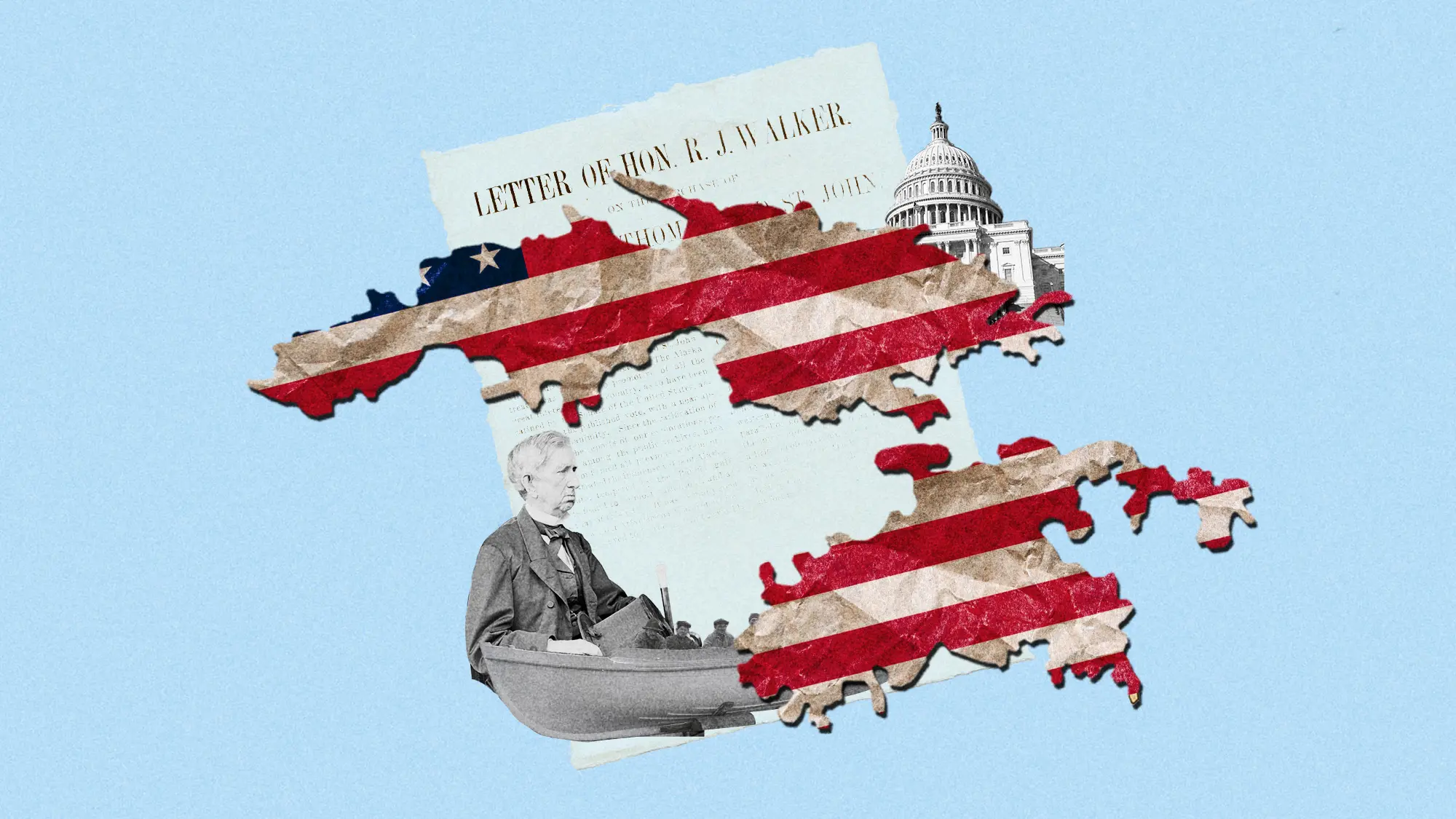
Robert J. Walker moved naturally within this world. When he appeared before the congressional Alaska Investigation the following year, he recalled a long conversation with Seward in December 1867 concerning “Alaska, St. Thomas, and St. John’s.” Seward knew him, Walker explained with some satisfaction, as a “life-long annexationist—in favour of annexation in every quarter, north, south, east, and west.” The Secretary of State showed him the Danish treaty and asked him to make the public case for it. Walker responded with a pamphlet bearing the revealing title Letter of Hon. Robert J. Walker on the purchase of Alaska, St. Thomas, and St. John’s. Alaska occupied less than a page, because Walker then expected little difficulty over the appropriation; the Danish islands received most of his attention. Seward requested 1,000 copies, and Walker distributed thousands more.
Greenland acquired a political existence before it acquired a diplomatic one.
The story subsequently acquired the murkier quality characteristic of Washington politics. In May 1868, the Russian minister, Baron Eduard de Stoeckl, retained Walker for $20,000 in gold to assist in securing the Alaska appropriation. Walker insisted that his function was advocacy rather than lobbying: writing pamphlets and newspaper articles, assembling arguments and speaking with supporters of the purchase. Rumours that Russian money had been used more directly eventually produced a congressional investigation. It substantiated none of the more spectacular allegations of bribery, but in reconstructing the affair it preserved something almost as valuable to the historian: a glimpse of the small political world in which Alaska, the Danish islands and the future territorial shape of the United States were being discussed together.
In April 1868, Walker enlarged the map once more. He suggested that Seward investigate Greenland and Iceland. Greenland was not valuable in his argument merely because of what might be found there. Its significance was relational. Alaska placed the United States on the Pacific side of British North America; Greenland would place it on the Arctic side. Together they would outflank Britain’s North American possessions and, Walker hoped, hasten the eventual incorporation of Canada into the Union.
Seward responded by commissioning a State Department report on the resources and strategic value of Greenland and Iceland. Nothing in the surviving evidence requires us to turn this into a secret programme of conquest. Indeed, doing so would make the story less interesting. Seward’s expansionism operated through opportunities rather than blueprints: a treaty here, an exploratory memorandum there, a pamphlet, a diplomatic conversation, a report prepared in anticipation of negotiations that might or might not occur. What joined them was less a schedule of acquisitions than a geographical imagination.
The distinction was lost on Seward’s opponents. Before the Greenland report had even formally appeared, journalist Uriah Painter learned that material on the island was being printed at the Government Printing Office. He later recalled telling Congressman Cadwalader C. Washburn that “one of Seward’s jobs” would soon “crop out,” and urged him to obtain the proof sheets. Washburn did so. A document intended to provide information for possible future negotiations thereby became evidence, in the hands of the administration’s critics, that those negotiations were already contemplated. Greenland acquired a political existence before it acquired a diplomatic one.
This mattered because Washburn’s opposition to Alaska went considerably beyond its price. He objected to the secrecy of the negotiations and to Congress being confronted with an accomplished fact, but he also distrusted the almost providential language in which Americans spoke of manifest destiny. A republic that treated indefinite territorial expansion as its historical right might eventually discover that it had changed its own nature, becoming, as he put it, “States dissevered, discordant, belligerent.” The Greenland proofs seemed to confirm his suspicions. He announced in the House, to considerable laughter, that the acquisition of Greenland and Iceland was already “in contemplation.” Another representative wondered whether anyone could be “insane enough” to purchase the “earthquakes in St. Thomas and ice-fields in Greenland.” The remark was intended as ridicule. It also happened to describe, rather neatly, the geographical range of Seward’s ambitions.
What followed is a useful warning against reading nineteenth-century projects backwards from twenty-first-century maps. The Greenland report appeared to Seward’s critics to disclose the shape of things to come. It disclosed only one of the shapes things might have taken. Seward acquired Alaska but not St. Thomas, St. John, Greenland, or Iceland. Canada proved resistant to Walker’s expectation that geography would eventually carry it into the Union. The wider design, if design is even the right word, dissolved into its constituent possibilities.
The possibilities themselves did not disappear. American governments repeatedly returned to the Danish West Indies, whose strategic value became still more apparent as naval power and control of the Caribbean assumed greater importance. Nearly half a century after the inhabitants of St. Thomas and St. John had voted to become Americans, the United States finally purchased the Danish West Indies.
Then history completed the inversion. As part of the 1916 settlement, Washington declared that it would not object to Denmark extending its political and economic interests over the whole of Greenland. The Danish islands that America had failed to acquire became American; Greenland, which Walker had imagined alongside Alaska as part of America’s future, became instead the subject of an American acknowledgment of Denmark’s position.
There was a legal irony here as well as a geopolitical one. Nineteenth-century international law knew perfectly well how one sovereign could cede territory to another. It was considerably less certain where, within that transaction, to place the people who happened to inhabit the territory. The Danish referendum of 1868 did not resolve the difficulty. If anything, its strange fate exposed it more clearly: the inhabitants were consulted, they overwhelmingly approved the transfer, and the transfer nevertheless failed.
That is why the episode offers something more interesting than another historical precedent for contemporary arguments about Greenland. The past did not contain the present waiting to happen. It contained possibilities, some realized, some abandoned, and some returning in forms their authors would scarcely have recognized.
The history of American interest in Greenland is also part of the history of the islands America did buy, the islands it failed to buy – and the increasingly awkward question of whether an island can be bought at all.
© IE Insights.