

Priyanka Chaturvedi on India, Empowerment, and Persistence
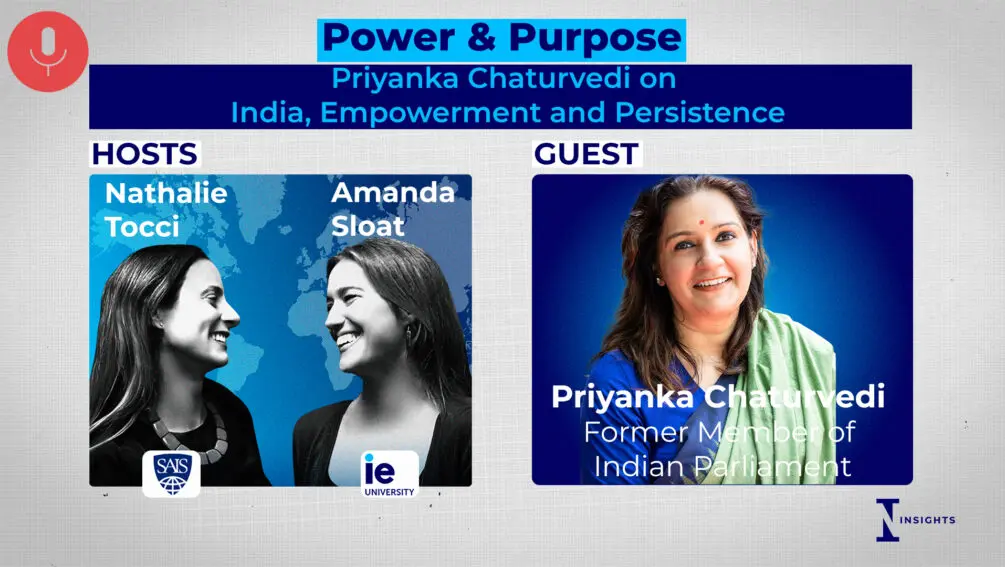
How does the world look from India today? Priyanka Chaturvedi joins Amanda and Nathalie to explore India’s evolving global role, its relationships with Europe and the United States, and the challenges of regulating technology in a democracy. She reflects on her journey from media to politics, the challenges women face in political life, and why persistence matters in public service.


© IE Insights.
Transcription
Amanda Sloat: Welcome to Power and Purpose.
Today we are joined by Priyanka Chaturvedi, a member of the Indian Parliament and deputy leader of her Shiv Sena party. Today we’ll be discussing her decision to leave behind a public relations career for politics and what lessons she learned along the way about the role of women in politics.
We’ll also be discussing how the world looks from India, including Priyanka’s work on democracy and technology. Priyanka, welcome to the show.
Priyanka Chaturvedi: Thank you so much for having me on your podcast.
Nathalie Tocci: Priyanka, it’s a real joy to have you with us and let’s dive straight in. So in many respects, both India and I guess Europe collectively are middle or perhaps wannabe great powers on the world scene.
The sort of traditional conversation about India and Europe is that we share the values of democracy and multilateralism and all sorts of things, and yet in the past this was really a relationship which in many respects was characterized by sort of mutual frustrations and misunderstandings and missed opportunities.
My question is, you know, is this changing now? Of course, we’ve had this sort of major trade agreement between the EU and India. Do you consider this to be a sort of structural shift in the relationship? If so, why? How much of this is Trump determined and how much is it about perhaps just Delhi and Brussels finding a different way of communicating and understanding one another.
Priyanka Chaturvedi: Firstly, I’d like to begin with the EU-India FTA, which took a long time in making, but I would also thank Donald Trump for that, for bringing both the countries together to finally make a decisive call to have this happen.
And also to tell you that we, I’m part of the External Affairs Standing Committee, which is headed by the minister. And for us, it’s the biggest priority is to further the relationship and strengthen the relationship that Europe and India are working towards because we feel we have more convergences than divergences and we can definitely keep the difference of opinion on various issues aside to ensure that there are common agreed goals and it’s a common development for all that India has always been speaking about.
So yes, it is very much a priority for us to ensure that the FTA turns out to be a win-win proposition for European Union as well as India. So that is part one.
In terms of the connectivity, I think Europe and India stand at a point right now. We are seeing just so much happening around us that we need to establish reestablish the global norms, the global trade that we speak about, the ideas of democracy that we speak about.
Equality, justice for all, inclusivity for all is something that India and European Union can definitely take the lead on that. And European nations should be doing that as well.
I think the only divergences that we see are perhaps on various relationships and on terms of freedom of press, freedom of speech, et cetera. But those are things that change as per cultural context, change as per geography.
But I can tell you one thing for sure, that as an ally we have seen Europe always rise up to the occasion and going by the shared democratic values that we have. It’s only going to be a win-win situation.
It’s only going to strengthen further. And by the virtue of India being a strong, dependable ally, it is going to be something which even Europe would benefit out of.
Amanda Sloat: I’m curious, following up on that, how you see India perhaps shifting its role as a middle power in the global order. You’ve just been talking about a situation where we’ve got strengthened relations between India and the EU.
There seems to be an improving relationship between India and China and the relationship between India and the US has been a little bit turbulent after a number of years of strengthening ties and then gotten much more complicated. Certainly lots of conversation here in Europe about middle powers. We had the Canadian Prime Minister speak about that at Davos.
So curious, given all of these broader shifts within the global order, how you see India situating itself and how you see its various relationships with partners evolving.
Nathalie Tocci: And perhaps just to add to that question, your foreign minister Jaishankar has often spoken about multi-alignment. Can you kind of help us decipher what the relationship is between multi-alignment and India’s commitment to multilateralism?
Priyanka Chaturvedi: So as far as, if you look at India’s civilizational history, the ethos, when we got independent as a nation, we were emerging out of colonial rule and invasions, et cetera.
And we believe at that point in time, India would need to reach out to the entire world to be able to ensure the needs of its people and to ensure that India sees a growth trajectory on its own terms and conditions.
So it started with a non-alignment movement to where we are now, which is strategic autonomy where we will obviously converge on issues that matter to the world globally, but also how we can, from the perspective of Indian citizens ensure that we are not coming in the way of economic development, global development, global trade, et cetera, and ensuring that we get the benefits of that as well.
So it has been a longstanding policy that India, by the virtue of different political parties coming to power, there has been a sense of continuity. There hasn’t been a sense of wanting to side with a particular nation on the basis of the ideological myths that the world keeps telling us on how to behave, what to do, how to conduct ourselves. We followed our own trajectory.
So that is part one. So yes, we did see some ups and downs with the United States of America, but we are again going back to a more stable positioning. The trade agreement has happened and we look forward to some more positive outcomes coming from that.
But yes, we are all living in turbulent times, and India’s story has been that of ensuring that whether it is multi-alignment, whether it is multilateralism, we continue to have this conversation with every single country.
Yes, we have two countries which we share borders with, where we find it extremely problematic. So we also have to look at the national security perspective.
So those are things that when you mentioned that we have a relationship with China, yes we do have a working relationship with China, but we also understand the threats that emerge out of there. And it is not just about the national security bit, but also how there is a disruption of global trade and how they will leverage over supply chains.
That is something which goes against the very foundation of a global trade order.
So while we continue to engage with the world, we also align people first and India first, which is the core policy that we have seen in our various commitments globally and various conversations globally.
Just recently we had the Raisina Dialogue. It came at the middle of the disruption that is happening in West Asia, but we had conversations, we had Iran on the table, we had Israel on the table, we had the US on the table, we had the European Union on the table. Everybody was discussing, not talking to each other perhaps, but sending their message across the world.
So that is what India’s ethos has been, that the dialogue should continue, decision making could happen on the basis of continuous engagement with the world.
So we do have problems with certain no-go territories, like in terms of Pakistan, but even with Pakistan, we’ve tried our best to try and find a peaceful mechanism to respect each other.
Unfortunately, we’ve had wars to also handle as far as Pakistan is concerned, but India has never been the country to go attack another nation. So we also understand the value of peace.
Nathalie Tocci: And going from the foreign policy to the domestic. I mean, what we’re seeing, and this is obviously a global story, not specific to India.
I mean, it’s certainly a big European and American story of democracy in many places of the world being under threat. As I said, including in the United States and in Europe with the growing rise of far right nationalism, populism, et cetera. What is your view of the health state of Indian democracy today?
Priyanka Chaturvedi: So I think many times India has been the victim of some model idea of democracy that should exist globally. Some global standards that were set where India was not at that table of setting those democratic model standards.
But if you look at where we are in terms of geography, in terms of cultural context, we have a democracy which is very unique. Many people from the outside may not understand this, but it is a very unique structure that exists.
Of course, there are stretches, there are push and pulls that we continue to see, but again, whether it is freedom of speech, freedom of the media, et cetera, again, those standards set by countries who believe that they have got the moral authority to set those standards.
But India has some.
Nathalie Tocci: And which by the way now are violating exactly.
Priyanka Chaturvedi: Absolute, absolute. So the middle powers come into play again here. The ones who set the standards for us, set the so-called gold standard of democracy, gold standard of freedom of speech and freedom of its citizens, are the very ones who are violating that with impunity, with absolute disregard to what we signed up as United Nations member nations.
So having said that, as far as India is concerned, of course there are push and pull of democracy. I’m in the opposition. We do see challenges at times and we want to raise certain issues where we do see some hesitancy coming from the side of those who are in power.
But it is a democracy which continues to engage, continues to talk. And in terms of vibrancy of democracy, we have multiple political parties across states who vie for people’s vote.
And ultimately it’s the people of the country who get that choice to decide who they want to become.
Of course, you may not have a government which is looked at from a perspective of popularity on the world stage, but in terms of catering to the needs of the domestic people, the citizens of the country, they live up to it.
And they are also held accountable by the virtue of a vibrant opposition as well, and our institutions.
As far as our institutions are concerned, the good part about our institutions has been that they continue to be autonomous, not influenced. Again, that is also a discussion that keeps happening, but if you look at it through a larger perspective, the institutions have continued to stay autonomous, though we continue to fight this battle to ensure that they are not influenced by the government of the day or the power structure.
But if I look at it from a macro perspective, India’s democracy is doing just fine.
Amanda Sloat: Well, let me squeeze in one more policy question before we turn to your story. Building on what you said about regulation, about freedom of speech, and that’s the issue of technology, which I know has been something you’ve worked a lot on in your parliamentary office.
There’s a tremendous amount of debate between the United States and Europe on this, especially given Europe’s unhappiness about some European regulation. There’s debates about censorship, what actually should be allowed as free speech, what’s actually untrue or harmful. And I’m curious how you sitting in Delhi see this situation and what exactly you have been working to campaign on in terms of online safety?
Particularly, I know you’ve been quite focused on issues related to women.
Priyanka Chaturvedi: So when I began my political journey as a member of Parliament, and the first issue that I picked up with my IT minister was about how democracies are being influenced by technology, how misleading narratives, how information disinformation, misinformation has become a huge tool for those who want to destabilize democracies.
We are seeing this play out in various parts of the world, which believe in the basic functionality of how freedom of speech and freedom of media works. So that was my first point that, you know, the minute you surrender that in terms of the technological influences and technology knows no boundaries, social media knows no boundaries.
It only knows disruption. It can be, it is a very empowering tool, but it is also a tool that can create mayhem and create chaos globally, and we are seeing that play out.
So that was the first issue that our democracy should be able to safeguard, its the basic ethos, and it not be totally handed over to technology to decide what the electoral outcomes would be.
So that was the first point to a point where Grok as a tool came without any safeguards in terms of the prompts that were given and the response it was generating as far as women were concerned. That is extremely problematic.
I’ve also spoken about silences in terms of voices of women in tech spaces. That is also something which is swatted by bullying, threatening, character assassination, sexual menace. It silences a lot of women, especially women who want to speak on policy and politics, and there is a distinct campaign that goes on literally almost on a daily basis, globally, not just in India.
India was at the receiving end of, I mean, I have been at the receiving end of a lot of trolling, but that did not silence me. It only made me vocal and I believed that the moment I become silent, I end up getting these people to win. These are the bad actors who use social media to disempower people.
So that is something that we have been raising. And as far as India’s concerned, we do have freedom of speech in our constitution given to us as a right, but it comes with certain restrictions. It has not been absolute freedom of speech, which Europe enjoys, which US enjoys due to the ability to have these guardrails, we are able to bring in policies that ensure that, while freedom of speech is not harmed, it does not become disruptive.
By virtue of giving, under the garb of absolute freedom of speech, that many countries are facing consequences of, those are the ways we’ve been dealing with it. And whenever we felt a policy intervention is needed, we have done that. But by virtue of certain restrictions, that, by the way, it was the first amendment made to our constitution when constitution was adopted, there was absolute freedom of speech.
India very soon realized because of the distinct personality of every single state that becomes a part of the union has different cultural context, different languages spoken, different way of dealing with things, different even cultures as well. So we understood that.
So there are restrictions in place because of which it becomes easier to navigate in terms of bringing some kind of policy intervention.
Nathalie Tocci: This is fascinating. Can I just ask you something? I didn’t know this. I mean, do you feel that the way in which that restriction in the Constitution has been formulated has so far managed to strike the right balance between, in a sense, freedom and security?
Priyanka Chaturvedi: Absolutely. As anything that threatens national security is something which is restricted as per the Constitution. So that is something which gives the ability. So if a government uses it to balance it in the right way to show the country the direction, it is a very powerful tool to be able to do that.
And also to hold these platforms to account. Also, we need to understand most of the platforms are not based out of India.
The community guidelines that they follow are not set as per the Indian standards. So we are able to get them to be held accountable as well.
Most of the times I’ve been in various conversations globally with people who are interested in tech and how digital platforms are kind of being used as a tool in many places under the guise of just being messenger, the safe harbor route that they’ve been taking in most of the countries.
Also the country’s not being able to restrict them by virtue of the absolute freedom of speech that is enshrined in every citizen’s right. That is something that they’ve been, while in India, we’ve been able to hold both, to balance the two, the people of the country, as well as those who are the service providers here to be able to kind of be accountable for their conduct.
Amanda Sloat: This is always the hardest part of the podcast for me, which is shifting away from very interesting conversation on policy to the personal side of the story. But I am thinking that this is a good transition point to get to how you are where you are now in terms of being able to use the voice and the experiences that you’ve had as a woman in politics.
But I wanna go back to young Priyanka. I understand you were raised in Mumbai. From what I’ve read online, there were patriarchal expectations for you about marriage and family, and yet you began a very successful career running a media and public relations firm before you pivoted to politics. So I’m interested in hearing about those early years, how you managed to escape those expectations and what your thinking was when you were young about a media career.
Was that something you had seen yourself doing long-term and why?
Priyanka Chaturvedi: So when I think of my younger years, I would’ve never envisaged that I’d see myself as a politician or a parliamentarian or speaking up on causes that matter to the citizens of this country, because in India there are just so many barricades and barriers that are put up around you if you do not come from a privileged background, or you do not come from a background which has political connections or part of family structure as such, which has access to politics.
So I came from none of those. And from Mumbai, yes. My family, my parents were very strict about this idea that before you think of a career, you have to first think of a marriage.
So education of course happened, but marriage was always the first sense of responsibility that they wanted to kind of fulfill. So I did get married very early. Yeah, it was a very simple, easy to go person. Let me follow all the cultural mindset that my parents have and follow that to the T.
But it was only much later, after the 26/11, and I got into a media career, which was doing just fine because I found spaces where I could be able to cater to media services in terms of recruitment, getting the right staff, getting the right people. Because I had worked in the media background, I realized how difficult it is for media companies to recruit talent which understand how the space works.
That kind of, by virtue of having worked there, gave me a ringside view of what was happening and how we can probably use this to ensure that the right people fit into the right spaces. That took off very successfully. I was pretty happy with my career the way it was going. I had also got a scholarship, I think it was with ISB and Goldman Sachs. They had a program on women entrepreneurs, so I was a part of that as well.
But what changed my entire mindset was when the 26/11 terror attacks happened in Mumbai. As a Mumbaikar, someone who came from the city, born and raised in the city, I felt very strongly about it and I felt we as citizens who are contributing as taxpayers also need to be equally involved in policy and politics because if we don’t get heard till we don’t have a voice, it is going to be difficult to tell the world where we come from or what are the challenges we face.
In the grip of politics, many times all of this is lost which we as citizens felt at that point in time. That is how my political trajectory began. I started with teaching street children. The kids who live in slums in Mumbai, we were teaching them, we were handholding them, we were supporting them, we were helping them.
So they are not influenced by bad actors, bad faith actors, and brought into a space which will lead to more criminal activities. And that got me interested. I got into politics. I was in a national party, which is the Indian National Congress, which is a principal opposition party right now. But at that point in time, they used to be in power.
I worked with them and it was due to one particular reason that I decided to quit. Which many even Indian women do not believe that I could have taken a stance like this. That is when someone had misbehaved with me during the course of my political work, where I felt a party should have stood up.
Where we talk about women’s dignity, women’s respect, and women’s participation in politics. That did not come because it happened during the middle of an election. I felt let down because I came into politics to get more women heard. To be the woman who gets heard on issues, on policies, on politics, et cetera. But I felt let down, and that is when I changed my political party and I moved to a smaller party, which was from the state of Uttar Pradesh.
And after two years of working with them, they chose to send me to the parliament and that is what I’ve done. So I’ve been very conscious of the fact of the barricades. I’ve broken the barriers that have come down and to be the voice of, I would say, those people usually not heard in the premises of the Parliament, so I try to do that very consciously.
People’s issues, people’s matters at every intersectionality. Every policy. Intersectionality impacts women. I keep making that point. Many people sometimes accuse me of speaking too much about the women-centric policies, how women are going to be impacted, but I feel that is my responsibility.
We need to continue speaking up and being heard.
Nathalie Tocci: So Priyanka, just to unpack that a little bit. So, okay. Your first pivot was from media to politics, and then there’s this major second pivot within politics, the National Congress to Shiv Sena. Could you, well, firstly, I think for our listeners that perhaps are less familiar with Indian politics, if you could give us a sort of very quick overview of how you view the differences between these parties, and then perhaps just a little bit more on your switch. I understand what the context was of that switch. How would you kind of unpack why you took this, I guess, fairly uncommon decision to change parties?
Priyanka Chaturvedi: So let me tell you, in India, in the west, you have a right wing party and a left-wing party and ideologies are very clearly defined.
India does not matter. India’s political parties usually veer towards a more centrist point of view, but ultimately more people-driven point of view.
So, and political parties. We see so many political parties, many people in politics. It’s not like if you are a Democrat, you’re a lifelong Democrat. If you’re a Republican, you’re a lifelong Republican.
In India, many politicians change political parties, but yes, very few women. Vocal women who are, who are, you know, who are the national spokesperson. I was the national spokesperson of a party, chose that decision. I had two choices in front of me at that point in time, and those choices were very clear to me, should I resign and become silent?
Just one of the many who tried to make history, change history, or should I just change my platform and continue to espouse the causes I believe in? I chose the latter simply because that was a story of 10 years of my hard work as well as the space. Of course, the political party made for me. And there was one very big enough reason for me to decide to leave the party at that point.
It was a very painful decision, but the party also chose not to stand by me at that point in time, which I thought just because at that point in time we went to an election procedure, et cetera. They chose to do that. I also thought that instead of being silenced, instead of being a footnote in history, I need to continue speaking up.
I continue to be heard and continue to speak for women’s causes and issues that should be prioritized in this country. Especially with regards to women in politics and women getting the dignity and respect that is needed in politics, and I changed the platform, my ideas did not change, my worldview did not change.
Every citizen in this country or world over keeps improvising on their choices, keeps deciding on their choices, keeps weighing on their choices, and keeps learning about new things. That my mind has always continued to be open to more ideas, open to more knowledge, open to changes in how you deal with the situation.
So that is how I chose at that point in time. Of course, I was criticized left, right, and center by many people because not many women who were vocal, India had not seen something like that at that point in time. And because by the virtue of me being very vocal, it was discussed in Indian media for a long time to come.
But I saw massive support coming from women especially, and people who valued rational voices on television as well as in media. And that is why I got that love and support and I managed to continue the way I have. Even if you look at my tenure in the Parliament, when it came up to renomination, we did not have the numbers.
The outpouring of support I’ve got from the citizens of this country has been tremendous and that, that I think is the value add that I brought in terms of politics. So I’m glad I chose the choice I did. Simply because I chose not to be silent. I chose to continue working despite all the challenges that, and India is a patriarchal society.
There are very few women in political spaces, there are very few women in the Parliament, India assemblies, and it’s just about, I would say, 10 to 12% of women representation inside its parliament. Which is unfortunate.
Amanda Sloat: I wanna follow up on that. You’ve mentioned a couple times the challenges of women in politics, women in parliament, and would be interested in hearing more your experiences of that, the challenges that you have faced as a woman.
I understand that you, and was it what 11 other women MPs were suspended for an entire winter session of parliament for quote, creating ruckus. I don’t even know what exactly that means. The implications of suspending people from Parliament for an entire session seems very problematic. So curious how you as a woman have navigated that space and have been able to continue having your voice heard despite some of these structural challenges.
Priyanka Chaturvedi: So, yes, I was suspended because I dared to come get inside the well of the house on an issue which was very deeply problematic, which was about privatization of insurance companies, which would probably lead to a lot of joblessness in the country. So at that point in time, the entire opposition. And the way the bill was brought in was in a very sneaky fashion.
It wasn’t told to us that it would be introduced in the Parliament. It was suddenly on the last day of the Parliament session before the winter session, the monsoon session. It was just quietly, it was slipped through as part of the supplementary business. So we were all opposing that, and we were all getting our voices heard.
By the virtue of that, the parliament was adjourned, and when it reconvened, they chose to suspend those people who came inside the well of the house. Parliament disruption happens a lot in India. I’m sure many of your viewers may not know this, but suspensions happen. Disruptions happen, adjournments happen by the virtue of opposition coming into the well of the house and protesting.
So that is how I was suspended in the next session. I was suspended for an entire session. And when you’re suspended, none of your questions, your interventions, your policy, you know, your thoughts on a particular policy are heard or even brought on record.
And for me it was, you know, I was very surprised.
My family used to keep joking about it, that you’ve never been even punished by your school teachers ever. You’ve not been so non-controversial and now for the entire nation to see you getting suspended for an entire session. They were trying to make light of it, but for me it was a personal setback.
But I chose to go to the parliament every single day. I used to sit outside the parliament. All the parliamentarians who were suspended used to sit outside the parliament and whatever interventions I wanted to make because I did not have a voice inside, I used to put it out on my social media handles that if I was in the parliament today, if I was part of the session today.
These are the questions I would’ve raised. This is the zero I would’ve said, this is the subject I would’ve spoken about, and these are my policy views on so and so bill, et cetera. So I continued to do that. That also had a tremendous impact because people knew that I was committed to the idea of being in the Parliament, but it was the decision of the government to suspend me.
But all the days of the working days of the Parliament, I was very much there and I performed my duty even outside of it, even if it wasn’t recorded, it didn’t go on record inside. So yes. Recently, a year ago, 130 parliamentarians were suspended, were kept outside of the parliament and really, really important bills were cleared.
Even despite having more than 130 MPs outside of the parliament and not participating in the debate. So this is a problem. This, this particular part of parliamentary democracy is deeply problematic, where we have bills passed within seconds, within minutes of hearing, no opposition voices, and then in hindsight, wanting to go back and revisit those laws that we’ve created and make those adjustments, make those amendments and reintroduce them.
For example, even the women’s reservation bill. Women’s reservation bill in India was introduced by the virtue of not having enough women in the parliament and assemblies. We all, at that point in time, continued to say that it is a deeply problematic issue because you’re trying to increase the number of seats in the parliament.
Not the existing seats don’t get the reservation. You are wanting to increase the number of seats and then introduce a 33% reservation. And those increase of seats is already being pushed back by many, many of the states, but it did not work. Now, in hindsight, again, we are going back to an amendment to ensure that we have reservation by the time we go into the next general election.
I know it sounds a bit crazy, but this is how India’s parliament works and our democracy functions.
Amanda Sloat: Is that just generally accepted that within a democracy you can suspend elected representatives of the people and deny them a formal voice?
Nathalie Tocci: The thought of Priyanka standing outside parliament and basically having her own surrogate parliament outside, I must say it’s just an incredible image.
Priyanka Chaturvedi: We used to have a more parliamentary day every day because 13 MPs, but by the same token, the number of it all. From 13, it went up to 113 MPs being suspended.
So yes, it is something which of course does come up for discussion that how can you suspend so many members of parliament?
These are members of parliament who are elected directly by their people. You’re effectively silencing that entire constituency from raising anything, any issue of importance for that constituency. And a member of parliament has dual role to handle, aid their silence inside the parliament, and they have to go answer to their constituency why they could not raise certain issues.
So yes, those are things which, you know, in moving forward as a mature democracy, as a mature power, both largest economy in the world. What is the message we’re sending to the world?
So yes, we do have those conversations as well, but as of now speakers and a chairperson in the upper house do wield that power to be able to suspend members of parliament.
Amanda Sloat: One additional consequence I understand of your suspension was that you stepped down from hosting what had been a long-running interview program where you were profiling women MPs to inspire young women to enter politics, which is the very purpose in fact of this podcast, which is to not lose an entire generation of young people to a career in public service.
And so I’m curious both your lessons that you learned on that program from conversations that you had with women MPs, and also what advice you would give to our young listeners of this podcast who might be thinking about careers either in public service or in elected politics like you have done.
Priyanka Chaturvedi: My only advice would be to never be silenced and never be cowed down or bullied by what people think should be the leader’s agenda.
The leader’s agenda has to be directed by their own conscience and what they believe is good for the nation. That’s most important. A sense of commitment to what you do, a sense of consistency. An absolute clarity of mind as to what purpose you’re going to be serving once you step into the political space.
So make up your mind, but be determined and consistent. That’s most important.
But in terms of my own parliamentary track record, et cetera, again, like I said, I’ve come from that conscious point of view that I have been given this opportunity I have to make do the best way I can and try and do whatever the best I can bring forward in terms of challenges, in terms of opportunities that arise.
So yeah, so this is the only advice I would give that for someone who came from totally outside of privilege, outside of political background, to have done that has can only come when you’re very clear in your head that this is what you want to do, and that sense of commitment and the sense of patience as well.
Because politics is all about uncertainties and also dealing with these uncertainties. On one day you are on a happy high, that you’re not exceedingly well, and the next day you’re left with nothing and you’re wondering why are you even wasting your time?
So though there are moments, there are such moments when you feel that I can’t deal with this. I don’t need this anymore. I don’t need these controversies in my life. But then you realize there’s a larger responsibility that you now have towards your people, towards the nation and towards the parliamentary democracy to continue to prevail.
Nathalie Tocci: And actually, this kind of brings me to your situation today because I understand that your political term is coming to an end this spring.
And given that the upper house requires a nomination by your party, I understand that you did not receive this. I’m just wondering if you could tell us a little bit about how you are living this. I mean, you know, do you consider this to be a failure? Do you consider this to be simply a phase of your life that has ended and a new one that is beginning?
And what does that new phase open up for you?
Priyanka Chaturvedi: So the moment I did feel of when, when we did not have the required numbers, it did kind of, it did upset me a bit, but I also realized that it is a sense of, I would say it’s a pause for me. It’s not a full stop that I must pause. I must be able to continuously be committed to what I’m doing and look at returning back to the parliament through, through the, as an elected representative.
But those are things which is just playing on in my mind. But however, when I realized that the numbers do not add up for me, and if it was to be a competition, if it would be a choice between me and some senior leadership, obviously the senior leadership would be given preference over me. I knew all of that personally.
But you know, something my father always taught me is that never be attached to positions and never be attached to the idea of being in power at any cost, as well as learning to move on gracefully.
So at this point in time, I think the best opportunity for me is to move on with my head held high for having raised all the issues that people wanted to hear me raise. So that, and the kind of outpouring of support I’ve got from across political party lines has been truly, truly amazing and has given me a sense of positivity that I have done something meaningful by the virtue of being relieved of this responsibility.
I have joined as a young professor in one of the leading universities in India where we’ll be teaching a course on humanities and dealing with technology and how to navigate the space and how to navigate things that we are dealing with in terms of the way tech is shaping up, how do you form legal policies around it, et cetera.
That is one thing I’m doing. I’m also in the process of writing a book, which has just got finalized with the publisher, and I’ll be more engaged in geopolitics and building relations with the EU and America and democracies that align with India’s idea of economic growth story.
Amanda Sloat: I have no doubt, you’ll remain very busy and find very productive ways to contribute both to your students and to the broader intellectual debate. I wanted to pick up on your book. I know you have a love of reading. I know you used to have a blog, so I am very curious myself and for our listeners, what your current best book recommendations are.
But I’m curious in that vein, how you have approached this question of wellness and what you have done for yourself personally to stay both healthy and sane in the midst of all of the parliamentary battles, the political space that you have worked in. We talk a lot on this podcast about whether work-life balance is possible.
I am curious your perspective on that. So tell us your best book recommendations and also how you stay healthy and balanced while you are doing everything professionally.
Priyanka Chaturvedi: So firstly, far as work-life balance is concerned, that’s what every woman who deals with a strong career and careers which are so, I would say not too certain in a sense where you’re heading next.
I’ve always felt guilty of not having spent enough time with my family, especially my children during the growing up years. My daughter was just two years old when I got into politics. Today she’s 18 and she’s studying and very independent. I’m only glad that my children understood the work demands that I have, and they’re equally happy to see me contributing in whatever space I can.
So work-life balance. Also, I would highly recommend everyone to have a pet dog at home because they are the ones who are your stress busters. They give you unconditional love. They ask you no question. They never come and complain that we missed you. But they always, whenever you’re there, they only have love to shower to you.
So I think that is one thing I keep telling my children. I joke with my children that if I got a chance to decide whether it’s a dog or your, I would’ve chosen a pet dog. I hate to say it, but I do that. But because there’s such unconditional love to give me without any complaints. Sorry.
So that is.
Amanda Sloat: I love that, that this is our first dog recommendation on our podcast. I think it’s a brilliant one.
Priyanka Chaturvedi: So, so, yeah. So my dog keeps me sane because of the unconditional love that it has to give to me. My husband’s been a big supporter in terms of a lot of decisions I had to take, uncomfortable decisions that I had to take. So that is taken care of.
But in terms of how do I keep sane, again, the idea of detachment that you’re detached to the fruit.
So, so I’m a big believer of the Gita, Bhagavad Gita tells you the way of life, the way to deal with life, the way to deal with challenges and your sense of responsibility and what you get out of it. So I’ve been very detached to outcomes. I’ve been only attached to what I have to serve on. A lot of causes, a lot of issues.
So that way I deal, whenever I do see a lot of stress coming through social media, et cetera, or through the parliament, I just withdraw. I withdraw, I rethink, I take a pause, and then I get back again. But I just don’t get silenced or I don’t just stop fighting. I keep fighting for another day. So that is how I keep myself sane.
In terms of, in terms of that, that, that was the question, right? These two things.
Amanda Sloat: I love the concept of detachment, and yes, as Natalie knows, I have done a lot of yoga. I have spent a lot of time in India doing yoga, and that concept of detachment really resonates.
Nathalie Tocci: So you may now want to take up the recommendation.
Priyanka Chaturvedi: Yeah, so now what moved away from, I was reading a lot of nonfiction. Now I’ve gone back to fiction because fiction is bringing me joy because nonfiction world gives you reality checks, and I think I’ve had enough of reality checks in the last six exact months. So I’m reading a lot of fiction. I’m reading a lot of mystery novels and whodunnits. And even humor, P.G. Wodehouse is something I keep recommending to everybody and anybody that don’t take life so seriously, learn to laugh, learn to pause.
So I’d highly recommend any of the P.G. Wodehouse titles that I’ve read. There are a lot of books on, we have a lot of deities that we pray to, and women are looked from the perspective as when we worship them, they’ve been worshiped from the perspective of Shakti power.
That they have. So a lot of our texts that we have talk about how women have the power and the capacity to shape narratives, you know, to reshape the world order. So something that, so anything that gives me, you know, motivates me further to continue.
So at this point in time, as I speak to you, there’s a couple of fiction books that I have read. There’s an author called, popular fiction author called Lisa Jewell. She’s written some amazing books, some mystery books. So in case anyone’s interested in that.
In terms of nonfiction, I’m reading GeoTechnoGraphy by Samir Saran. Considering that that is part of how I am also going to be, how I teach my students in the university.
So these are a few recommendations that I have. And considering I’m also writing a book, I’m doing a lot of research on that book as well, and that’s a nonfiction.
Amanda Sloat: Amazing. Thank you for all of those.
Nathalie Tocci: And to sort of close off on this absolutely delightful conversation. Can you give us, I mean there’s been actually quite a lot of joy throughout this conversation, but perhaps just give us a last little bit of Priyanka joy by telling us what has made you smile over the last few weeks.
Priyanka Chaturvedi: I think my children put the biggest smile on my face when they said, when you sign off, you’re signing off on a very happy high note that you have contributed towards the nation, the love and outpouring of support you’re receiving from people as you complete your term and congratulating you for the term that you served in the parliament.
That in itself speaks for your contribution. So my children have been my biggest sense of joy, though I keep joking about the dog bit, but my children continue to be the biggest source of joy for me. And the day I got to know I’m not getting nominated, it was a bit low, but after one, I decided, looking guys, we all moaned this, that we are, I’m not getting renominated, let’s now go ahead and move on with our lives.
So yes, those are decisions that I take sometimes impulsively, sometimes thoughtfully, to ensure that the joy doesn’t go out of our lives just because there’s a joy that has been taken away in one particular instance of your life that you’re going to be living.
Nathalie Tocci: Thank you so much for this conversation. Priyanka, I think this has been a real actually lesson in the sort of art of detachment, but also the need to keep up that love and that passion for what you do, and that throughout our lives that there will be lots of curves and unexpected detours, but ultimately that clarity and that consistency that you’re talking about, I think really is what drives us and what should be driving us moving forward. So thank you so much for being with the show with us.
Priyanka Chaturvedi: Thank you so much. It was lovely having this conversation and I wish to keep in touch with all of y’all and continue to do the amazing work you do and get the women’s voices heard.
Nathalie Tocci: Thank you so much, Priyanka. Appreciate it.
Priyanka Chaturvedi: Thank you so much.
Amanda Sloat: Power and Purpose is an IE Insights podcast produced in association with IE University and Johns Hopkins School of Advanced International Studies. Production and Sound Design by Reptile Studios. We’ll be back soon with the next episode. Make sure you never miss an episode by subscribing to Power and Purpose wherever you get your podcasts.