

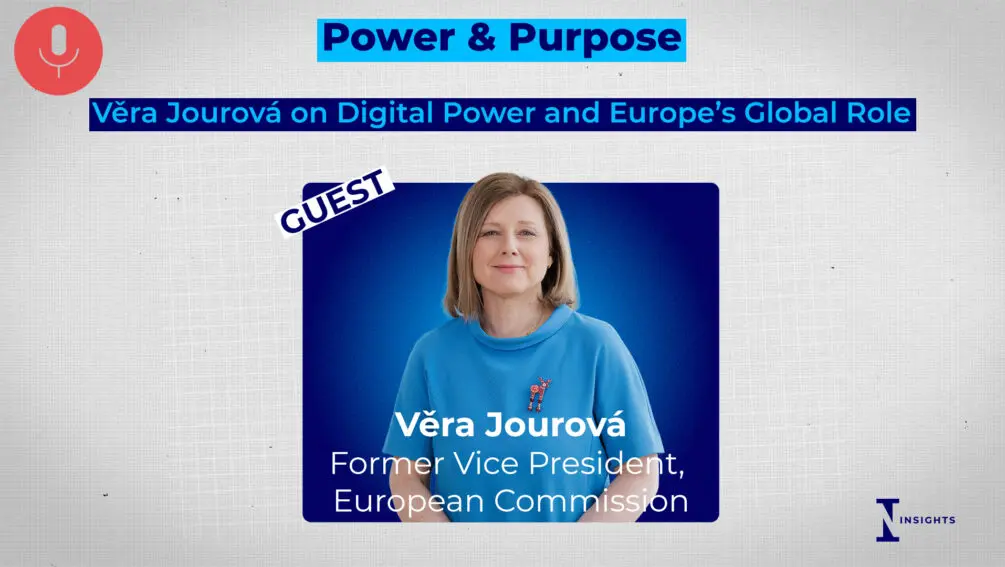
Věra Jourová on Digital Power and Europe’s Global Role


Transcription
Amanda Sloat
Welcome back to Power and Purpose. I’m Amanda and I’m Nathalie. We are delighted to be joined today by Věra Jourová. She has a distinguished history in the European Union, serving as Commissioner for Justice and as Vice President for Values and Transparency. In these roles, she worked on media freedom, disinformation and rule of law issues. After leaving the EU, she returned to her alma mater, Charles University in Prague, where she serves as vice rector for human resources and advises Czech President Petr Pavel on EU and democracy issues. Welcome to the podcast.
Nathalie Tocci
Well, thank you so much for being with us. And let me dive straight in. You have really been at the forefront of regulating digital issues in Europe, especially as they relate to human rights and democracy. I’m thinking about early successes and your involvement in GDPR, the Digital Services Act, the European Media Freedom Act.
Now looking at all of this together, Europe, and in particular the European Union, has often been known in the world for what has now been coined as the Brussels effect, where norms and rights are not only expanded in Europe, but they also contribute to shaping global standards. Now, at the same time, the EU has recently come increasingly under attack, both internally in the EU and particularly across the Atlantic for over regulating, with some saying that this harms competitiveness.
Could you give us a sense of where you stand and what you think of this tension between regulation, norm diffusion and the risk that it may actually hamper competitiveness? Yeah, yeah.
Věra Jourová
Thank you for this for this question. It really brings me back to what you call having a history. Yes, I have a long history in general. Look global standards. I was quite proud to travel around the world and sell the privacy rules, because the American global digital companies spread all over the world. And suddenly the individual people lost in the black box, people in several other states and continuous don’t like it.
That’s why it was not an easy sell. But I managed to convince the governments in Japan, in South Korea, in Canada, others partly in the United States. But it’s a long story to convince them that the people deserve better protection. So this is the global standard, and this is a positive thing together as a parallel happening was the discussion with the digital companies on the problem of illegal content.
And, well, in European states, we have a very bad history with content and with bad words resulting in violence. So I was, I think, the main figure who discussed with them with the with Facebook and Microsoft, Apple, Google, the first codes of conduct, which were voluntary arrangements. I was asked whether I am I’m happy about the regulation. The regulation had to come.
It was necessary because the gentleman agreements on hate speech, child pornography, terrorism, extremism, and finally also very well targeted disinformation. This gentleman agreement could not work anymore. And so we came with regulation. We came with Digital Services Act, which is covering this issue of illegal content; the Digital Markets Act, which is addressing the issue of creation of police, which we don’t want in Europe.
We also have the first ever global AI Act. And here I have some hope that AI Act might serve as a global inspiration, because AI can serve people in a fantastic way. But in case I get out out of control of people, it might be a bad boss. And I always say the tiger must not get out of the cage.
So to wrap up, not all regulations are bad. Not all innovations are good, and it’s unfair to say that the EU is just the queen of regulation. We also invested, and we will invest a lot of money in innovations, in creating clusters, connections between technological research and business. Europe wants to invest more in clouds and better data governance.
But also European Union really tries to be the address for the talents. And so not only regulation, but I understand that regulation is a dominant topic and something to be explained. That’s why I am glad you asked about that.
Nathalie Tocci
Just a quick follow up on this. I mean, are you worried about this push that we increasingly see, including, I mean, not just from across the Atlantic, but including in key European capitals, starting with Berlin, of this narrative of the EU over regulating. And I often and I don’t want to put words in your mouth, but I’m often a little bit concerned.
Well, very concerned, I should say, about how behind this push for deregulation, there may be an implicit push for disintegration. And I don’t think it’s a coincidence that you have, for instance, Eurosceptic far right parties also using this language.
Věra Jourová
It must not result in dismantling the some kind of harmony and common understanding. I would be for very radical simplification and dropping the things which are not substantial. And in GDPR, I was signed under that. But I was saying a lot of times, do we really have to insist on such strict rules for the small companies? For instance, to give you an example, and the answer of experts was yes.
Even the small company can do a big harm to the users. Yeah, so I am in favor of simplification in some cases even deregulation. But I am sure that what we hear from Germany is this. Yes, we want to simplify. What we hear from Washington is forget it, don’t enforce your digital regulations. And this is a really shameful.
I cannot imagine some Europeans would say to the federal lawmakers in the United States, okay, so you have the laws, which we don’t like as Europeans, so don’t enforce them. It’s absolutely crazy. So I think that we have to mobilize all our self-confidence and explain also over Atlantic why we have to defend our interests and right of our people against the many American digital monsters.
Amanda Sloat
Well, let me follow up on that and just push you a little bit further, especially for our listeners in the United States. You talked about disinformation, and there was a big debate about this in the United States during Covid with social media platforms, with people putting information online about Covid that was seen to be inaccurate. It was pulled down then from a number of sites, and this started to prompt big debates in the US about censorship.
And the Trump administration, of course, is implemented. Visa bans on Tiara Burton, who is implementing the Digital Services Act on other civil society activists who were working on similar issues. So I’m curious how you respond to some of these criticisms about getting the balance right between removing disinformation and then this question of who gets to decide if it’s disinformation, and at what point does that become censorship, and why?
The US in and Europe, at least at the moment, have such different approaches to this question?
Věra Jourová
Yes, thanks. How much time do we have? This is a complex thing that I will try to be simple and short. Look, I was that close from being sanctioned as well together with Britain. But I think in United States diplomatic circles, they realized that I’m already on the Russian sanctions list, and they would place me on the American one for the same thing, because I was very vocal against Russia distributing disinformation in the EU as a part of their military action.
Yeah. So I want to say that to complement what I said before about the American monsters. I am a big fan of transatlantic relations, and I never worked with the digital industry with this special feeling that they are all almost all Americans, that we have to squeeze them or we have to suppress their possibilities to do business in Europe.
So this has to be mentioned. As for the freedom of speech, we have in the European Union for decades, and in the laws of the Member States. Definition of illegal content. Yeah. So this is not new that now the Digital Services Act works with this term illegal content, because it has been defined in all member states for decades. So this is nothing new.
Terrorist content, violent extremism, hate speech which can have consequences in a real, real violence child pornography. This is not new. And so we just broke a strange conviction of many that what is prohibited offline can be tolerated online. And this is a fatal mistake because online, the beach or child pornography has million times stronger impact on real life of people.
So that’s why that’s why I was always defending in in Silicon Valley or in Washington European approach by saying we just want to balance things and correct things online is also a real world where our rules, which are old and which are necessary, have to be applied. And from United States, I always heard the reference to the First Amendment of the Constitution.
I would never put into question anything from the American system. They have their rules, we have our rules, and we have historical reasons for that. And I sometimes use a really rather dramatic comparison or historic parallel. Just imagine if Goebbels would have had Facebook, he had radio, he had radio and it was enough. But just imagine.
Amanda Sloat
That’s quite, quite an image. Yeah, absolutely.
Věra Jourová
Or Mengele having the AI available for measuring the faces and noses of people and sending them to the right or to the left to to hell, or to allow them to to live. Look, this is not so theoretical. And at this moment I might refer to the book written by Madeleine Albright, Czech lady who had to flee totalitarian regimes twice.
She had to flee Hitler and later Stalin regime. And she wrote a book about fascism several years ago. And she was so scared, telling me that her students in Georgetown University in Washington asked her, madam, Professor, why are you writing about the old things, old things, things which can never come back? Look at the reality now we have fascism again, growing fascism as a as an ideology, suppressing parts of the society and and having having some more features which we can see online already.
Nathalie Tocci
Let me ask you one last question about Hungary. In Hungary, there has recently been a wonderful earthquake and after 16 years in power, Prime Minister Viktor Orbán has been ousted. Now you have really been at the forefront of a long battle as far as this is concerned, in particular in your time in the commission pushing for rule of law conditionality.
Now, for a while, it really felt like nothing was working right. And then, of course, nothing works until it does. So I’m just wondering if you could reflect a bit about how you feel that that rule of law conditionality eventually helped or didn’t in Hungary, but beyond Hungary, what role do you think the EU rule of law conditionality can have in other European countries?
Given that, as you were mentioning, this is not just a phenomenon in one member state, but unfortunately many others as well.
Věra Jourová
Yeah, corruption is ineffective. That’s why it is dangerous. Yeah. So we didn’t want to underestimate that. At the same time, it was a regime which was chosen by the people of Hungary in free elections. So for me, this was always a holy space where I could do something. As a commissioner, I tried to push and I tried to comment, but at the same time I was criticized by many for not doing more.
And I was always saying I do quite a lot, but I am not in the driving seat. It’s the Hungarian citizen. And let’s hope there will be the next elections, which will be free and fair, and the Hungarian citizens will decide their future. This happened and I’m happy you asked about the conditionality. Well, it was in fact the measure to stop the EU money flow into the country, which does not respect the rule of law.
And it has a history, because we established the European Prosecutor’s Office to investigate corruption and fraud on EU money. I remember well that moment in 2017 when the Hungarian ambassador and minister told me, we will not join in Hungary, there will be no European prosecutor. And I said, but we need to have the EU money under control because the EU taxpayers want us to protect their money from corruption and from fraud, especially in the country, which is on the way to authoritarian regime.
So Hungary did not join the European Prosecutor’s office. And then my reaction was, I remember well, I said it here in Vienna publicly, who doesn’t understand the values will probably understand the money. And it was the start of the proposal of the conditioning EU money by elementary principles. And the conditionality caused freezing of Hungarian money for several years, and now still €17 billion is in the treasury of European Union.
And Péter Magyar is already trying to unblock the money and to use the money. So it’s not easy for him now.
Amanda Sloat
Yeah. Well let me stay in Central Europe and pivot from Hungary to your personal story. You grew up in what was then communist Czechoslovakia. I understand your parents ran a folk troupe, which I’m very curious about. And you had mentioned Madeleine Albright book, her writing about fascism, about experiences that that she had, which arguably is quite relevant.
Now, I’m sitting here in Spain, where there is nostalgia by some young people about the dictatorship, about these past regimes. So I’m curious for you personally what you can share with listeners about what your experience was like as a child growing up in a communist country, and in particular, how that experience has ended up shaping you now in your professional life, in the way you approach some of these questions.
Věra Jourová
A blessing for me to get the portfolio where I could really use my experience from my young years because the revolution came when I was 25. Fortunately, I already had two children. So because after revolution, I never have any family. Because it was such a fantastic time of opening up of all opportunities. I hated Bolsheviks and I was very much influenced by my father.
Every evening we were listening to the Voice of America and the Radio Free Europe. Very silently. I was instructed every day by my father, you must not say it to anyone. And then at school, I remember I was 13 when Charta 77, exploded, and my teacher, she was a really strong Soviet comrade. She knew that we are listening to the Western radio.
So she asked me to come in front of the whole class and say what I know about Charta 77. And I was so horribly stressed that I have to differentiate what I had in the official TV and what I heard on The Voice of America, because I knew that I might really make big troubles to my parents and just, yes, yes.
So just imagine 13 years old child being exposed to such a horrible pressure. So I probably didn’t do so well because then I had big troubles to get to the school, to the secondary school, and then to the university. I, I had to change name, I had to get married and a kind of cut off my family to be admitted to the university. And so but this experience.
Amanda Sloat
So you think there was there was a direct link between some of these moments in school, or that your teachers somehow found out your family was listening to the radio, and then that led you to be penalized?
Věra Jourová
Of course, the secret services had the people under fantastic control. They knew that my family is not a friend of the regime. Yeah. And my father, who was very open and outspoken, I know who I inherited it from. He was known as somebody who is not the promoter of the regime. But what I want to say, I harvested this experience in my work during my work in the commission, because when I remember the regime, absolutely no independent media, independent and fair judges, you can forget it.
They were servants to the regime, civil society, absolutely nothing. There was a parallel, a police, the people who connected in a secret way to be able to speak freely. There was no academic freedom. My I studied Faculty of philosophy during the previous regime. It was absolutely bizarre. Instead of cultural anthropology, I studied subject called the critics of the bourgeois theories of culture.
You know, the only one ideological angle. Totally bizarre and stupid. Yeah. So when I appeared in the commission and I suddenly started to see some signs of the start of a similar regime in some member states, especially suppressing the media and judiciary.
Nathalie Tocci
You basically went off immediately.
Věra Jourová
After the antenna works because it catches the first signals, hey, this is happening again. We have to do something to stop it. But again, it’s in the hands of the voters. That’s why I say that the modern kind of democracy with all the freedoms has two main conditions free and fair elections, and well-informed citizens, not manipulated consumers. And here are coming back to the digital saga. What the digital platforms are doing, the effect is that they are creating this easy to manipulate crowd. That’s dangerous. And it was a really striking moment for me when I was dealing with the GDPR and protection of privacy. I didn’t know much about that before the publishing, so I had to study a lot and listen to the experts and wise people about the risks for privacy of individual people.
And I suddenly saw that the individual people are a kind of disappearing in the blind box. They just give their identity, their private data, sign with their blood, some contracts with the digital system, and then they disappear. And they don’t have absolutely no, they don’t have any to keep the decision making over the data and identity in that system.
I had a strange feeling. My God, I experienced that. Yes, it was during the communist regime, the handling of risk individuals, the respect for the privacy and freedom and ability to decide on their lives. It’s very similar, akin to a conclusion that you can establish totalitarian regime not only on the basis of very dangerous killing ideology, but also by means of the power of money.
And knowing this, when I saw the digital bosses standing behind Mr. Trump during his inauguration, suddenly I saw the connection of this big money and technological supremacy and ideology and politics. It was the moment when I started to fear. Honestly.
Nathalie Tocci
Yeah, completely. Let me better touch on another, I think, key moment of your life, which came a little bit later, which I imagine must have been extremely difficult for you. So you began your career in local and regional government, and then I understand that you got arrested. On accusations of accepting a bribe to secure EU funding for a building project.
And you spent one month in pretrial detention. Now, the police eventually concluded that the accusations were completely groundless. However, eight years past, as far as I understand, before you actually received any compensation, could you describe how that experience, which must have been absolutely terrible for you, then shaped? I mean, how formative was it, you know, how did it shape the way in which you then looked at the justice system and the way in which justice, if it’s a malfunctioning justice, can actually fail citizens?
Věra Jourová
Yeah. This experience, of course, had a formative effect. And when Jean-Claude Juncker gave me the position of European Justice Commissioner, he showed a lot of sense of humor because she said to me that somebody who experienced prison must be a good commissioner for justice. But it sounds like a joke, but it’s true that I realized how absolutely essential to have an impartial, professional judge with full moral integrity who will never sent to jail somebody who is innocent as this never is, of course, always with a question, because this is the system created by human beings.
It’s not. Justice is the invention of the God. Justice system is the invention of people who are mistaken. There were two big lessons. First of all, I had so many sins. But corruption, it was really far from my nature. And how can this happen? And I wanted to understand that. So a year after I was released from prison, I started to study the law and it was a daily study, a horrible five years.
I had also two children studying being divorced. It was really a crazy thing to do to start the study in this deep crisis after the accusation, because the accusation last two years, it was just one month in prison, but then two years of the process, it never went to the court. Yeah, because there was absolutely no evidence. So the lesson was, when you are in deep misery, you must not be sorry for yourself and rather to mobilize power and potential not to wait for others to help, although there were people helping me.
But this was, I think, the illustration of I think it was Nietzsche who said, what doesn’t kill you just make you stronger. So very often I am asked to give this message to the young generation. When you appear in life in a really deep misery, look at your own potential and don’t give up. Because for me, this was the start of the new career and you know the end of it.
And the second lesson, when I was in prison, I was full of revenge because I knew where the people, concrete people who accused me, and that was a priest coming to visit the prisoners of Protestant church. And I’m a taste. But of course, it’s nice to have a visit in prison. So. So the priest was coming to me, and he tried to convince me that the personal revenge against concrete people will just eat up, swallow the energy.
I should invest in other things in my family, in coming down the atmosphere and spending time with the children and also doing something for myself, which I did by the study. So that’s why since then, I have a slogan I have to save energy for key things.
Nathalie Tocci
That’s so important.
Amanda Sloat
Understand? After this, you then actually got involved in in politics briefly, you joined a political movement that I believe the acronym translates in English as as action for Alienated Citizens. You ended up serving as a member of Parliament for a year. You then served as Minister for Regional Development for less than a year, and then you were nominated to the European Commission.
So I’m curious how you found your experience in politics. Had that been part of your plan, did you think you would stay in domestic politics, or was your heart really always with the European Union?
Věra Jourová
Oh, yes. Thank you. My God. How long did you have a you studying my long CV?
Amanda Sloat
It’s I know this is you know, there’s lots of interesting tidbits beyond just the headlines and people’s biographies.
Věra Jourová
Ups and downs. Yeah. I was tempted to come back to the ministry where I used to work. It was the real satisfaction, the moment when I came back because I was an expert on regional development. But then the Czech Republic was supposed to nominate a person to the commission, and the advice from Brussels was if you nominate a woman, you will get stronger portfolio.
And my party boss, Andrej Babis, who is now also depicted in the media as the oligarch and populist. So he was my party boss in 2013. Yeah, we speak about 13 years old story and he asked me to find the woman because first he asked me, do you want it? And I said, no, I am a happy minister.
I want to stay home. And he asked me to find a good candidate. But, you know, in the Czech Republic, we don’t have many people with the career or after the career of ministers of or prime ministers who can speak fluent English and who would be willing to go to Brussels. It is not an easy choice. So then, because I didn’t find anyone, I had to, sorry, sacrifice myself.
And then. So it was not easy. And the start was especially difficult because I didn’t get the portfolio I wanted and I had to learn everything from scratch.
Amanda Sloat
Well, I think all of this is very interesting, especially for the young students that we have listening to this, and it is why we like to probe into to people’s backgrounds a little bit. I on this question of students, like I mentioned in the introduction, you’ve returned to Charles University. Were you studied when you were young? So just to bring your career around full circle, I’m curious how it feels to return to where you started, to now be walking the halls that you walked as a student, and in particular, what advice you would give students that might be considering careers in public service, especially at a moment in the world that is very difficult in many ways.
Věra Jourová
Yeah. My head is most always focused on the substantial things and save energy for, for those things which really matter. And the second advice do not hang online all the time and return back to the people because the communication people to people face to face is invaluable. It is something we have to come back. So I try to also serve as an example of somebody who can, who really got from the very bottom to the very high position.
And the students very often ask me how it works for a woman from the Eastern Europe to play the first league with influential, self-confident men. To be a woman in politics, you simply have to work twice as much as compared with some male colleagues, because the stereotype still works. When the men starts to speak, the people have a tendency to listen and to take him seriously.
When a woman starts to speak, you have to have pretty important content. Sometimes even gestures or emotions shown to be listened to. Yeah, simply as a woman, you have to work hard on building the authority, not authority of the official function, but also of knowledge and of the strength of personality. And also my lesson was that when you are descent and when you are open to others, when you collaborate, it’s a good long term strategy, much better than aggression or cheating or using some unfair methods, because this might be the method to achieve some short short term results, but long term cannot work.
Nathalie Tocci
Yeah, completely agree with you. One last question. Given that we love to end our conversations on a positive note, and if you could perhaps share with us something that has made you smile, something that has given you joy over the last few days.
Věra Jourová
Yeah, yeah, well. And many things, many things. I realized that it doesn’t cost anything, any time investment, nothing. Just to realize tomorrow it will be the day I am looking forward to. Yeah, and I always have some good moments in the next day. Yesterday, I can’t remember whether the moment was also your podcast. Well, maybe it’s but the moments of absolute happiness is when I grab one of my grandchildren and take them somewhere to the lake or to the forest.
We are now coming into the spring for springtime, so this is fantastic to be out and the children give you so many unexpected impulses and ideas that it is just fantastic to be with them. And the other moment I have 14 years old grandson and then for granddaughters six, five, four, three years old. Wow, I have a quota for the night, maximum three.
What I love is to invent fairy tales, and the children then require the same fairy tales from their parents. And the parents don’t have the tools.
Nathalie Tocci
Don’t know what to say.
Věra Jourová
Little joys of course. I am also under the. But the pressure of the job, politics and the atmosphere in the society and such a level of uncertainty and anxiety. Of course, it is also affecting me. Well, I try to just to switch off that and focus on these good moments.
Nathalie Tocci
Well, fantastic. But I think you have really taught us a tremendous amount today about the importance of being open, the importance of being decent, and the importance is that priest in prison told you of saving your energy always for for positive things. So thank you so much better for being with us today.