Faculty Spotlight with Nacho Molina

From quantum field theory to cancer systems biology, Prof. Nacho Molina brings biophysics and machine learning together at IE Sci-Tech.
When Nacho Molina talks about cells, he does so with the precision of a physicist and the curiosity of a systems thinker. Trained first in fundamental physics and later in computational biology, his career has taken him across Europe’s leading research institutions - from the École Polytechnique Fédérale de Lausanne (EPFL) in Switzerland and the University of Edinburgh in the UK to Centre National de la Recherche Scientifique (CNRS) in France - before bringing him back to Madrid as Professor of Machine Learning and Data Science in Biotechnology at IE Sci-Tech.
At IE School of Science & Technology, he now leads the Health & MedTech Lab within the IEX Labs where his team develops interpretable, biophysics-informed deep learning models to understand how gene regulation shapes cell identity in health and disease. His work brings together artificial intelligence and systems biology: combining single-cell and spatial multi-omics data with mechanistic modeling to uncover the molecular logic behind cell proliferation, differentiation, and reprogramming.
In this conversation, he reflects on the intellectual journey from cosmology to computational genomics, the responsibilities of developing AI tools for healthcare, and why humility may be one of the most important qualities for scientists working at the frontier of biology and machine learning.
Tell us a little about what you do today, and what first brought you to Madrid.
Today is a mix of joyful multitasking: I just finished teaching, currently revising my latest manuscript to address reviewers’ comments, and thinking on building an international consortium for a Human Frontieres Science Program (HFSP) application with a a bold, unexplored concept: trade-offs between energy and memory in how cells maintain their identity. In parallel, I am interviewing outstanding researchers to build a lab that genuinely bridges AI and biophysics to tackle the next challenges in biotechnology and biomedical research.
Madrid brought me back for two reasons. One is personal: it is my hometown, and I am returning after more than 20 years conducting research across Europe (EPFL, the University of Edinburgh, and CNRS). The other is professional: the chance to join an ambitious, dynamic, and genuinely exciting project. I believe that is what IE University, and the development of the School of Science and Technology during the next years, represent.
What drew you to IE, and how does it align with the kind of research and teaching you want to be doing now?
I find IE genuinely unique and deeply inspiring. Its strong emphasis on interdisciplinary collaboration and entrepreneurship creates the right conditions to develop research with real-world impact in biotechnology and health.
On the teaching side, it aligns perfectly with how I like to teach: modern, hands-on, problem-driven learning, where students master the fundamentals and apply their knowledge to solve real-world problems in an impactful way.
Do you remember the moment - or influence - that first sparked your interest in physics and biology?
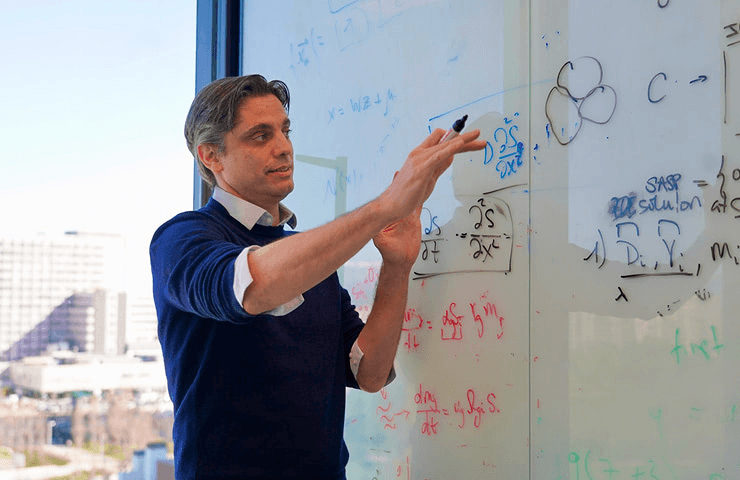
For physics, yes, very clearly. In high school I read Cosmos by Carl Sagan. I still remember closing the book and thinking, “I want to become an astrophysicist.” It was pure wonder - and the feeling that, with a few simple principles and a lot of curiosity, you might actually make sense of the universe.
My interest in biology arrived later. When I was in Amsterdam working on a Master’s thesis in cosmology, I spent many long late-night hours talking with a close friend and roommate who was doing a PhD in biology and collaborating with physicists. Through those conversations, I realized just how complex biology is - and how many fundamental questions are still unanswered. I naively thought it would be fun to uncover the fundamental laws of evolution. At the time, it sounded like a great idea… it turned out to be much more difficult than expected.
Was there a moment in your career when you realized you wanted to focus on biotechnology and health applications?
There was not a single dramatic moment, but a gradual shift: the more I worked on quantitative models of gene regulation and cell-state dynamics, the clearer it became that these questions are not only intellectually beautiful, they are also medically relevant. Once you see how deeply cell identity, proliferation, and reprogramming connect to cancer, regeneration, and aging, it is hard not to want your work have tangible impact. And AI has changed the landscape: we now have the opportunity to turn complex biological data into mechanistic understanding.
What responsibilities do scientists have when developing AI tools for healthcare?
Four words: interpretability, transparency, validation, and humility. Healthcare is not a playground for impressive demos. Models must be understandable enough to trust, transparent about their limitations, checked for bias and unequal performance across populations, and validated rigorously. And humility matters: biology is profoundly complex, and unlike generating text or images, we are still in a data-limited era that even very advanced AI models cannot simply fully resolved.
Many AI systems are described as “black boxes.” Why is transparency especially important when applying AI to biology and healthcare?
Because the cost of being wrong is not abstract. In healthcare, decisions affect real people, and errors can amplify existing inequalities. Transparency lets clinicians and researchers understand why a model makes a prediction, when it might fail, and how it behaves outside the training data.
In biology, transparency also matters for discovery: we don’t just want predictions - we want insight. If the model is a black box, it’s harder to learn mechanisms, generate hypotheses, and build knowledge that others can reproduce and build on.
You’ve worked in research and academia across several European countries, including France, Switzerland, and the UK. How have these different research cultures shaped your perspective as a scientist and educator?
Each place shaped me in a different way. Switzerland taught me a lot about rigor, punctuality, and efficiency but more importnatly that size doesn’t matter: a small country with a clear vision can produce some of the best science in Europe. The UK gave me a sense of momentum: high energy, strong enthusiasm, and an excellent culture of discussion and initiative. France reminded me that a sustainable scientific life matters too. It values work-life balance more than many systems, and I had a lot of fun there doing what I love most: research and supervising talented students.
Scientifically speaking, I feel like I was born in Switzerland, became an adult in the UK, and in France I learned to enjoy the journey.
What advice would you give to students interested in data science and biotechnology today?
Become as strong as you can in the fundamentals: math, statistics, and programming. Those skills will never go out of style, and they’ll let you adapt to any new method or tool. And don’t be intimidated by biology or biotechnology: these fields are booming, they’re full of unsolved problems, and they’re going to keep growing fast. So jump in.
Tell us one personal thing about yourself that none of your students know.
I love chess! And if any student dares to challenge me to a chess duel and actually beats me, I might consider giving them an extra point on the final exam…