
With the aim of encouraging students to reach their full potential in a healthy, competitive environment and to obtain a rigorous information about their performance during the program, IE has established the evaluation system detailed below. Each course will be assessed according to the criteria determined by the professor, which is highlighted in every course syllabus. Professors should reinforce how students will be evaluated during their first session and resolve any doubts students may have.
Upon completion of each subject, the professor awards each student with one of the following five grades: Honors, Excellence, Proficiency, Pass or Fail. Honors, Excellence, Proficiency and Pass qualifications are passing grades, indicating the achievement of the level of knowledge and competencies outlined in the learning objectives. The grade of Fail indicates unsatisfactory performance, prohibiting the student from earning sufficient credits for graduation. Awarding a student a Fail grade is not mandatory but those students who have not achieved the required minimum in accordance with the learning objectives, or who have surpassed the established maximum of absences, will receive a Fail. Passing grades follow a distribution consistent with most used in leading Business schools:
Additional qualifications without a distribution curve:
Professors should follow the grade distribution outlined above. They may, however, make small adjustments in the number of students assigned to each grade (+/- 1 student.)* In addition, professors should provide students, and the Program Management team, with a grade breakdown for all grading components, with the objective of providing meaningful feedback to students.
(*)A major exception could be made only in the case of small classes of 15 students or less (low critical mass of students) where professors can be more flexible. Still, in this special context, professors are also expected to distribute the grades, differentiating student performance as well as providing the breakdown scores that correspond to each evaluation criterion as listed in the syllabus.
Management Skills Workshops and other similar pedagogical activities will be graded as NGS/NGU based on the criteria stipulated by the professor or the Program Director. This grade could have academic implications but will not give any weight to the final GPA.
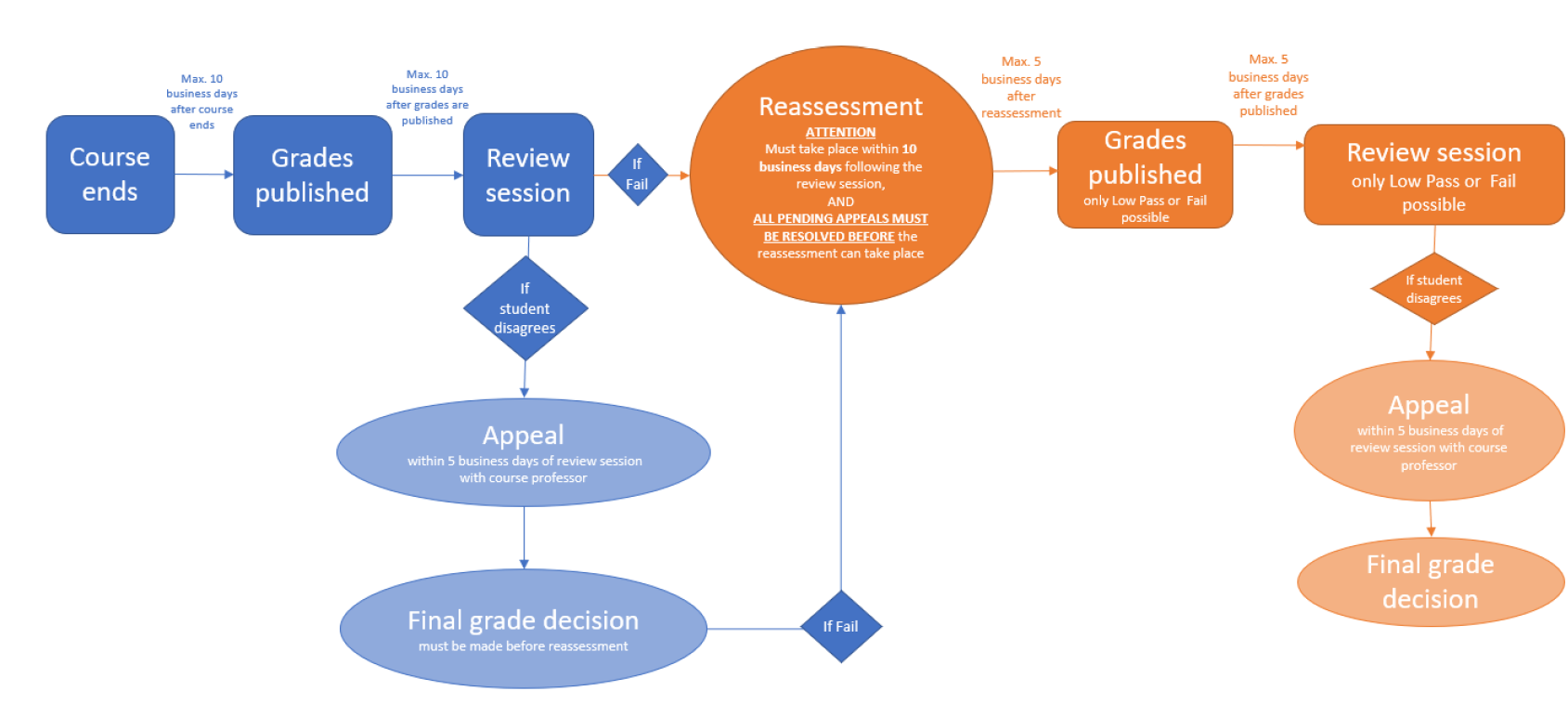
Seldom assigned, this grade represents a failure of achievement and/or commitment that results in the student falling below the minimum standards of the course. When students receive a Fail in a course, they have the opportunity to present themselves for reassessment in order to earn the necessary credits toward graduation. The reassessment, including content and evaluation, is the responsibility of the course professor in agreement with the Academic Director. Grades for the reassessment are limited to a Low Pass and Fail, both of which fall outside of the normal grade distribution. In the case of a Low Pass, the student receives the corresponding academic credit (sessions/weight) associated with the Low Pass grade that carries a grade point of 1.0. In the case of a Fail, the student would be required to leave the MIF Program for failure to meet the academic requirements of the program.
The reassessment exam should take place within the next 10 working days after the date of the review session, giving the student sufficient time to prepare for it and to resolve any appeal that might be in progress.
Students receiving a FAIL in the reassessment of a course will not be able to continue in the program.
As soon as the final grade of a course is published, students will be informed about the date and time of the review session, which will take place via ZOOM (link available in each course on Blackboard). During this review session, students have the right to receive feedback from the professor in order to better understand the rationale behind their evaluation. If during the review session the student is contesting a grade, the professor may review the entire work, not only the assignment in question, and the final grade can be adjusted accordingly (either up or down). If following the review session the student believes there has been an objective error in the evaluation of their performance, he/she may proceed with a formal grade appeal to the Vice Dean of the Program.
It is understood that professors have the right to determine the grading policies for their classes and the expertise to evaluate the student’s performance unless substantive and objective evidence to the contrary is presented. That said, if a student believes that an objective error was made in the evaluation of the final grade of a given course, they may submit an official grade appeal to the Vice Dean of the Program javier.tordable@ie.edu
1. If students disagree with their grade after reviewing it with the professor or if a student receives a Fail at reassessment and disagree after reviewing it with the professor, they may appeal the grade. The appeal must be address to the Vice Dean of the Program within a maximum of 5 business days after attending the review session.
2. Requests must be done by the student in writing, using the “Grade-Appeal-Form”, outlining the specific areas of the work that they feel were incorrectly graded (based on the content of the course syllabus) and explaining why they feel it merits reassessment. Arguments based on subjective opinions of a student, or requests for reassessment by another professor, will not be considered as grounds for reassessment.
3. The Vice Dean of the program, having considered the course professor’s opinion, and the Academic Director’s, should decide whether the appeal is justified and, if so, reassess the contested work.
4. As an exception, in extremely complex cases, the Vice Dean may forward the case to the Vice rector of academic affairs- Antonio.deCastro@ie.edu, who will make the final decision based on the documents provided and after consulting the Vice Dean of the program.
5. The Vice Dean must provide a response to the student outlining the outcome of the appeal and whether the grade has changed. The decision of the Vice Dean is final. There is no option for a third-party appeal to resolve grading disputes.
Below please find the flow chart for how this type of process is managed:
The student can ask for a review of the qualification obtained in the Final Master’s Exam. In the case that the final Master’s exam is group work with individual assessment, the request will have to be made by all the members of the group to the Academic Director javier.tordable@ie.edu, who will provide the feedback.
After receiving feedback, the student/group may request a review session with the Examining Board Secretary. During the review session, if a student/group does not agree with a section of their grade, the Examining Board Secretary may review all their work and adjust the final grade accordingly (either up or down).
If, after the review session, the student/group is not satisfied, they may appeal to the Vice Dean of the Program javier.tordable@ie.edu – within a maximum period of 3 days after the review session – following the steps described in “The Appeal Process” section above.
The arguments that support the appeal must be submitted in writing using the “Grade-Appeal-Form”. If you are considering the submission of a grade appeal, please review the specific requirements and instructions below.
Please note that the judgment made by the Vice Dean is final and that there are no provisions for student appeal to outside parties in resolving grading disputes.
INQUIRY -