- Home
- Civica
- Civica News
- The European Week Forges Long-lasting Connections At Ie University: "this Is What The Civica Spirit Is About"
The European Week forges long-lasting connections at IE University: "This is what the CIVICA spirit is about"

IE University hosted the last edition of the CIVICA European Week to discuss European Competitiveness.
IE University became the host of an event that reunited expert lectures and dozens of students from international universities. The CIVICA European Week is an experience for undergraduate students that takes place annually to foster connections and academic exchange. Universities like Bocconi, Sciences Po or the London School of Economics (LSE), Ukrainian partner universities and high school students partook in its latest edition at IE University. From the 22nd up to the 26th of June, IE University has challenged students to create a communication campaign directed towards European citizens that fosters European Competitiveness.
Catherine De Vries, Vice Dean of IE School of Politics, Economics & Global Affairs, and head of the Political Science Area; Odysseas Konstantinakos, Research Fellow at the IE Competitiveness Hub in Brussels and a PhD candidate in Political Economy at the European University Institute; Tullio Ambrosone, Coordinator of the IE Competitiveness Hub and Director of Arel Single Market Lab; Gemma Bedia, Senior Climate Change Project Manager at alinnea (the climate action think tank based at IE University); Asier Hernando, former Regional Director for Latin America at Oxfam and professor at IE University; Francesc Martinez Bailac, Alternative Investments Director at Orilla Asset Management and former Director in Telefonica Group; and Laurence Romani, Director of the Center for Responsible Leadership, and professor from at the Stockholm School of Economics, were the lecturers of this event.
All experts provided a multi-faceted immersion into European Competitiveness, encompassing the political, cultural, economic and research scopes that students incorporated into their final projects. Some highlights of the lectures included the interventions of the Vice Dean of IE School of Politics, Economics and Global Affairs and that of the Director and Coordinator of the IE Competitiveness Hub in Brussels. De Vries provided a lecture on the question of how "the advantage of the EU is the scale; there is a stronger bargaining power, less of a coordination problem", further approaching the functioning of European representative democracy. Konstantinakos and Ambrosone provided a research analysis to this approach, pushing for the establishment of the Fifth Freedom to foster academic exchange and for the strengthening of the European Internal Market. "It is not a problem of scale, but of having twenty-seven states to coordinate", they explained.
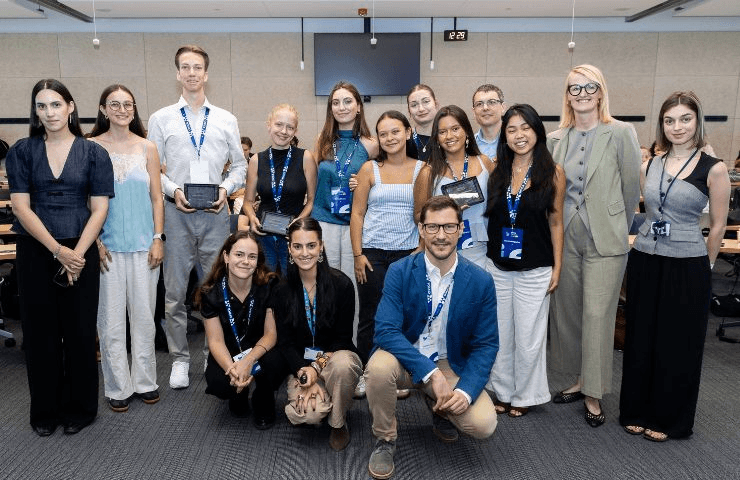
Additionally, other experts like Francesc Martínez explained the importance of being European to create business relations, explaining that "Europea is a style, it’s how we interact with companies". Alternatively, Gemma Bedia presented alinnea, the thinktank based at IE University, where they work "to accelerate the transition towards a more sustainable economy", acting upon sustainable cities, the green industry and water management, among other topics. Finally, Asier Fernando and Laurence Romani were key in the formation behind the students’ competition. The winning team presented a political communication campaign focused on giving candidate countries binding checkpoints and was integrated by IE University’s CIVICA ambassador, Oleksandr Mysyk. As he explains: "When my team and I started working on the project for CIVICA European Week 2026, we kept coming back to one frustration: Europe talks endlessly about enlargement as a value, but treats it as an afterthought in practice." His testimony represents that of the rest of participants: "Presenting that argument in front of peers from across CIVICA universities, and having it resonate enough to win, was genuinely one of the highlights of my time at IE. It reminded me why I got into this field in the first place: not just to study how institutions work, but to push, however modestly, for them to work better."
When further asked about their experience at IE University, students underlined the enjoyment of the activities performed during the European Week, which included a visit to the European Commission Office in Spain and the discovery of life in Madrid; the importance of learning more about the functioning of the European Union and, most importantly, the number of connections achieved in the scope of a week. Konstantinakos and Ambrosone exemplify the relevance of this event at IE University. As they explain: "This is what the CIVICA spirit is about: not only about being in a class but about forging friendships".