Global Leaders Convene within IE A&D’s International Committee to Advance the Future of Design Education

The 2025 plenary provided insights and proposals to further strengthen the School’s academic programs, research initiatives, and international reach.
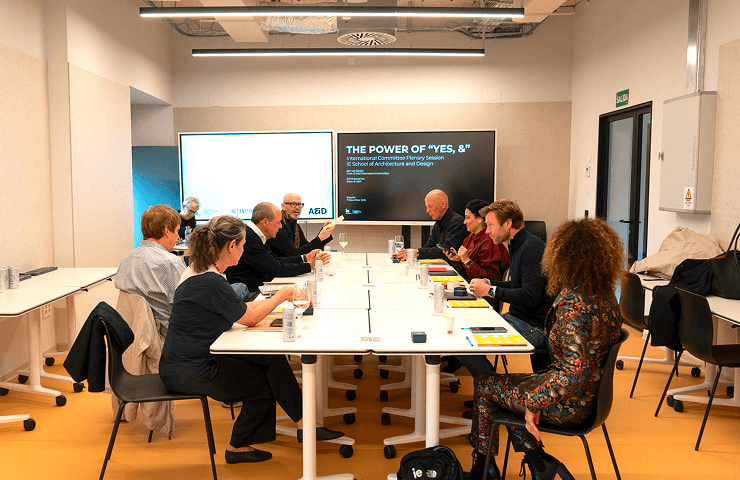
Madrid, 21 November 2025 – IE School of Architecture&Design brought together global leaders from architecture, design, real estate, culture, and technology for the Annual Meeting of its International Committee. The event, held on IE University’s campuses in Madrid and Segovia, served to assess the School’s strategy and drive its continued growth. Discussions focused on impactful research and the evolution of design education, exploring key topics such as interdisciplinarity, experiential learning, AI, and the value of strategic partnerships.
Chaired by Ben van Berkel, Founder and Principal Architect of UNS, the International Committee is composed of David Goodman, Dean of IE A&D; H.E. Sheikha Reem Al-Thani, Acting Deputy CEO of Exhibitions & Marketing and Director of Central Exhibitions at Qatar Museums; Clotilde Entrecanales, Global Director at Acciona Cultura; Hugh Forrest, independent consultant and former Co-President & Chief Programming Officer at SXSW; Nils Kok, Professor of Real Estate Finance and Director at Maastricht Center for Real Estate; Aref Lahham, CEO and Co-Founding Partner at Orion Capital Managers; Manuela Lucà-Dazio, Executive Director of The Pritzker Architecture Prize; Lucia Tahan, architect and software designer; and Lisette Van Doorn, Chief Executive Officer of ULI Europe.
Together, the Committee members offer diverse perspectives on the opportunities and challenges shaping the built environment and creative industries. Their shared vision supports the School’s mission to harness creativity and design as drivers of sustainability, equity, and beauty, an approach that requires dialogue across disciplines, sectors, and cultures.
Committee members provided insights and proposals to further strengthen the School’s academic programs, research initiatives, and international reach. Discussions addressed themes such as climate resilience, the role of cities as learning ecosystems, emerging professional practices, the integration of AI and new technologies, and the value of strategic partnerships.
A model for shared learning
Following the initial session at IE Tower in Madrid, where members met with IE University’s leadership, the plenary continued at the IE Creative Campus in Segovia. There, participants explored the School’s design, fabrication, and innovation labs, engaging in discussions on how evolving educational paradigms and the rise of AI call for renewed forms of collaborative, experiential learning.
"The School’s response is to build shared life experiences through the IE Creative Campus, immersive modules in part-time programs, global travel opportunities, and a strong extracurricular culture," said Dean Goodman. The Committee endorsed this model, underscoring that creativity flourishes through community, cooperation, and collective making.
With generative AI fully integrated into coursework and internal processes, the Committee examined how design education must continue to evolve. "Generative AI is a catalyst for design education. It expands our creative possibilities and challenges us to rethink how we teach, learn, and imagine," added Dean Goodman.
Interdisciplinary education
Dean Goodman’s presentation, "The Power of Yes, &", framed a conversation on interdisciplinarity, calling for a mindset that embraces the dualities central to contemporary design: creativity and responsibility, autonomy and engagement, culture and entrepreneurship, tradition and innovation.
"Our work is guided by the belief that design thrives at the intersection of disciplines. The future of architecture and design is a ‘Yes, &’ future, one that connects creativity, entrepreneurship, technology, and social responsibility," he emphasized.
This philosophy drives the School’s expansion across architecture, real estate, interior design, product design, fashion, graphic design, and immersive environments—fields increasingly linked to business, innovation, and technology.
Research and impact
A core focus of the plenary was the School’s research agenda, which spans social engagement through design, hybrid material cultures, technological innovation, entrepreneurship in the creative industries, and urban transformation. "Our research is grounded in impact," said Dean Goodman. "We contribute to policy, community engagement, regenerative materials, circular and low-carbon design, and new modes of collaboration with communities, NGOs, artisans, and industry."
The Committee reaffirmed the importance of combining academic rigor with societal relevance, recognizing the School’s growing influence in shaping societal change. Members emphasized that integrating research, practice, and collaboration is essential to cultivating a research ecosystem that connects academia with policy, industry, and community life.