IE School of Architecture & Design and EY Studio+ Lead Debate on AI and Immersive Technologies as Strategic Drivers of Business Transformation

The School’s new Master in Design of Immersive Experiences & XR will equip leaders to address challenges at the intersection of AI, immersive technologies, business strategy, and design.
Madrid, 16 March 2026 - IE School of Architecture & Design and EY Studio+ led a debate at IE University’s campus in Madrid on the role of AI and immersive technologies as strategic drivers of business transformation, competitive advantage and long-term value creation across industries.
Cristina Mateo, Associate Dean of IE School of Architecture & Design, addressed how the convergence of AI and immersive technologies positions virtual, augmented and mixed realities as strategic assets for organizations. Mateo explained that what was once linked primarily to experimentation now has direct implications for how companies design experiences, make decisions and create long-term value.
Mateo underlined that the School's new Master in Design of Immersive Experiences & XR, set to start in September 2026, will equip leaders to address challenges at the intersection of AI, immersive technologies, business strategy and human-centered design across industries such as real estate, hospitality, entertainment, retail and education. "Our goal is to shape the talent and leadership profiles that will define this transformation," said the Associate Dean.
A full-time, 10-month program based in Madrid, the master will prepare professionals to design and develop immersive experiences across both physical and digital environments. The curriculum combines design methodologies, spatial storytelling and emerging technologies, exploring topics such as spatial computing, extended reality (XR), interactive environments and artificial intelligence. Through hands-on projects, industry collaborations and access to IE University’s innovation ecosystem, students will work on real-world applications of immersive technologies across sectors including culture, retail, hospitality, entertainment, education and urban environments.
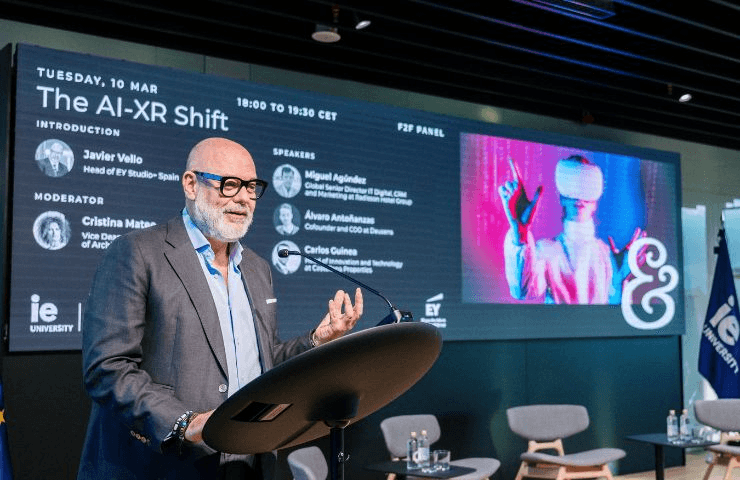
Javier Vello, Partner at EY and Head of EY Studio+, examined the factors driving the adoption of AI and immersive technologies across industries. Vello noted that while the human desire to create atmosphere, emotion and collective experience is longstanding, the current business context has shifted these technologies into a new phase of maturity.
He pointed to three factors accelerating adoption today: the speed and lower cost of AI-generated content, more accessible XR hardware, and growing demand for use cases in design and prototyping, training and safety, operations and maintenance, customer engagement and productivity. According to Vello, companies are increasingly looking not only for innovation, but for clarity, confidence, credible partners and responsible frameworks that connect technology with design, ethics and business value.
The roundtable brought together Miguel Agúndez, Senior Director IT, Digital, Leading Platforms, CRM, Marketing Technology and Sales Enabling at Radisson Hotel Group; Carlos Guinea, Chief Innovation and Technology Officer at Castellana Properties; and Álvaro Antoñanzas, Co-founder and COO of immersive technology studio DeuSens and faculty member in the new master’s program.
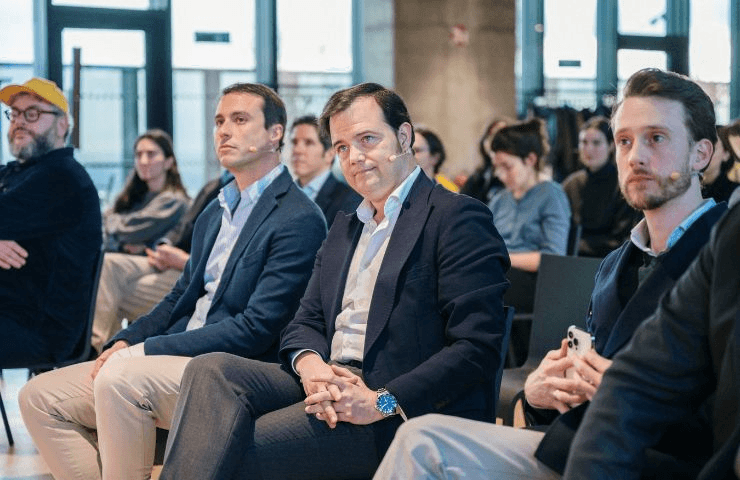
A shared theme emerged: immersive technologies are no longer seen only as marketing experiments or isolated pilots. In hospitality, Miguel Agúndez described how digital and immersive content is being integrated into customer journeys and commercial operations. He explained that for Radisson, tools such as navigable floor maps, meeting-room exploration and room-selection functionalities are becoming relevant not only from an experience perspective, but also as potential revenue generators. The challenge, he noted, lies in demonstrating clear business cases to leadership teams and connecting immersive experiences with wider digital ecosystems such as CRM, loyalty and marketing platforms.
From the real estate and retail perspective, Carlos Guinea emphasized the operational and commercial value of immersive tools. Digital twins and virtual simulations can help organizations test decisions before committing significant investment, while virtual tours make it possible to present multiple commercial spaces remotely and efficiently. He also stressed that future growth will depend both on customer demand and on the infrastructure required to support these experiences at scale.
Drawing on more than a decade of experience in immersive design, Álvaro Antoñanzas reflected on how the market has evolved. What was once often perceived as a "crazy" innovation or a short-term trend is now being considered more seriously as part of core business strategy. He highlighted training as one of the most significant growth areas, citing large-scale projects such as VR-based training environments for airport personnel, where immersive technologies can provide realistic, safe and scalable learning experiences that would be difficult to reproduce physically.
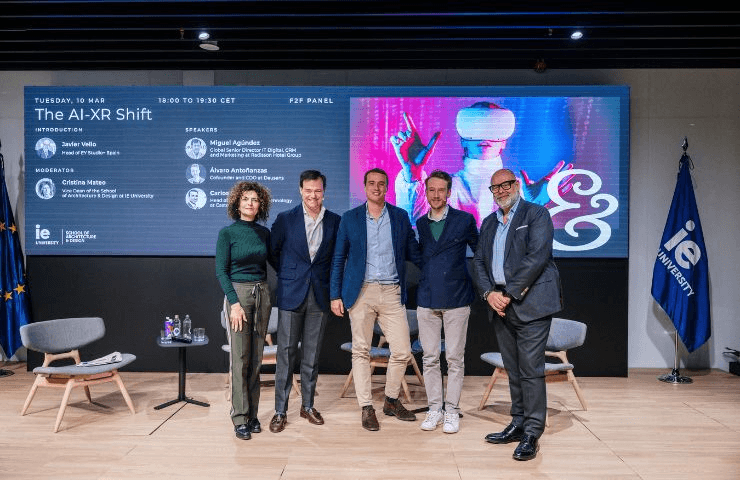
The discussion also identified talent as one of the sector’s major challenges. The profiles most in demand are those able to combine creativity, visual and spatial thinking, programming, systems integration, and business acumen. This need for multidisciplinary talent strongly echoed the rationale behind the School’s new master’s program and its emphasis on collaboration across design, technology, and strategy.
Speakers pointed to the role of AI in reducing production costs, accelerating the creation of immersive content, and enabling new applications such as virtual agents, intelligent avatars, and advanced 3D capture techniques. Rather than replacing immersive technologies, AI was described as the force that may finally make them scalable, more relevant, and more deeply embedded in everyday business operations.