IE School of Architecture and Design Inaugurates Master in Interior Design with a Global First Cohort

Liam Aldous, Monocle correspondent and ColourFeel founder, delivered a keynote on architectural storytelling and experience design.
Madrid, 6 October 2025 – IE University’s School of Architecture and Design has launched the first edition of its Master in Interior Design. Comprising 97% international students representing 17 nationalities, the program exemplifies the School’s global outlook. This diversity reinforces the program’s commitment to rethinking interior design, with a focus on how spatial environments shape human experience and contribute to positive change in society.
At the opening event, Dean David Goodman emphasized the School of Architecture and Design's entrepreneurial and international character, shared across disciplines from architecture to fashion to real estate. The school’s philosophy, he explained, is about embracing the conditions of the world while contributing to transform them: "We say yes to tradition, and always add something new."
Building on this vision, Academic Director and designer Andrea Caruso highlighted the program’s goal to move decisively beyond surface beautification toward a holistic and transdisciplinary approach. Rooted in human connection and unconventional learning, the Master in Interior Design focuses on how people truly live within spaces and how design can shape society: "We intend to look not just at how to make spaces look good, but at what unfolds within them."
An intensive 10-month, in-person program on IE University’s Madrid campus, the Master in Interior Design is driven by sustainability, craft, and entrepreneurship. It shapes participants for careers in residential and commercial interior design, hospitality, retail, healthcare, exhibition and event design, and furniture and set design. Students are encouraged to experiment across disciplines - including art, dance, film, photography, graphic design, social media, and communication - developing into leaders who prioritize human experience and embrace a post-human ecosystem that fosters harmony among humans, plants, and animals.
The program’s faculty includes practitioners such as Miguel Leiro, Spain's National Design Prize 2025; Rocío Pina of Enorme Studio, designers of Spain’s Pavilion at Expo 2025 Osaka; and Jorge Valiente Oriol and Amaya Sánchez Velasco of Grandeza, winners of the Golden Bee Award for Best International Contribution at the XXII Triennale di Milano.
Lessons for Future Designers
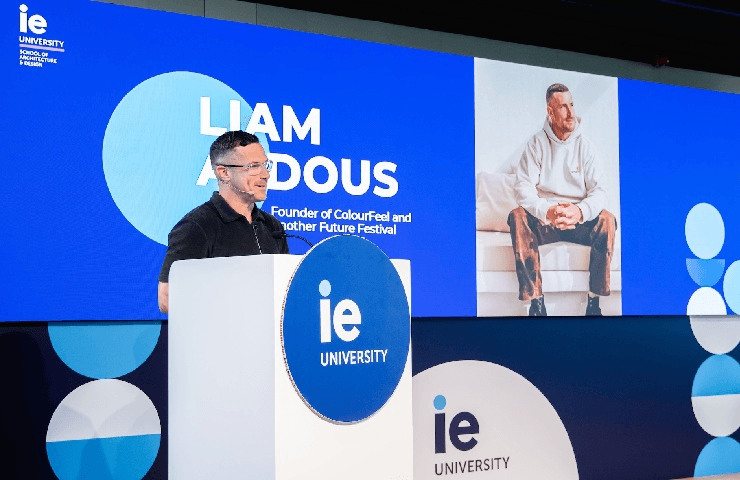
Aldous's talk at IE University focused on a series of architectural stories that offered broader lessons for young designers. He referred to Fernando Higueras's work, whose career embodied both the compromises and the rebellions of design under Spain’s Franco authoritarian regime. His Edificio Princesa, a concrete "vertical forest", commissioned to house retired generals, had a reputation as a fortress of the old order. Yet Aldous found signs of change inside and documented a generational shift among its residents. For Aldous, Higueras's career illustrates an important lesson: sometimes change must come from within the system, even if that system is flawed.
Another example was Antonio Cortés Ferrando’s Espai Verde in Valencia, a radical 1980s experiment in vertical living with features ahead of its time: integrated home offices, broadband-ready ducts, and communal gardens. Yet Ferrando’s self-made utopia risked sliding into a "god complex." For Aldous, this highlighted the need for humility: ambition must be balanced with perspective.
The story of Tbilisi’s Stamba Hotel carried a different message. Once a Soviet publishing house, it was transformed by a "benevolent billionaire" who, after listening to a local artist’s advice, rejected a major hotel chain deal. Instead, he shaped the site into a hotel that also serves as an "embassy of Georgian culture" and an incubator for creativity. The lesson here was that the human spark should be trusted, because it is spirit and intuition - not machines or corporations - that fuel cultural change.
He also revisited Le Corbusier’s Radiant City in Marseille. Completed in 1952 as a "vertical city" to restore order after the war, it still embodies the idea of architecture as a vessel for collective life. Guests staying in its in-house hotel are made honorary residents, free to share in the community’s spaces, including its rooftop. For Aldous, the visit underscored the necessity of designing beyond the present moment: architects must imagine the impact of their choices decades, even centuries, into the future, and remain conscious that their choices shape generations.
Finally, Aldous recounted the story of La Medina in Ibiza, a cluster of overgrown buildings once owned by a photographer who withdrew from society and later gifted the property to a young artist who, unlike others, recognized beauty in its chaos. Aldous helped revive the site as a secret artist residency. Yet history repeated itself: the new owner eventually retreated into isolation, and the dream of a creative hub dissolved. For Aldous, the story carried a clear lesson: places that inspire can also entrap. Designers must resist being dazzled by promise and remain mindful of realities and red flags. In the end, he concluded, they are often defined less by the projects they take on than by the ones they wisely refuse.
Across these stories, Aldous urged students to trust their intuition, stay curious and creative, resist the pressure to conform, and design with a long-term vision that considers the impact of their work for generations to come. Ultimately, he argued, great design stems not only from skill but from imagination, humility, and the courage to chart new universes while staying grounded on earth.