IE University Professor Grazielle Bruscato Receives the 2026 Emerging Scholar Award at Sapienza University of Rome

Bruscato has been honored at the Design Principles & Practices Conference 2026 in Rome for her research on design education, critical thinking, and experimental pedagogies.
Madrid, 23 March 2026 - Grazielle Bruscato Portella, Assistant Professor and researcher at IE School of Architecture & Design, has been recognized with the 2026 Emerging Scholar Award at the International Conference on Design Principles & Practices 2026, held at Sapienza University of Rome. Organized by the Design Principles & Practices Research Network, the conference brought together scholars and practitioners from around the world to explore the theme "Design Across Time."
The Emerging Scholar Award is granted to selected early-career researchers for their talent and contributions to the conference themes. Awardees also contribute actively to the event by chairing sessions, supporting technical coordination, and presenting their research.
"As a migrant, this award is especially meaningful to me as I carry a sensitivity to cultural difference and a commitment to amplifying voices often unheard", said Professor Bruscato. "The conference theme, Design Across Time, provides a timely frame for my work, but also for a question I carry forward: How can we, as educators and researchers, cultivate plural epistemologies and ontologies that do not simply expand the field, but transform how it is held and who it serves", added the awardee.
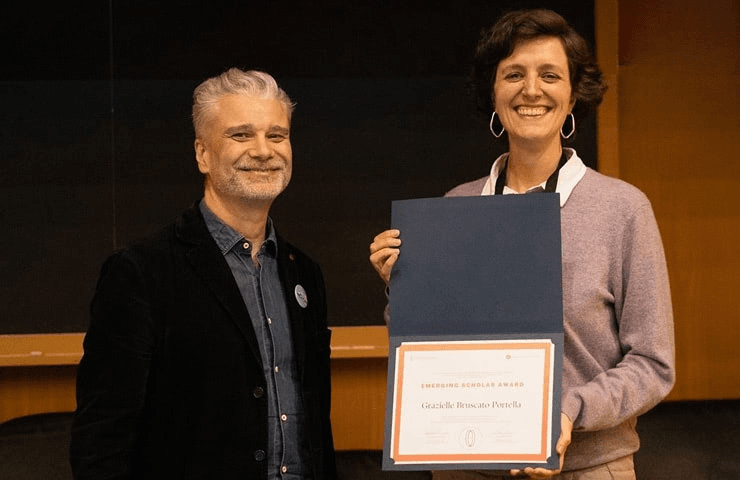 Lorenzo Imbesi, Design Director at Sapienza University of Rome, presents the 2026 Emerging Scholar Award to Professor Grazielle Bruscato.
At the conference, Professor Bruscato presented a working abstract from her ongoing research project titled “Making the Familiar Strange: Slow Looking, Counterfactual Thinking and Ontological Difference in Design Research.” The study proposes an alternative approach to design education grounded in practices of slow observation, speculative thinking, and embodied experimentation.
Bruscato's research is based on a pedagogical exercise developed with IE University undergraduate design students, encouraging them to examine everyday objects through altered perspectives. Working with common artifacts - such as a hockey glove, a cross, or a pincushion - students explore alternative histories, meanings, and uses through methods including drawing, role-play, video production, theater, and generative AI tools.
"This research explores how design education can move beyond purely functional or solution-driven models. Considering how research and practice are deeply interconnected processes, the aim of the project was to cultivate interest in how these relationships are established, giving special focus on critical reflection alongside experimentation, imagination and playfulness", explained Professor Bruscato.
Through these multimodal processes, the classroom becomes a space for critical reflection and “worldmaking,” enabling students to question dominant assumptions in design and bring forward perspectives that are often overlooked. The resulting projects take the form of performative and narrative explorations that challenge conventional design norms related to speed, productivity, and gendered labor. The study argues that such pedagogical approaches can broaden the epistemic horizons of design education, equipping students with tools to engage with reality in more critical, ethical, and imaginative ways.
"Many students describe a fundamental change in how they approach design after this exercise: becoming more aware of how objects embody cultural, affective, symbolic and temporal meanings, and how even the most ordinary artifact can become extraordinarily rich if you spend enough time with it. As a result, students can be capable of approaching everyday objects not as neutral tools, but as active participants in meaning-making processes, capable of reflecting broader narratives about technology, memory, and human behavior", added Professor Bruscato.
Launched in 2007 with its inaugural conference at Imperial College London, the Design Principles & Practices Research Network has grown into a global community of scholars, practitioners, educators, and researchers exploring the foundations, methods, and social contexts of design. The 2026 edition of the annual conference, marking the twentieth anniversary of the series, was hosted by Sapienza University of Rome and gathered scholars and practitioners from across the globe. It included keynote speakers Lorenza Baroncelli, Antonio Scarponi, and Diletta Huyskes, continuing the conference’s tradition as a forum for critical reflection on the evolving meaning and practice of design.