IE University Researcher and Professor Laura Martínez de Guereñu Publishes "Lilly Reich in Barcelona: The Materialization of a Neglected Authorship"

The book, supported by IE School of Architecture and Design, sheds light on the overlooked contributions of pioneering designer Lilly Reich.
Madrid, 17 October 2025 - IE School of Architecture and Design professor and researcher Laura Martínez de Guereñu has published a new book titled "Lilly Reich in Barcelona: The Materialization of a Neglected Authorship". The volume brings to light previously unpublished research and documents, offering a new understanding of Lilly Reich’s authorship and her creative partnership with Ludwig Mies van der Rohe.
Published by the Fundació Mies van der Rohe, with the collaboration of IE School of Architecture and Design, the Spanish Ministry of Housing and Urban Agenda, the Museum of Fine Arts of Bilbao, Estudios Durero, and the Embassy of the Federal Republic of Germany in Madrid, as well as with the support of the Alexander von Humboldt Stiftung, this publication builds upon Martínez de Guereñu’s groundbreaking research, which earned her the first Lilly Reich Grant for Equality in Architecture in 2018. Thanks to the cooperation of the Mies van der Rohe Archive at the Museum of Modern Art in New York (MoMA), the book also reveals dozens of previously unknown plans and photographs.
Before the book’s release, Martínez de Guereñu's research had already inspired the artistic intervention Re-enactment: Lilly Reichs Work Occupies the Barcelona Pavilion (2020) and the article "German Pavilion/German Exhibits: An Almost Forgotten Episode in the History of Modern Architecture", published in the journal Grey Room (2021).
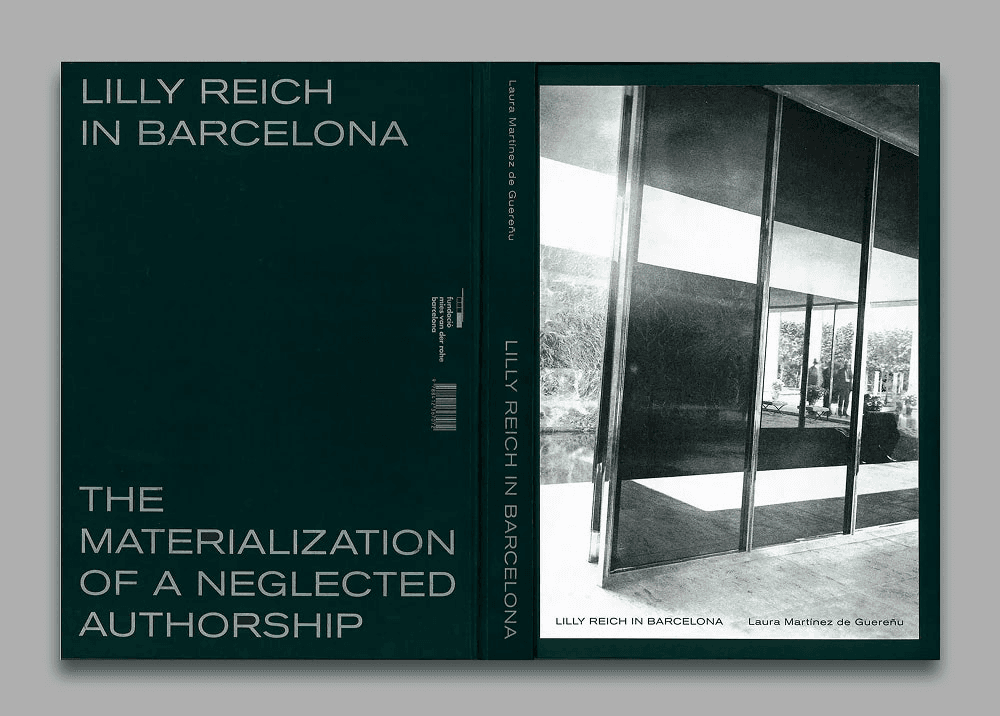
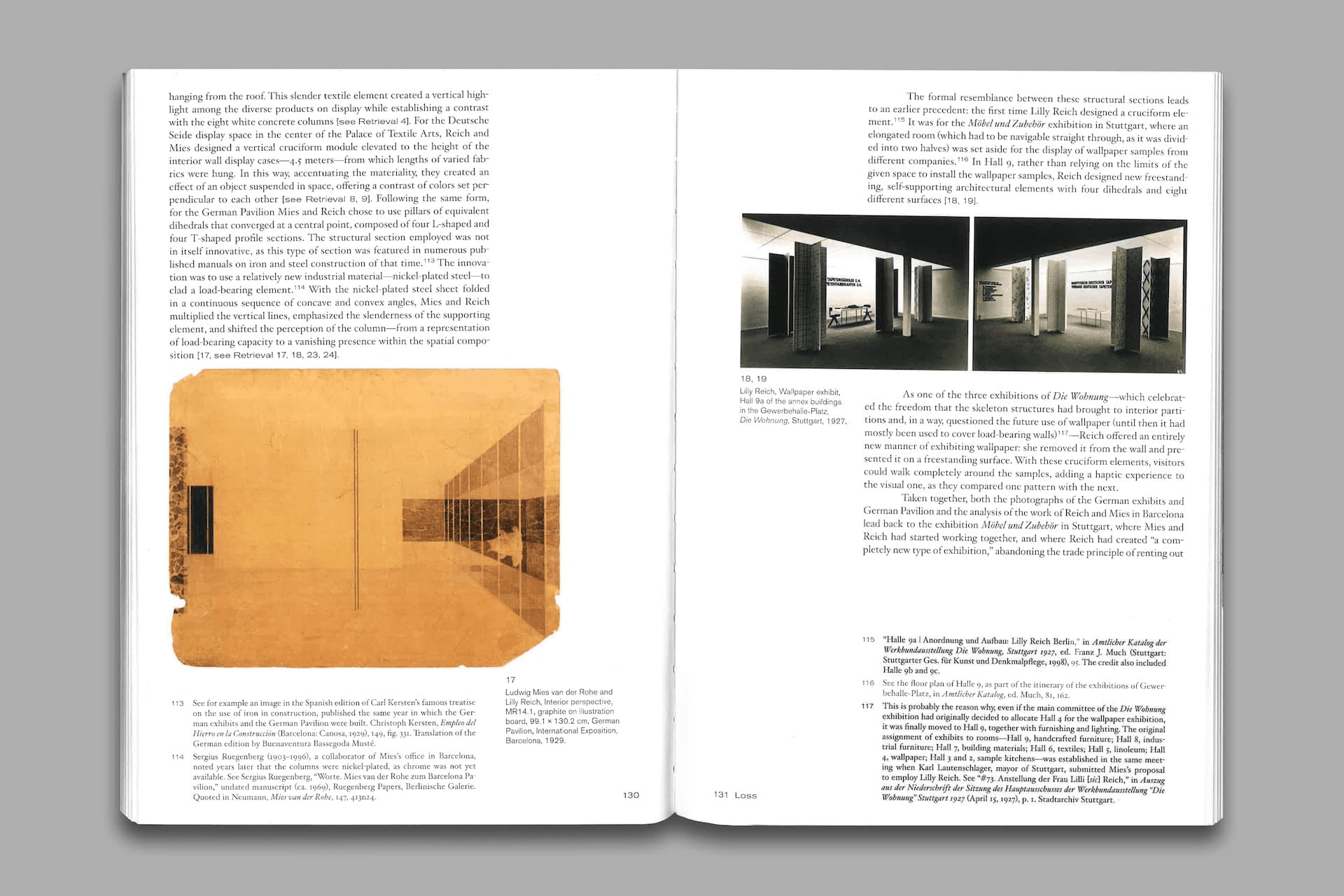
In order to gain an in-depth understanding of the collaboration between Reich and Mies, the book traces a journey through the works that both built in creative tandem, from the renowned Glass Room in Die Wohnung exhibition in Stuttgart to the Velvet and Silk Café in Women's Fashion display in Berlin (both in 1927), culminating in their masterpiece for the 1929 Barcelona International Exposition- the German Pavilion - now known as the Mies van der Rohe Pavilion. It also explores the work that Reich developed in Berlin, Frankfurt and Stuttgart before partnering with Mies, in order to identify her contributions to the collaboration in Barcelona.
The analysis is structured through three lenses. The first, Disregard, examines - through meeting minutes, correspondence, and archival materials - how Mies accepted the commission for the German Pavilion on the condition of developing it jointly with Reich, while Reich’s role was ultimately downplayed. "Mies accepted the commission but only under the condition that he could carry it out together with Reich and, at the same time, the figure of Reich was relegated and treated with indifference despite her involvement", states Martínez de Guereñu.
The second, Erasure, offers a counter-narrative to a supposed division of tasks between the design of the pavilion and that of the exhibitions, between Mies and Reich, which Reich herself never had the chance to contest. Finally, Loss, addresses the disappearance of key documents during World War II and the subsequent reconstruction of the pavilion’s archive and legacy. Reich died shortly after the end of the war, after cataloguing, packing, and safeguarding from the bombings of Berlin the legacy of her former partner, who had emigrated to America. This task secured the critical fortune of Mies's individual and shared work in Europe, but, unfortunately, not of her own.
The book’s detailed analysis of both individual and collaborative projects reveals the essential role Lilly Reich played in shaping key features of modern architecture. Her partnership with Mies opened doors to major exhibition projects where she could fully express her creative sensibility - yet the same collaboration ultimately obscured the recognition of her work.
Following its launch by the Fundació Mies van der Rohe in Barcelona, "Lilly Reich in Barcelona" has been presented as part of the Mugak International Biennial of Architecture 2025 at the Basque Institute of Architecture (EAI-IAE) in Donostia–San Sebastián and at the Fine Arts Museum of Bilbao, with additional presentations planned in Madrid and other cities to be announced soon.
Laura Martínez de Guereñu Elorza is an award-winning architect and tenured professor at IE School of Architecture and Design. Her research explores the professional collaboration between Lilly Reich and Ludwig Mies van der Rohe, aiming to uncover the dynamics of shared authorship in the creative process. The result of over a decade of working on this subject, brings together evidence from more than fifty archives worldwide. Drawing primarily on German and American sources, her work has been presented at international conferences and published in academic journals and other media in several languages. She has edited the monographic journal Who Designs Architecture? and contributed to the podcast Collaboration and Architecture, with the episode The Barcelona Pavilion.
*Cover photograph©courtesy Fine Arts Museum of Bilbao. All other photographs ©courtesy Fundació Mies