IE University Student and Saudi Fashion Commission Designer Exhibit a Joint Creation at Ithra

A cross-cultural design developed by Claudia Martínez Larive and Maha Alqahtani under the guidance of João Turri connects Spanish and Saudi ritual dress through craft and technology.
Madrid, 17 March 2026 - Claudia Martínez Larive, a second-year student in the Bachelor in Fashion Design & Bachelor in Business Administration at IE School of Architecture & Design, and Maha Alqahtani, a designer selected by the Saudi Fashion Commission, exhibited a jointly designed garment at the King Abdulaziz Center for World Culture (Ithra). The collaboration, bringing together Spanish and Saudi cultural references into a single piece, was supervised by IE University faculty member João Turri.
This initiative was made possible through the strategic support of Proaltus Capital Partners, in the context of its ongoing collaboration with IE School of Architecture & Design, and together with the Fashion Commission, the governmental body supporting the development of the fashion sector in Saudi Arabia. The project formed part of "Threads of España: Fashion Across the Regions", one of the exhibitions within "Spain Cultural Days", which showcased the richness of Spanish heritage and contemporary creativity. The event was conceived by Mediapro Events and held in January 2026 at Ithra.
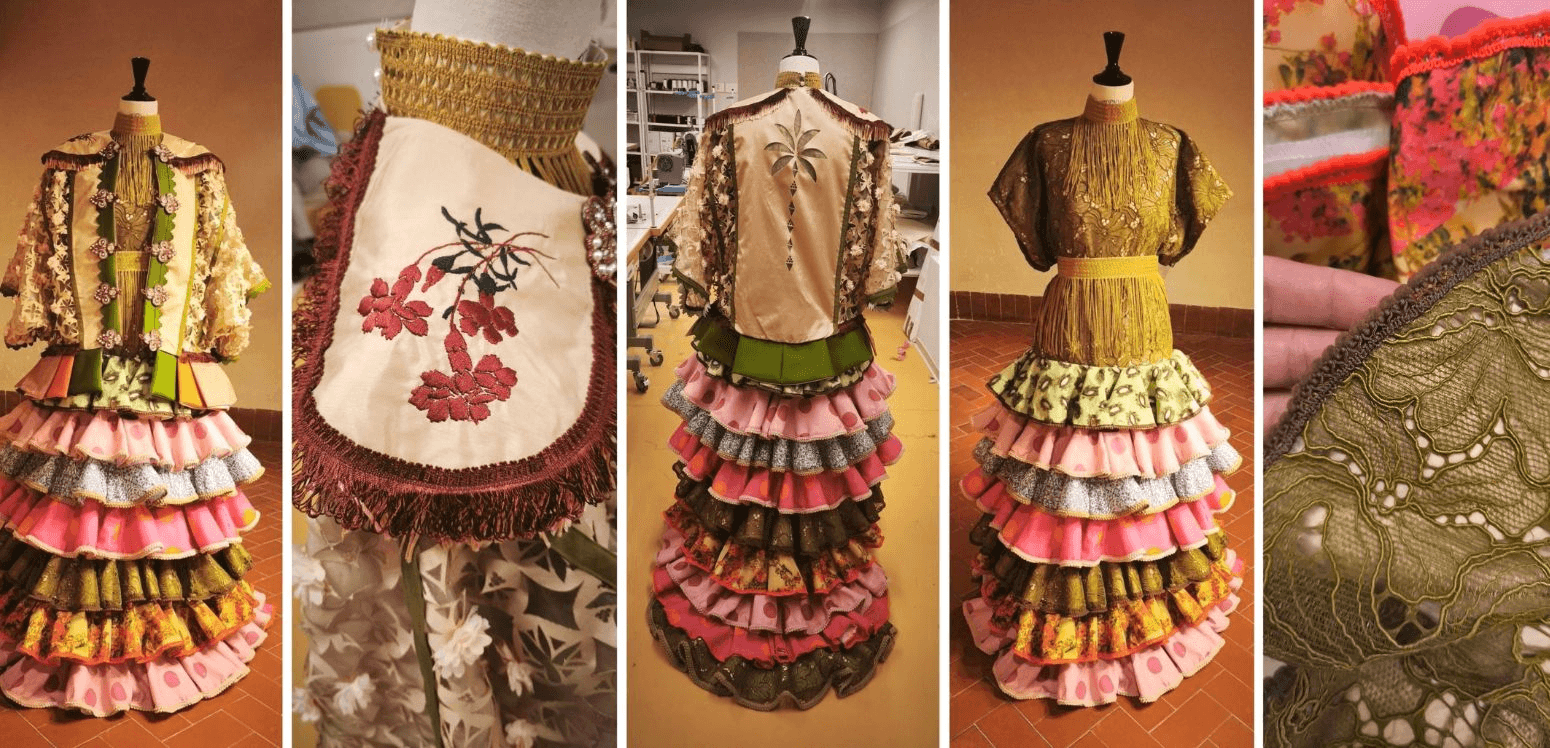
Designing through dialogue rather than merging aesthetic codes superficially, the project was conceived as an exchange between two traditions of ceremonial dress.
From the Spanish side, Claudia Martínez Larive’s research translated Andalusian references into spatial and kinetic principles. The expressive volume of the flamenco dress informed a silhouette that reacts to the body in motion. The fan introduced a logic of modularity and unfolding in the relationship between layers and panels. The torero jacket contributed the idea of ornamental structure, where decoration is inseparable from construction. Together, these references shaped a design language centered on movement, layering, and performative presence rather than stylistic quotation
From the Saudi side, Maha Alqahtani’s proposal operates through precision, symbolism, and surface articulation. The garment preserves the wide, ceremonial proportions of traditional Saudi dress while introducing a contemporary ornamental system based on repeatable geometric motifs. These motifs were laser-cut and engraved, then applied as textile appliqué, transforming heritage patterns into digitally fabricated elements. Trims, plackets, and sleeves become zones where craft meets technology and where ornament defines structure. The pattern-making logic follows a modular construction that reveals a rational, almost architectural assembly.
"At the beginning, I was really nervous because it’s a culture I had never experienced. But now that I’m here and I see everyone smile when they see the dress, it makes me very happy and very grateful to be able to share this experience with Maha", said Claudia Martínez Larive.
"Events like this are very important for us to share our culture and heritage with other cultures and to create an open dialogue between them, strengthening our heritage in a contemporary way while preserving its authenticity", added Maha Alqahtani.
The result is a piece that maintains the ceremonial presence of both traditions while being unmistakably contemporary in its fabrication and design logic. Exhibited during Ithra’s Spain Cultural Days which transformed the entire cultural complex into an immersive celebration of Spanish culture and attracted more than 350,000 visitors, the garment formed part of a broader program of performances, exhibitions, workshops, and installations. In this context, it stood as a material demonstration of how design education can operate as cultural mediation, translating heritage into contemporary language through collaboration, research, and making.