Raymond Johansen, Former Mayor of Oslo, Addresses Climate Governance and Zero-Emission Urban Challenges at IE School of Architecture & Design

Johansen explained how climate budgeting and strategic procurement reshaped urban governance and advanced zero-emission construction policies in the Norwegian capital.
Madrid, 24 February 2026 - IE School of Architecture & Design welcomed Raymond Johansen, former Mayor of Oslo from 2015 to 2023 and current Secretary General of Norwegian People’s Aid, for a lecture examining how cities can translate climate ambition into concrete urban transformation. The session took place at IE Tower, the technological and sustainable campus of IE University in Madrid, and formed part of the School’s lecture series RE_SOLUTION. Jerónimo van Schendel, architect and Academic Director of IE School of Architecture & Design’s Master in Business for Architecture and Design, moderated the conversation and addressed the implications of urban governance for built environment professionals.
Johansen contextualized his tenure within the political and economic climate of 2015, when growing public concern about climate change, youth mobilization, and cross-party environmental commitments created space for structural reform at the municipal level. He explained how Oslo positioned itself as both "small enough and large enough to be a testbed," seeking to pilot solutions that could later be adopted by other cities. His administration focused on measurable, local instruments capable of influencing tangible outcomes in mobility, waste management, and construction.
The Oslo Climate Budget
His lecture focused on the integration of environmental goals into the core mechanisms of municipal governance, particularly the introduction during his mandate of the Oslo Climate Budget, an innovative system at the time designed to align emissions reductions with financial planning and political accountability. "We count CO₂ emissions in the same way as we count money," said Johansen. By placing the climate budget within the Department of Finance and linking it to existing management structures, Oslo transformed climate commitments into administrative obligations that required measurable results.
Johansen described how this framework shifted climate policy from a symbolic commitment to a tool of governance. Each municipal department became responsible for implementing and reporting on its own emission-reduction measures, creating transparency and internal accountability. According to Johansen, this approach allowed the city to track progress toward its target of substantial emissions reductions by 2030, while identifying gaps and adjusting policies annually through the budget cycle.
Strategic Public Procurement
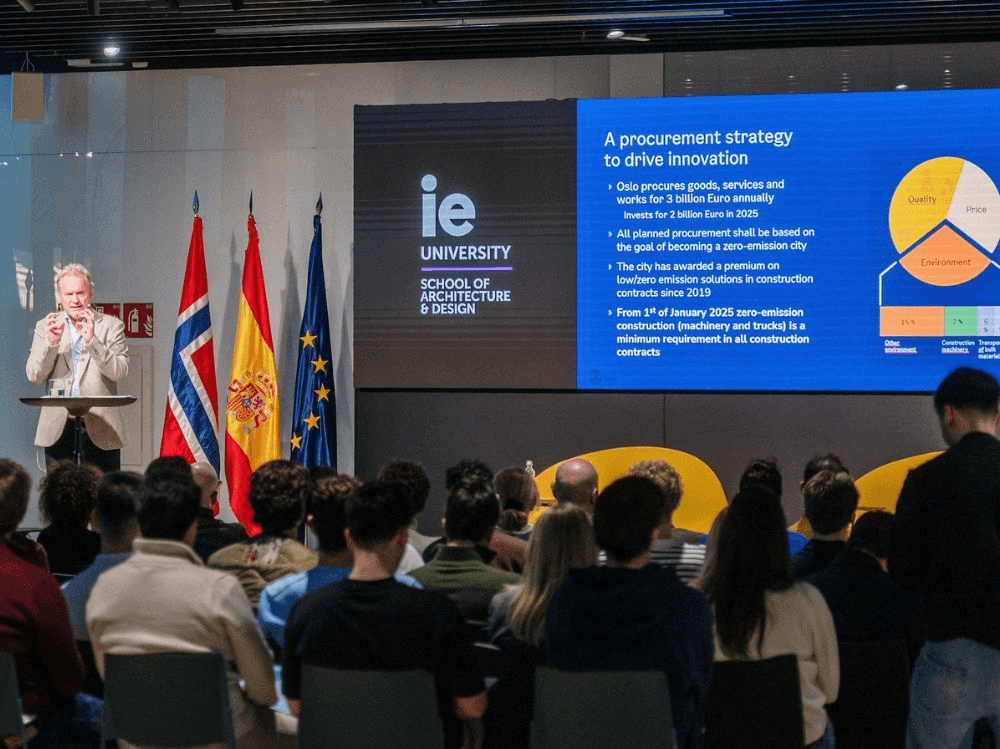
A significant part of the lecture addressed public procurement as a strategic climate instrument. Under Johansen’s leadership, Oslo used its purchasing power to accelerate the transition toward zero-emission construction sites, influencing both local and international markets for heavy machinery and construction technologies. "Cities should never underestimate how far they can get by being a demanding customer," noted Johansen, highlighting the importance of long-term predictability and consistent regulatory signals in enabling private-sector investment and innovation.

The discussion with students, moderated by Jerónimo van Schendel, extended these reflections into the professional realities of architects, developers, and urban designers. Questions focused on how to shift from cost-based decision-making to value-based procurement, how to engage private companies in early-stage innovation, and how political leadership can sustain long-term transitions despite changing electoral cycles.
Johansen reflected on the initial resistance from industry and explained how early collaboration with a group of private companies helped demonstrate that zero-emission construction was both technically feasible and economically viable.
Students also raised questions about political polarization and the growing resistance to environmental regulation in different contexts. In response, Johansen stressed the importance of building broader alliances across cities and social groups, noting that environmental policy cannot rely solely on technical expertise but must also connect with citizens through clear narratives and tangible results.
The session concluded with a reflection on the responsibility of universities and design schools. Johansen argued that future professionals in architecture and urban development must understand public governance mechanisms, not only design excellence, if they aim to influence systemic change. In a context of rapid global urbanization, he reminded the audience that "the future belongs to the cities," and that institutional tools such as budgeting, regulation, and procurement will increasingly shape how those cities are built.