Yasmeen Lari at IE School of Architecture & Design: "Architecture, for me, is about building a just future"

Closing the School’s CRAFT & CARE lecture series, the architect and humanitarian advocated for community-led building and architecture as a tool for social and ecological justice.
Madrid, 28 April 2026 — IE School of Architecture & Design welcomed Pakistani architect Yasmeen Lari for the closing lecture of the School’s CRAFT & CARE 2025-2026 lecture series, bringing to campus a voice that has consistently challenged the boundaries of architectural practice. Lari presented a model of practice grounded in care, community participation, and environmental responsibility. "Architecture, for me, is about building a just future," she said, framing the discipline as both a social and ecological imperative.
Lari is Pakistan’s first woman architect and the designer of some of the country’s landmark modernist buildings such as the Pakistan State Oil House in Karachi and the Finance and Trade Centre. After retiring from conventional architectural practice in 2000, she shifted her focus toward humanitarian architecture and social justice. In 1980, Lari co-founded the Heritage Foundation of Pakistan, leading major conservation and heritage safeguarding initiatives, many in collaboration with UNESCO. In recognition of her contributions to architecture, heritage safeguarding, and humanitarian assistance, Yasmeen Lari was awarded Pakistan’s civil merit awards Sitara-i-Imtiaz in 2006 and Hilal-i-Imtiaz in 2014. In 2016, she received Japan’s prestigious Fukuoka Prize for her contributions to Asian art and culture.
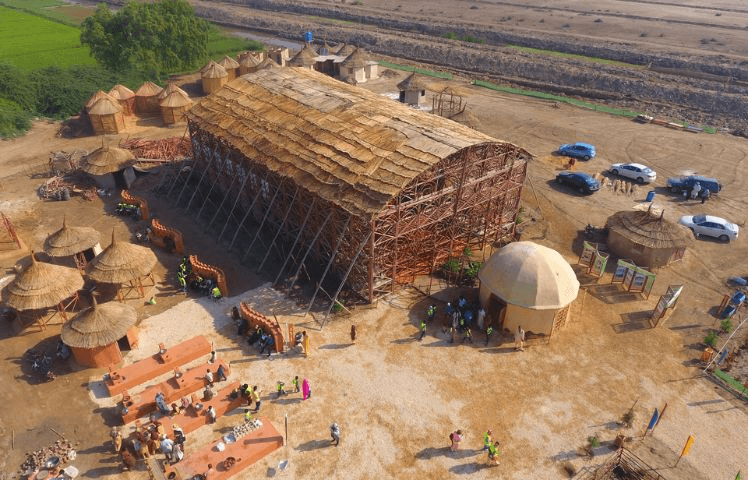
Organized around what Lari defines as the "four zeros"—zero carbon, zero waste, zero charity, and zero poverty—her talk traced a shift from conventional, resource-intensive construction toward an approach rooted in local knowledge and community agency. Lari works with materials such as bamboo, mud, lime, and thatch—natural, locally sourced materials that help reduce environmental impact while enabling communities to build and maintain their own spaces. "I need to make sure that I am not contributing to the mass of carbon emissions," she noted, reflecting on her decision to stop using cement and steel altogether in her projects since 2000.
At the core of her work is what Lari calls "barefoot social architecture," a methodology that shifts the role of the architect from designer to facilitator. Projects are developed through participatory processes, where communities, particularly women, take the lead in building, decision-making, and knowledge sharing. "They are displaced, but they are not disabled," she emphasized. In this model, architecture becomes a collective act, shaped by those who inhabit it.
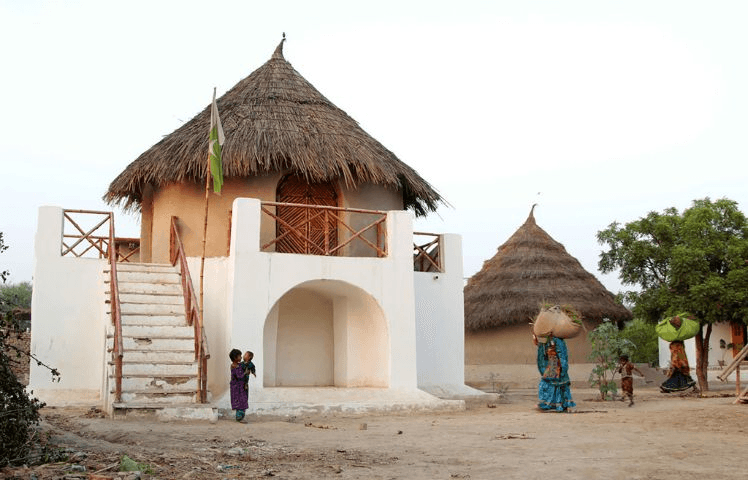
Lari’s projects draw from vernacular traditions, reactivating techniques that have long responded to climate and context. From passive cooling systems based on courtyards and wind flows to the use of earth and lime for thermal regulation, her work demonstrates how historical knowledge can inform contemporary solutions. "We have to look at what is already there and learn from it," she noted. These principles are translated into modular construction systems, such as prefabricated bamboo structures, that can be assembled locally, adapted to different uses, and scaled across regions.
The impact of this approach is both architectural and systemic. Over the past years, her work has expanded into a wide-reaching ecosystem that integrates housing, sanitation, food production, and community infrastructure. Operating without reliance on external funding, this model is based on local resources, peer-to-peer knowledge transfer, and collective labor. "Why should I need funds when so many resources already exist in the field?" she asked.
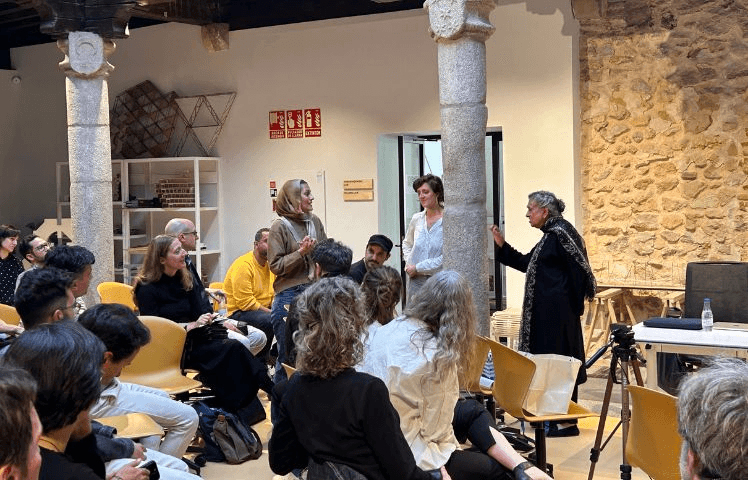
Lari stressed a central idea: architecture must respond to the conditions of its time. In a context marked by climate crisis, inequality, and rapid technological change, she argued that the discipline must expand its scope and reconsider its priorities. "It is not only the privileged who have a right to well-designed environments," she noted. "Those on the margins need more, not less design."
Addressing students directly, Yasmeen Lari highlighted the urgency of finding new ways to practice architecture that go beyond conventional career models and engage with the realities of a majority of the world’s population. "We must find different ways to practice architecture," Lari said, warning that otherwise "the profession risks becoming redundant."