Javier Madero
I'm an architect with Swedish, Mexican, and Spanish roots. I hold a Bachelor’s and a Master’s degree in Architecture from IE University, where I also co-directed Prologue Magazine. My academic work mostly focused on construction history and material innovation: my bachelor’s thesis on thin-tile vaulting in Spain was presented at the 8th International Congress on Construction History at ETH Zurich, and my master’s thesis, supervised by Ben van Berkel (UNStudio), explored the reuse of plastic waste as a construction material.
I currently work at Carlo Ratti Associati, and joined the practice through the Curatorial Team for the 2025 Venice Architecture Biennale. In this role, I was responsible for managing projects and participant relations, and for the coordination of key programmes, including GENS and Construction Futures. I now work across design, editorial and business development, contributing to publications, strategic partnerships, and design projects at the intersection of architecture, technology, and public discourse.

"At IE, I learned how architectural training can translate across disciplines."
Q&A with Javier Madero

Define your experience in the master’s program in one word
Fruitful.
What were the main challenges you faced during the program?
We were the first batch of students undergoing the Master of Architecture programme, so there were some hiccups that have likely been addressed in the following years. The distribution of the workload was difficult and there was confusion about what should be our priorities or how to approach our tasks.
How did the program help you overcome these challenges?
We had good dialogue with the professors and administration organizing the programme.
What was the networking experience like?
We have had the opportunity to get in touch with a great network thanks to IE.
What is your favorite memory from your time at IE?
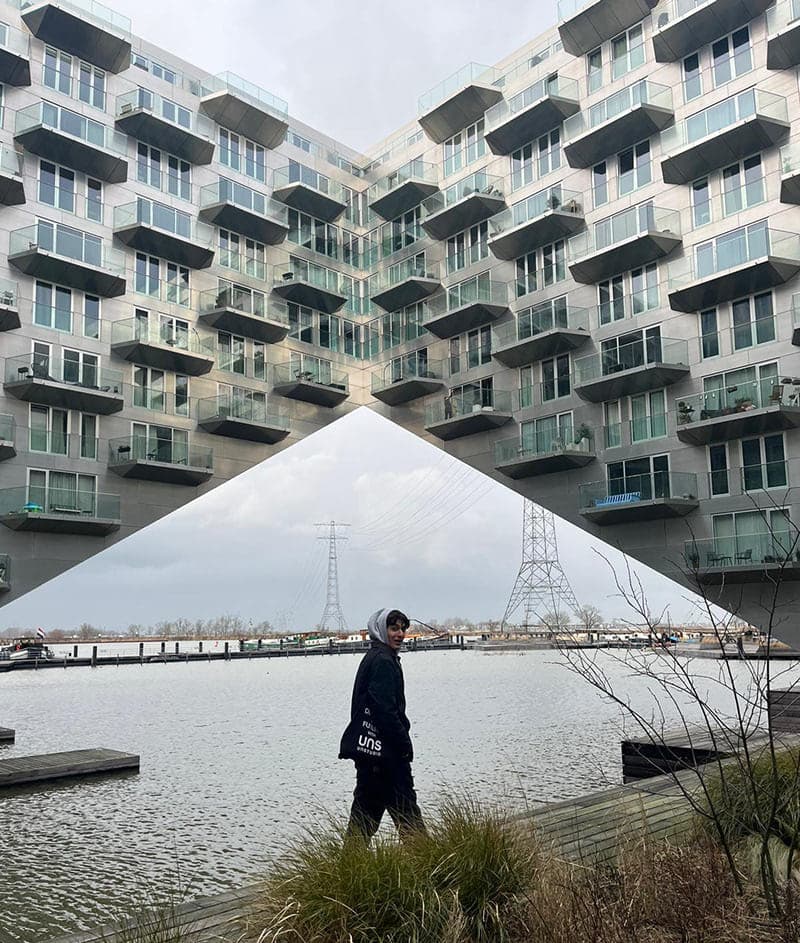
The opportunity to live both in Segovia and Madrid, as well as to do trips with the university including to Granada, Barcelona and Amsterdam, were great highlights.
Why did you choose this program and to study at IE?
IE combines a demanding and rigorous architectural education with the freedom to experiment. It trains you to be technically solid, while also encouraging you to be bold, take risks, and test ideas beyond conventional boundaries. I also admire IE's strong connection to other disciplines, such as business, art, communication, and technology, which helped me understand architecture not only as a design practice, but as a broader cultural, economic, and strategic field.
If someone was considering studying at IE, what would you tell them?
I would tell them that IE's Architecture programme is demanding, but that’s precisely its strength. It gives you a solid architectural foundation while pushing you to think beyond architecture as a closed discipline. If you’re curious, willing to work hard, and open to experimenting across disciplines, IE offers an environment where you can be ambitious, take risks, and develop your own position as an architect.
What does a typical day in your current job look like?
Every day starts with biking to work across beautiful Turin. From the moment I get to the office, there isn’t really a typical day, which is something I value a lot. My work changes constantly depending on the projects at hand. One week I might be focused on research and editorial work for an exhibition or a publication, while the next I’m contributing to an architectural design proposal or competition. Alongside this, I also work closely with the business development team, helping shape strategic decisions, prepare proposals, and communicate with clients. This mix keeps the role dynamic and allows me to move fluidly between research, design, and strategy.