IE School of Humanities launches Human/AI Agency Initiative to explore creativity and responsibility in the age of AI

This new platform brings human questions about meaning, art, and agency into the heart of technological change.
IE School of Humanities has launched the Human/AI Agency Initiative, a new space dedicated to understanding what it means to think, create, and decide in a world increasingly shaped by artificial intelligence.
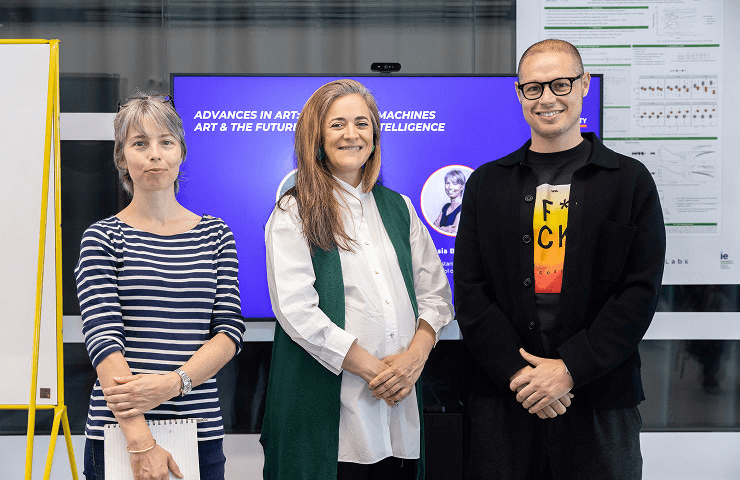
The initiative opened with a conversation titled ‘Augmented Machine Art & the Future of Human Intelligence’, held as part of TechIE, and brought together Sergio Álvarez-Teleña, co-founder and CEO of SciTheWorld, and Maroussia Bednarkiewicz, Assistant Professor of Digital Humanities of IE School of Humanities. Instead of beginning with familiar debates around efficiency or disruption, the dialogue started with art: one of the first places where technological change is felt, and often questioned.
Álvarez-Teleña described a shift toward AI native systems that do more than assist human work. They shape how decisions are made and how organizations function. "As machines increasingly generate content and structure processes, the human role is evolving. It is becoming less about execution and more about setting direction, asking the right questions, and taking responsibility", he said.
Professor Bednarkiewicz stressed that "this perspective invites a more nuanced view of AI. It is not a replacement for human intelligence, but something that amplifies it. The more powerful these systems become, the more important it is to reflect on the values and assumptions behind them".
The Human-AI Agency Initiative will continue to develop through a series of panels, workshops, and activities, creating opportunities for technologists, humanists, and entrepreneurs to engage with these questions in depth. By fostering ongoing dialogue, the IE School of Humanities places creativity, meaning, and human responsibility at the center of the AI conversation.