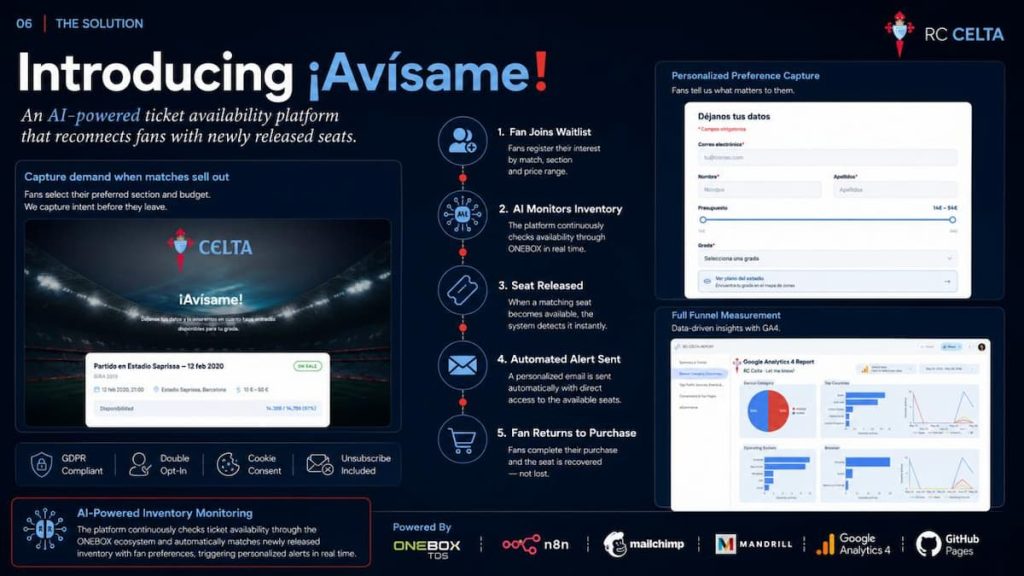
A group of master’s students were given one brief: help RC Celta de Vigo recover lost revenue from unused stadium seats. There was no existing platform, no template to follow and no developer standing by. Through only five sessions in the AI for Marketing Lab, they built a live website, a working backend workflow and an AI-powered notification system that could alert potential buyers when tickets became available for resale.
“We went from briefs to actually creating a live MVP and a landing page, which I thought was only possible through a developer,” says Gaargee Wandrekar, one of the students who took part. “In five sessions, we learned how to train our Claude AI, connect it to the ticketing platform, connect it to Mailchimp and go through the whole process.”
This is what studying marketing with AI looks like at IE University. Learning is not based on hypothetical projects or isolated tool tutorials, but real briefs from real companies with real outcomes.
A new approach to education: marketing with AI
The AI for Marketing Lab was created to close the gap between traditional teaching and current industry demands. Companies are no longer looking for professionals who can manage isolated tasks. They want people who can design and run complete systems.
Professor Iñaki Gorostiza Esquerdeiro, who leads the Lab, is direct about where things stand. “I honestly think that we are in a new era,” he says. “AI is changing everything. It’s changing the processes, it’s changing the methodologies and technologies, it’s reshaping absolutely everything.”
“I think that this is not the future; this is the present, and this is how we should start training students.”
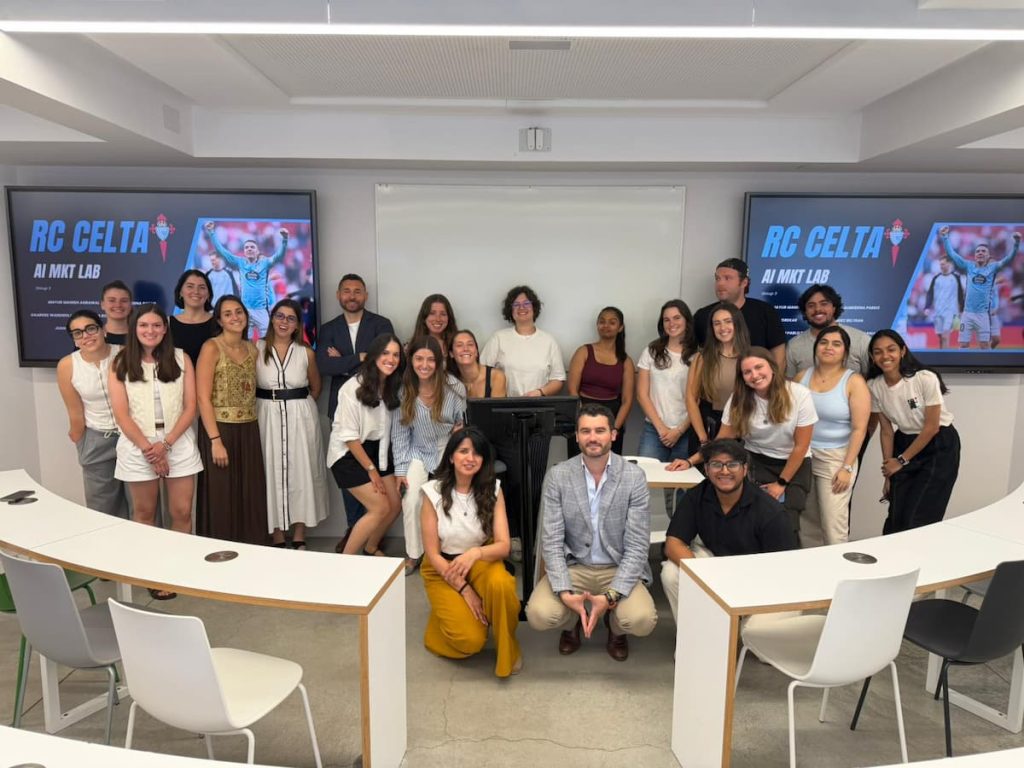
To reflect this, the Lab functions like a real agency project rather than a traditional course. Students work in teams, receive a live brief from a company and develop a functional AI-powered solution from start to finish that covers strategy, execution, data analysis and final presentation.
“When we started designing the Lab, we knew that we wanted to work with real companies,” Iñaki explains. “When you are working with a real-world project, you need to deal with real-world challenges, real-world technologies, real-world tools.”
Understanding AI as a system
A key idea behind the Lab is that AI is not just a tool to support marketing tasks, it is an entire operating layer that changes how marketing work gets done.
Iñaki describes the structure through three layers: strategy, agents and data. The strategic layer focuses on understanding the customer and defining direction. The agentic layer introduces the possibility of marketing with AI so that actions can be executed autonomously. The data layer measures and improves every step.
“Now, students need to get familiar with what an AI agent is,” he says. “An agent is going to do it because it’s going to be cheaper than you, faster than you and more intelligent than you.”
For students, this shifts how they see their role. Rather than executing tasks manually, they learn to design systems, define workflows and guide AI tools effectively. Not to mention, these are skills that are increasingly central to senior marketing roles.
And the result? In the case of RC Celta de Vigo, the Lab provided the skills, guidance, collaboration and confidence to create a product that solved the revenue problem of unsold stadium seats. Through a platform called “¡Avísame!”, students created AI-powered ticket availability platform that reconnects fans with newly released seats.
“It was really cool to be able to actually work for a client instead of just making a hypothetical project.”
Building practical, transferable skills
Throughout the Lab, students work with tools like Claude and automation platforms such as n8n, Make and Zapier. More importantly, they learn how to connect these tools into complete, functional workflows.
For Gaargee, one of the most valuable lessons was discovering how much expertise shapes the output. “I saw the potential of AI and how it can automate a lot of things,” she says. “But even small changes in the prompt can make a big difference.”
For fellow participant McCall Horton, the value came from the confidence built through working with a real client. “We were tasked with creating, from the ground up, a website that hadn’t existed yet, a landing page that hadn’t existed yet and a whole backend workflow,” she says. “You need to understand how to use these skills and tools, but you don’t often get to use them in a hands-on way. It was really cool to be able to actually work for a client instead of just making a hypothetical project.”
“We went from briefs to actually creating a live MVP and a landing page, which I thought was only possible through a developer.”
The Lab also places strong emphasis on teamwork. Students bring different strengths—some more creative, some more technical—and learn to distribute roles accordingly. The second half of the Lab pushes beyond the client brief entirely, asking students to propose new ideas and improvements of their own. “That was maybe the most important part of the Lab,” says Iñaki, “when they start thinking about how to improve the processes, new opportunities and how to use the data they have.”
What students leave with
By the end of the Lab, students have built real solutions, worked with real clients and developed a portfolio that reflects what the industry actually needs right now.
For Gaargee, the experience directly expanded her professional profile. “Now I can say I don’t only do digital marketing; I can also help you create a landing page, optimize your page and integrate automation into your marketing.”
McCall sees it as a foundation for flexibility. “I want to master as many tools as possible to make myself as flexible as I can. I feel like the course really made me feel confident in being able to troubleshoot on my own and build things on my own.”
At a broader level, the Lab prepares students to think differently about what marketing is: it’s not simply a set of campaigns to manage, but a system of strategy, technology and data to design.
As Iñaki puts it: the goal is to help students move from learning about marketing to actively shaping it.

Scott is editor-in-chief of Uncover IE and Senior Content Manager at IE University. He holds degrees in English Literature and Spanish from Saint Louis University and has spent more than a decade working in content strategy, editorial leadership, journalism and multilingual communications.