- Home
- Civica
- Civica News
- Ie University Hosts Civica’s Public Lecture On Neurodivergent Profiles In Education: "the Differences Come From The Same Root Causes As The Strengths"
IE University hosts CIVICA’s public lecture on neurodivergent profiles in education: "The differences come from the same root causes as the strengths"

The event was held at IE Tower and featured Professor Monika Baár, Natália Nagyné Nyikes, and Dolores Gage, accompanied by Nicole Rosow.
In its commitment to the CIVICA Alliance, IE University held on Earth Day a lecture on the topic of neurodiversity and its inclusion in education. The event was held in a hybrid format, in which attendants joined from many different countries. Speakers were introduced by Nicole Rosow, director of Sustainability at IE University, as the initiative was included in its Earth Month Program. Professor Monika Baár, from the European University Institute; Natália Nagyné Nyikes, from the Central European University; and Dolores Gage, IE Executive MBA alumna, shared their knowledge on neurodivergence.
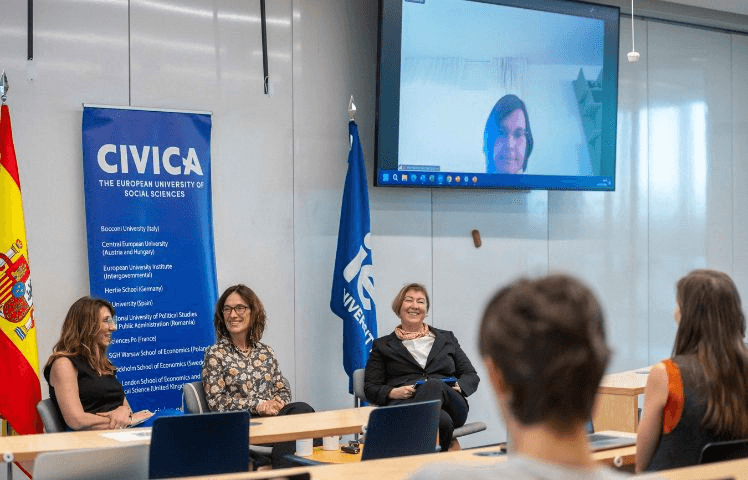
The event provided a three-sided conversation on dyslexia. It started with an overview on the history of disability across Europe by Professor Monika Baár. Professor Baár specializes in History of East-Central and South-Eastern Europe and comes from the European University Institute, in which she is Dean of Graduate Studies. She explained the emergence of dyslexia as a diagnostic category, initially referred to as "word blindness". Its evolution led for dyslexia to be finally located in the brain, not connected to the general ability of the individual, and was only recognized in the British Parliament in 1987. As Professor Baár argued, it is essential to make sure that there is support for dyslexia in universities.
Dolores Gage provided a both practical and human approach on dyslexia, based on her personal experience with her son. Gage, who is an IE Executive MBA alumna and Cambridge graduate, holds an MEd in International Education and Bilingualism. She explained that, in diagnoses in which neurodivergences like dyslexia, dyscalculia and ADHD converge, specialists lack a holistic approach that look at the whole picture. Her efforts to better understand her son led her to discover "The Gift of Dyslexia", by Ron Davis, creator of the Davis® Method, of which Gages is now Facilitator and Presenter. Gages stated that neurodivergence comes with a set of talents and strengths, which challenge the connection with the world through disorientation. "When we see difference as brilliance, rather than deficit, we support learning, we preserve self-esteem, and we help people thrive", she claimed.
Finally, Natália Nagyné Nyikes brought her experience and research on working in classrooms with neurodivergent students. Nyikes is the Disability Rights Officer at the Office of the Pro-Rector for Teaching and Learning at Central European University, and is completing her PhD in language pedagogy at Eötvös Loránd University. "If you want to build an inclusive, accessible classroom, we must train our teachers", she explained. Nyikes explained that dyslexia is a learning environment challenge. Teachers must overcome the anxiety that comes with participating in an academic environment through certain strategies, which can be as simple as asking students how they are.
The three experts opened the floor for questions from the audience, which shared related personal experiences. They finally pushed to shift the perspective on neurodiversity through fostering understanding. "The differences come from the same root causes as the strengths", Dolores Gage concluded. As claimed by Nicole Rosow, who was joined by Elisa Hicks, Executive Director of Campus Life at IE University, in relation to the lecture being included in the Earth Month initiative: "we take a broader view: sustainability is also about people, about creating environments where everyone feels included, is treated fairly and is able to thrive."