- Home
- Civica
- Civica News
- "the Security Conversation Does Not Exclude The Enlargement Conversation": Dr. Ilke Toygür, From Ie University’s Global Policy Center, Talks About European Security And Defense In Civica Sponsored Panel
"The security conversation does not exclude the enlargement conversation": Dr. Ilke Toygür, from IE University’s Global Policy Center, talks about European security and defense in CIVICA sponsored panel

The Director of the Global Policy Center reflected on the coalitions of the willing for Europe in the CIVICA conference, held at the London School of Economics.
Dr. Ilke Toygür, Director of the Global Policy Center and Professor of Practice of European Politics at the School of Politics, Economics, and Global Affairs at IE University, participated in a panel the role of non-EU NATO members in Europe’s security and defense. The event took place at the London School of Economics (LSE) and was sponsored by CIVICA, the alliance of leading social sciences universities that fosters academic exchange through initiatives such as the faculty short visits. Aaron McKeil, Academic Director on the MSc International Strategy and Diplomacy programme at LSE Ideas, and Pernille Rieker, Director of the ARENA Centre for European Studies at the University of Oslo, also participated in this conference. The chair of the event was Yaprak Gürsoy, professor of European Politics and Chair in Contemporary Turkish Studies in the European Institute at LSE.
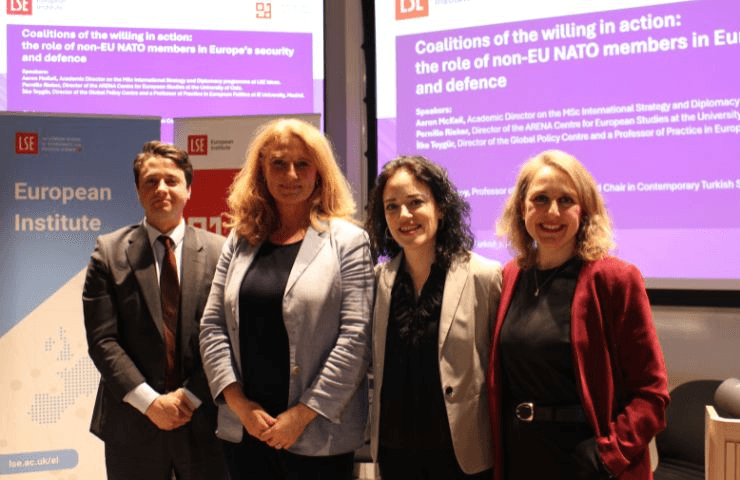
Discussion evolved around the role of non-EU NATO members in the security and defense of Europe. Dr. Toygür opened her intervention by stating that Europe is now facing the biggest security restructuring process since the end of the Second World War, following the Russian invasion of Ukraine and the second administration of Donald Trump. "What leads to conversations about coalitions of the willing and partnerships is this: threats are evolving far faster than institutions", explained the Director of the Global Policy Center. In fact, Dr. Toygür further pinpointed the creation of twelve new security and defense partnerships by the European Union with countries such as Canada, also included in SAFE. Aside from establishing security and defense partnerships to foster the EU’s strategic autonomy, European countries are seeking renewed approaches to deliver swiftly on security. "We are seeing a new conceptualization of the coalitions of the willing in European security," Dr. Toygür explained, noting that while the concept isn't new, its application is evolving.
Pernille Rieker focused on the importance of widening the institution of European security. "The question is not only what Europe is doing, but who calls the shots, how, and how the EU can integrate non-EU NATO members into a more flexible but still coherent European security and defense architecture", she argued. In what concerns security, Rieker affirmed that "European security today is not only about defense in a narrow military sense". Furthermore, Aaron McKeil added a Canadian perspective to the conversation. McKeil emphasized that the international order is under rupture, especially given how the United States now approaches the defense of the free world. Canada, in this scenario, is willing to collaborate for common defense arrangements "Canada remains invested in a free, open, and peaceful Europe, including Ukraine", McKeil claimed.
The European Union may thus find a broader view of defense and security through non-EU countries, according to the analysis provided by Director of the Global Policy Center at IE University. Although there is a deliberate ambiguity coming from Turkey in what concerns certain issues—such as the Russian invasion of Ukraine—, the country remains a relevant actor. As Dr. Toygür stated in the round of questions with the audience, Turkey is the second largest army in NATO, and countries like Spain are interested in achieving collaboration in the defense industry. Dr. Toygür, brought to LSE thanks to CIVICA, ultimately explained that “the security conversation does not exclude the enlargement conversation: their intersection will create different possibilities and different forms of engagement between non-EU and EU member states.”