- Home
- Expert Series
- Who Took The 'napalm Girl' Photo? Why Attribution Still Matters 50 Years On
Who Took the 'Napalm Girl' Photo? Why Attribution Still Matters 50 Years On

Some photographs do more than record history. They become history.
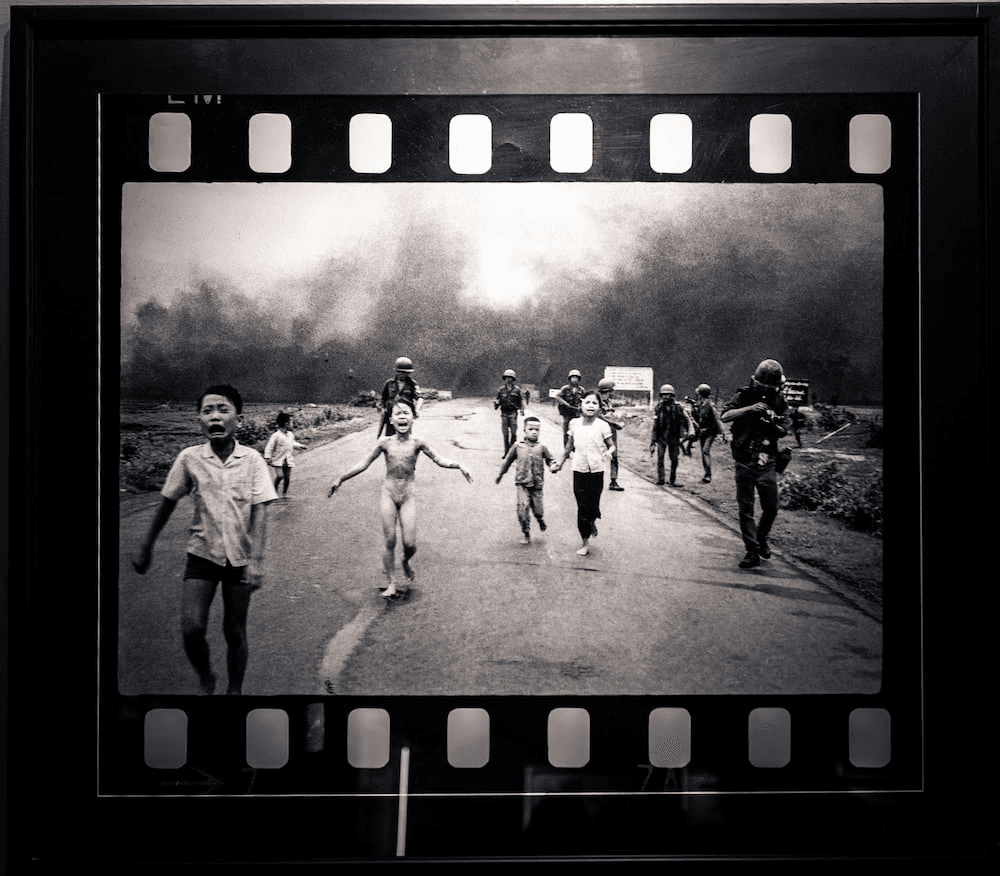
"The Terror of War," better known as "Napalm Girl," is one of them. The image of 9-year-old Phan Thị Kim Phúc running naked and terrified after a napalm attack became an enduring symbol of the brutality of the Vietnam War. It helped transform international perceptions of the conflict and strengthened the demand for peace. For more than 50 years, the photograph has been attributed to the Vietnamese Associated Press photographer Nick Út.
The documentary "The Stringer" challenges that account. It presents evidence suggesting that the photograph may instead have been taken by Nguyễn Thành Nghệ, a Vietnamese freelance photographer whose name disappeared from the official record. The attribution remains contested: the Associated Press continues to credit Nick Út, while World Press Photo suspended its attribution following an independent investigation.
Truth has no expiration date
Recently, I had the opportunity to discuss the documentary and the wider role of journalism with photojournalist Gary Knight and Spanish television journalist Anna Bosch at Hay Festival Segovia. Our conversation went beyond the forensic question of who pressed the shutter on a road outside Trảng Bàng in June 1972. It raised a more uncomfortable and enduring question: Who gets to tell the story?
Some photographers have criticized Knight for reopening the case. Why disturb an established historical account? Why question the reputation of a celebrated photographer? Why now?
His answer is about justice. If someone has something important and legitimate to say, we have a responsibility to listen. Time does not absolve us of that responsibility. The line that has come to define the project puts it plainly: "Truth has no expiration date."
There is also a broader historical reason to ask the question. The photograph was not simply an exceptional piece of photojournalism. It had enormous political significance. It shaped how millions of people understood the war and contributed to the public pressure to end it. When an image carries that kind of importance, its authorship matters.
Authorship, memory and the limits of the archive
Knight offered an illuminating analogy. Imagine discovering that "Guernica" had not been painted by Picasso, but by an unknown artist whose name had been deliberately removed. We would not dismiss the discovery as an irrelevant correction to the footnotes of art history. We would understand that authorship is inseparable from recognition, memory and justice.
The comparison is imperfect, of course. Yet the underlying point remains: when a work becomes part of humanity's visual memory, identifying its creator is not a matter of vanity. It is part of the historical truth surrounding the work.
One of the most moving moments in "The Stringer" occurs when former AP photo editor Carl Robinson meets Nguyễn Thành Nghệ. In the film, Robinson says he was instructed to change the photographer's name on the caption. Decades later, the two men meet and recognize what each represents for the other: "You are my proof, and I am your proof."
The encounter reveals something profound about truth. Evidence does not exist only in archives, negatives and institutional records. It can also survive in human memory, in guilt and in the persistence of those who were written out of the official narrative. Such testimony must be rigorously examined, but it should not be disregarded merely because it challenges a powerful institution or arrives late.
The erasure of local photographers
The controversy also illuminates a larger imbalance in international journalism. During what the Vietnamese understandably call the American War, Western audiences and media organizations tended to give greater legitimacy to American, British and European correspondents.
Vietnamese names were often treated as unfamiliar, unpronounceable or even amusing. Foreign journalists became the recognized narrators of the conflict, while many local photographers who witnessed and documented their own country's devastation were pushed to the margins.
Knight makes the erasure concrete with a simple challenge: apart from Nick Út, how many people can name even one Vietnamese photographer who covered the war?
For most of us, the answer is none.
This is striking because the Vietnam War became a benchmark for modern photojournalism. The conflict produced some of the most consequential images of the 20th century and established the reputations of numerous foreign photographers. Yet the Vietnamese journalists working alongside them have largely vanished from global memory.
Why do local journalists still go uncredited?
This pattern is not confined to the past. In many contemporary conflicts, local photographers and reporters are the only people able to document what is happening. Foreign correspondents may be denied access, evacuated for security reasons or unable to navigate the language and social realities of the place they are covering.
Local journalists remain because it is their home. They assume extraordinary risks, yet their work is often published through international organizations whose brands receive more recognition than the individuals who gathered the information.
Giving these journalists proper credit is not an act of generosity. It is a question of professional integrity. It also improves journalism. A reporter who speaks the language, understands the culture and belongs to the society being portrayed can see realities that an outsider may miss.
International journalism is impoverished when local professionals are treated only as drivers, translators, fixers or anonymous "stringers," rather than as authors in their own right.
Who is allowed to enter history
But perhaps the most fundamental challenge is more prosaic: there is increasingly little money to pay for international reporting.
Foreign coverage is expensive. It requires travel, time, security, experienced professionals and a willingness to investigate stories whose commercial return may be uncertain. As media revenues decline, international reporting is among the easiest areas to cut. The result is a dangerous paradox: at a moment of profound geopolitical instability, societies are losing the capacity to observe the world carefully and independently.
We cannot defend serious journalism only in the abstract. If we believe it matters, we must help finance it. That includes paying for the newspapers, magazines and digital media we consume. The expectation that reliable journalism should always be free eventually produces journalism that is underfunded, dependent or absent.
"The Stringer" is therefore about much more than the name beneath a photograph. It asks us to examine how authority is constructed, whose testimony is believed and who is allowed to enter history. It reminds us that images do not reach us without intermediaries: someone takes them, someone selects them, someone writes the caption and someone decides whose name appears underneath.
Looking again at the past cannot undo an injustice. But it can restore a voice, challenge an inherited hierarchy and make future journalism more honest. Truth may be delayed, disputed or inconvenient. It does not, however, expire.
AUTHOR
Borja Santos is Associate Dean and Professor at IE School of Politics, Economics & Global Affairs at IE University. He has over 20 years of experience in designing, implementing and evaluating public policies in Africa, Europe, the Americas and Asia. He is also an Acumen Fellow, President of the Harvard Kennedy School Spain Alumni Network, advisory board member and frequent contributor of articles and policy briefs to media outlets and think tanks including El País and the Real Instituto Elcano.
