From Bottega to Platform: Craft, Work, and Learning in Transition

Cristina Mateo examines how IE School of Architecture & Design operates as a platform for contemporary apprenticeship, linking craft, technology, and evolving careers.
Madrid, 6 February 2026 - For centuries, apprenticeship was the primary system through which knowledge was transmitted across generations. Learning unfolded through proximity: by observing, repeating, failing, correcting, and gradually assuming responsibility. The workshop—whether the Italian bottega or its equivalents elsewhere—was not merely a site of production, but a social and cultural system in which work, identity, and learning were inseparable.
Industrialization disrupted this model. Production was fragmented, knowledge abstracted, and education increasingly detached from making. Over time, apprenticeship was pushed to the margins of prestige education and reframed as manual labour rather than a form of intellectual or creative authority. While this industrial model enabled scale and efficiency, it also separated thinking from making, decision from consequence, and learning from responsibility.
Today, apprenticeships are making a comeback—not out of nostalgia, but as an alternative to the limitations of the industrial model. The artisan–apprentice relationship offers an alternative to a contemporary condition in which work is often is often precarious and isolated, disconnected from material consequences, and focused on metrics which do not take into account quality and care.
At IE School of Architecture & Design, this return is not understood as a revival of the past, but as an opportunity to rethink apprenticeship for contemporary creative practice, sustainability challenges, and new forms of work. Central to this rethinking is a clear ethical position: craft—particularly vernacular, indigenous, or territorially embedded practices—is not treated as a resource to be extracted, aestheticized, or abstracted from its social and ecological contexts. Instead, craft is understood as a situated system of knowledge, inseparable from the communities, histories, and environments that sustain it.
This stance is visible in projects developed with local communities through the d-Lab, or in the Construction Lab’s collaborations with artisans on techniques such as the construction of InnixAR, a Catalan vault structure, using augmented reality on the Segovia campus (on the cover). In these cases, knowledge is not “taken” but shared through structured, reciprocal relationships that acknowledge authorship, context, and responsibility.
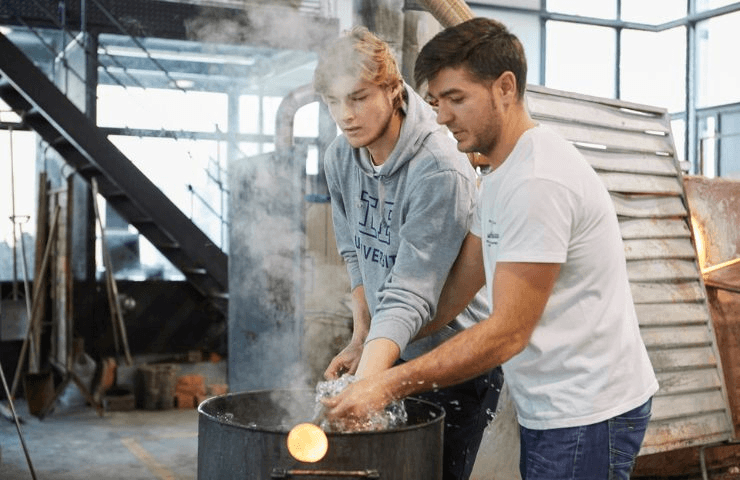
From the bottega to the platform
Historically, the apprenticeship system was built around a relational model of knowledge structured by two figures: the artisan and the apprentice. The artisan was a custodian of techniques, materials, and standards of quality, whose authority derived from experience and peer recognition rather than formal credentials. The apprentice was not a short-term trainee, but a person in transformation, learning through embodied practice over time. Learning and production were inseparable: to learn was a means to live and contribute.
This model valued long-term, tacit knowledge; intergenerational transmission; responsibility toward materials and outcomes; and work as a source of identity and belonging. While often exclusionary, it produced a deep alignment between thinking, making, and responsibility—and generated cultural continuity and economic value for its territories.
Florence for instance, was well known for stone carving, gold smithing, leather, wood, and painting workshops organized around the bottega model, where artists such as Michelangelo and Leonardo began as apprentices. Indeed, this model strongly influenced architecture, art, and design education until today.
What has changed is not the relevance of these principles, but the conditions under which they operate.
Why now: the post-industrial context
Industrial economies prioritized speed, scale, and standardization. Work was divided into tasks, learning modularized, and knowledge detached from bodies and materials. Education followed this split, often forcing a choice between theory and practice.
Today, in a post-industrial world, creative and design professions operate in environments marked by uncertainty, ecological urgency, and technological transformation. Automation and AI are increasingly replacing routine tasks, but leave judgment, care, and ethical responsibility firmly human. As a result, craft is increasingly valued in high-end sectors such as luxury, where these human qualities remain irreplaceable.
What becomes evident is that the industrial model did not only fragment production; it fragmented responsibility. This creates a timely opportunity for a renewed apprenticeship model, one that reconnects thinking and making, decision and consequence.
Moreover, in addition to its cultural and pedagogical value, craft contributes tangibly to the global economy and labour markets. The broader creative economy, of which craft is an integral part, generates significant economic activity and jobs, contributing anywhere from roughly 0.5 % to 7.3 % of GDP and up to 12.5 % of total employment in some national contexts, with creative exports growing strongly in recent years (UNCTAD’s 2024 Creative Economy Outlook).
And within the specific realm of traditional and artisanal craft linked to high-value sectors such as luxury, recent estimates suggest that craftsmanship generated over $150 billion in global revenue in 2023, representing about 12 % of the global luxury market, with projections indicating continued growth through 2030 (Luxonomy).
Contemporary reinterpretations: apprenticeship as platform
Contemporary initiatives have responded to this context by transforming apprenticeship from a fixed hierarchy into a curated professional transition. Institutions such as Villa Noailles, through Design Parade, operate less as training schools than as platforms for visibility, critique, and career acceleration. Organizations like Queen Elizabeth Scholarship Trust in the UK or Fondazione Cologni in Italy already connect networks of master workshops, emerging professionals, funders, and educational institutions, turning apprenticeship into a supported and legible pathway rather than an informal or exclusive arrangement.
Outside Europe, institutions such as Penland School of Craft or Haystack Mountain School of Crafts offer time-bound residencies, peer-based mentorship, and shared infrastructures across multiple material cultures. Here, expertise circulates horizontally as much as vertically: participants may enter as learners in one context and act as mentors in another.
Recently, Dries Van Noten (former fashion designer) announced the creation of the Fondazione Dries Van Noten to celebrate, study, and promote craftsmanship in all its forms, positioning it as a living, evolving practice rather than a static piece of heritage.
Across these models, a decisive shift is evident. Apprenticeship is no longer defined by permanence, territorial fixation, or rigid hierarchy, but by curation, mobility, and reciprocity. The master becomes a host, mentor, and knowledge partner; the apprentice an emerging or already established professional (could be a well-established industrial or product designer, for instance) seeking a specific form of transformation. Learning is intensive, time-bound, and professionally legible, yet flexible enough to allow roles to evolve. Indeed, careers have become non-linear and fragmented, making lifelong learning a necessity rather than an option.
Luxury-sector initiatives such as the Michelangelo Foundation’s Homo Faber Fellowship, the Hermès Foundation's programs, or LVMH’s Institut des Métiers d’Excellence exemplify this evolution. None simply replicate historical hierarchies. Instead, they integrate transmission with business literacy, visibility, and mobility, aligning apprenticeship with what economist Charles Handy described as the "portfolio life."
These programs increasingly frame the artisan - apprentice relationship as a partnership, sometimes structured through duets, recoding hierarchy into collaboration.
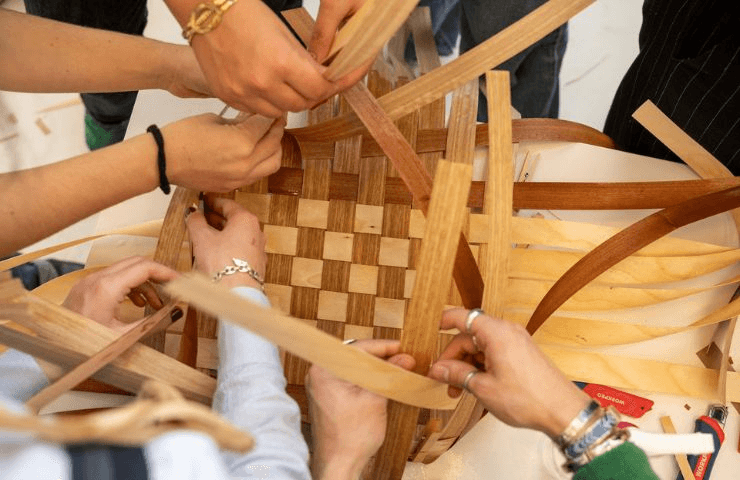
IE School of Architecture & Design: apprenticeship as platform
It is precisely this platform-based understanding of apprenticeship that IE School of Architecture & Design adopts and extends. IE University does not seek to recreate a single workshop, tradition, or lineage. Its strength lies in acting as an educational and cultural platform that enables encounters across disciplines, generations, geographies, and levels of expertise, in what we tentatively call the “Future Craft Platform”.
Through its international academic environment, studio-based pedagogy, digital transformation focus, and public engagement—ranging from active participation in design events, such as Madrid Design Festival to partnerships with global companies such as Hermès or Saudi Heritage Commission—IE University provides the infrastructure that makes contemporary apprenticeship viable. Facilities such as the IE Creative Campus Segovia and Madrid Fab Lab support circulation rather than permanence, curation rather than hierarchy, and responsibility rather than standardization.
In this model, expertise is situational. An artisan may mentor in one context and learn in another; an apprentice may bring advanced digital, managerial, or design knowledge that reshapes the collaboration. Apprenticeship becomes a shared, choreographed process rather than a fixed role. What is key is the network, and IE University is placed with the right tools for that. We have 80K alumni globally, are present in 27 offices across the world, have 10k students of which 90% are international.
Moving forward: "Future Craft Platform"
At IE School of Architecture & Design, craft apprenticeship is therefore not understood as a nostalgic hierarchy, but as a future-oriented model of work and learning. One that reconnects thinking and making, embeds care for materials and people, and supports professional lives defined by mobility and change.
Not anchored to a single material culture, IE University operates as a platform that translates territorial craft logics into global education, connects local knowledge to international practice, aligns apprenticeship with contemporary careers, and bridges craft, technology, sustainability, and culture.
In doing so, craft is no longer an elective or a heritage topic introduced as a silo in an academic course, but a way of educating creative professionals capable not only of imagining new worlds, but of responsibly making—and sustaining—them.
* On the cover: Artisan Salvador Gomis Aviño building the InnixAR vault designed by Wesam Al Aasali at IE University, assisted by AR goggles. Photo© Roberto Arribas
_
Cristina Mateo is the Associate Dean of the IE School of Architecture and Design, where she leads strategic initiatives, business development, and stakeholder engagement across the school's programs. With a Ph.D. in Sociology from Goldsmiths, University of London, and an Executive MBA from IE Business School, she specializes in urban ethnography, branding, communication, and digital transformation. Her professional background includes roles at Madrid City Council and VisitBritain, focusing on city branding and e-commerce strategies, and Razorfish, Marchfirst and AtKearney, where she led pioneering projects in Human-Computer Interaction (HCI) and User Experience Design (UXD). At IE University, she teaches courses on "Sociology and Culture" and "Digital Transformation," and contributes to research on the intersection of technology and urban life.