IE School of Architecture & Design Showcases Students’ Urban Visions for Circular Working in NEXT.2

MArch thesis projects explored circular design and adaptive urban strategies in Amsterdam’s Sloterdijk district, in collaboration with UNS’s team.
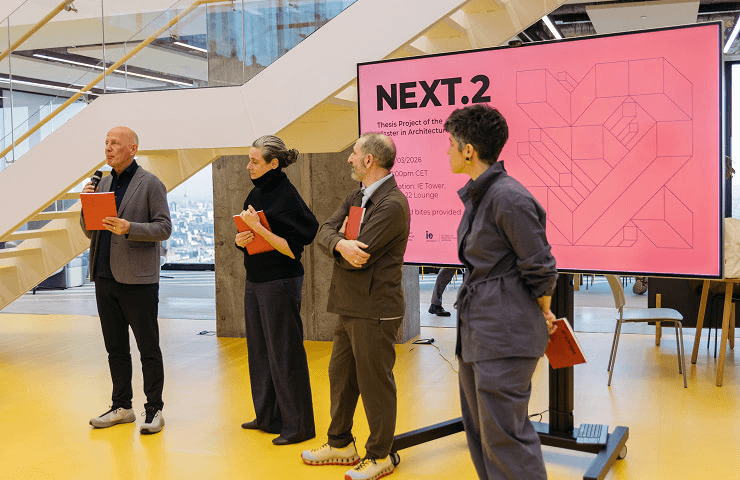
Madrid, 10 April 2026 – IE School of Architecture & Design, in collaboration with IE Editorial Knowledge and UNS, published NEXT.2. Thesis Projects of the Master in Architecture, 2024–2025 showcasing the work of the latest cohort of the program. The book focuses on Circular Working, addressing how architecture can respond to shifting systems of production, labor, and urban life.
Bringing together 15 thesis projects, NEXT.2 envisions architecture not as an isolated act of form-making, but as a strategic process. As Thesis Chair Ben van Berkel explains, “design is not the making of static objects. It is the alignment of adaptive structures, frameworks capable of learning, responding, and evolving over time.”
The projects demonstrate students’ ability to engage complexity with clarity, combining analytical research, spatial intelligence, and technical rigor to propose new architectural models. “The Final Thesis serves as a laboratory where all participants work in pursuit of discovery,” said Fernando García Pino, Thesis Director. “A well-conceived architectural project defines systems, establishes reference frameworks and, in the best cases, can even shift paradigms.”
Students explored how work is being redefined through hybridization, flexibility, and new expectations around well-being. As Marcela Aragüez, Academic Director of the Master in Architecture, notes, the course “directed attention toward systems of production, labor conditions, and the spatial frameworks that support an increasingly diverse spectrum of work.”
All projects were developed in the Sloterdijk area of Amsterdam, a rapidly transforming urban district characterized by infrastructure, density, and latent spatial potential. Identified as a key development zone, Sloterdijk provided a real-world testing ground where students could engage with existing conditions while proposing future-oriented strategies. The area’s “infrastructural intensity and urban incompletion” revealed opportunities to rethink underused spaces, residual plots, and hybrid environments.
Through a Design in Situ approach, students immersed themselves in the territory - mapping flows, observing environmental conditions, and understanding the site through direct experience - before translating these insights into architectural interventions. The result is a body of work that moves from territorial analysis to spatial and material resolution, aligning design with real conditions while remaining open to speculation, and that could be arranged across five themes:
Hybrid work and new spatial typologies examines how architecture can respond to evolving models of labor by integrating productivity, well-being, and social interaction. Post-Stressed Field by Yusuf Sühan Bozkurt proposes a speculative office where work and leisure coexist within a continuous structural system, while EchoHaus by Isabella Espinal Veites rethinks the workplace through sound, organizing space according to acoustic environments to support focus, collaboration, and care.
Infrastructure as civic and spatial framework reinterprets large-scale systems as active architectural agents. The Knot by Leonel Prieto Vargas transforms fragmented railway infrastructure into a circular hub that reconnects urban territories and fosters social exchange, while Life Underneath the Infrastructure by Daniela Figueroa Rozzotto activates residual spaces beneath train tracks, converting them into layered environments for culture, education, and community use.
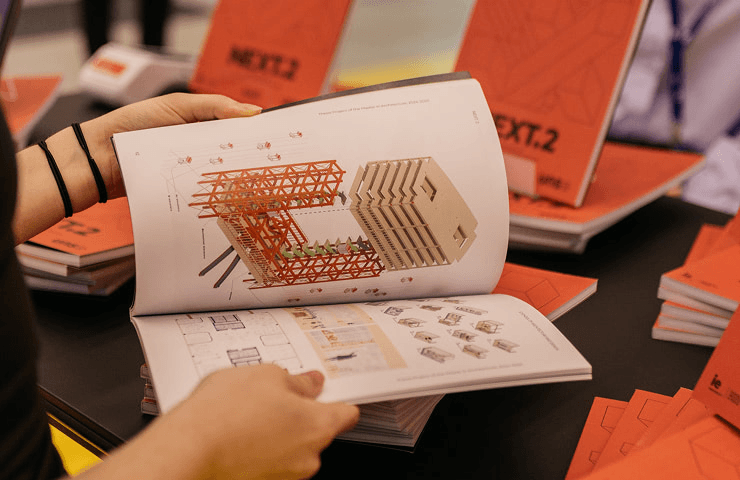
Circular systems and regenerative design focuses on material reuse, lifecycle thinking, and environmental performance. Sloterdijk 2050 by Tristán Sartorius Elorrieta proposes modular timber towers designed for disassembly and long-term adaptability, while Work in Bloom by Elena López Müller integrates biodiversity and ecological systems into existing infrastructure, transforming it into a regenerative workspace.
Productive ecosystems: food, water, and resource cycles explores architecture as a platform for production and circular flows. Gastrokantoor by Juan Manuel de la Serna del Águila integrates the entire food cycle—production, consumption, and waste—within a hybrid office building, while The Waterlab by Daphné Alejandra Fournel embeds water collection, treatment, and ecological systems into the architectural design.
Adaptive urban strategies and new forms of collectivity investigates how architecture can mediate between urban systems and public life. Tafel by Carolina Schönburg introduces an elevated public layer that reconnects fragmented urban areas while integrating food innovation and social exchange, while The Charged Box by Gabriela Osorio Fernandes proposes a hybrid environment where cultural production, performance, and work coexist.
NEXT.2. Thesis Project of the Master in Architecture, 2024–2025 is available in print at IE University stores and can be read on-line.