Nifemi Marcus-Bello Explores Innovation Rooted in Craft at IE School of Architecture & Design

His lecture connected context, making and material experimentation to design as a socially engaged, practice-led discipline.
Madrid, 29 January 2026 - As part of the IE School of Architecture & Design's CRAFT&CARE lecture series, designer and artist Nifemi Marcus-Bello, founder of Lagos-based NMBello Studio, delivered a keynote that resonated with the School’s approach to integrate innovation, craft, and social impact into design education.
Reflecting on his practice that spans commercial design and material research rooted in artisanal traditions, he framed craft not as heritage nostalgia but as a method for activating cultural knowledge and rethinking systems of production. As he explained, "sometimes research is in the doing, research can actually be physical objects."
Through early commercial projects such as the LM Stool - designed to be built with existing generator-casing manufacturing processes in Lagos - students were able to see how design can emerge from understanding local production capacities rather than imposing external solutions. Recalling how the piece first entered the world, Marcus-Bello noted: "The first stool I ever sold was at a house party." For him, building a practice was never about marketing but about community: "You just need a tribe of people who believe in the product."
The core of his lecture focused on three material explorations- bronze, aluminum and copper - that articulate craft as both inquiry and embodiment. These projects offered concrete examples of how working closely with materials can become a form of research, innovation and cultural reflection.
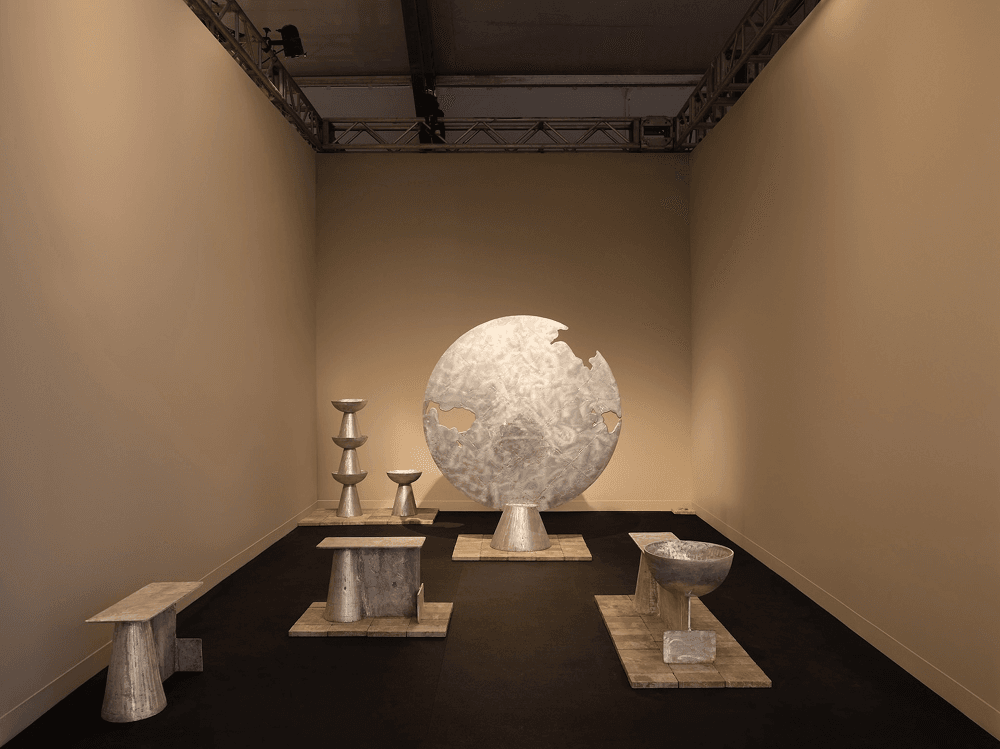 Oríkì (Act II): Tales by Moonlight’ by Nifemi Marcus-Bello©courtesy nmbelloStudio
Tracing his relationship with metal back to adolescence, when he apprenticed in welding, Marcus-Bello reflected that "making was a way of finding self, finding solace." This early experience shaped the way he later approached craft communities in Benin City, Lagos and the Copperbelt in Zambia as spaces of knowledge exchange rather than extraction - an approach that echoes the School's emphasis on learning from context and engaging with practice at multiple levels.
In Benin, he worked alongside traditional bronze casters, embedding fingerprints of makers into the limited edition Friction Ridge bench as an archive of embodied labor. In Lagos, local recycling practices informed Oríkì (Act II): Tales by Moonlight, a series of recycled aluminum objects rooted in storytelling and collective memory. One of the pieces he initially resisted became unexpectedly central to his career: "I was really scared to show it and it ended up being the most successful product I’ve ever done," illustrating for students how uncertainty and vulnerability can be part of the creative process.
In Zambia and Nigeria, his work with copper examined the politics of extraction and refinement, producing objects that reflect nomadic typologies and the imperfection inherent in sand casting. Speaking about this process, he emphasized: "I try not to aim for perfection. I would rather be as honest as possible within the work."
Marcus-Bello also discussed his approach to production, emphasizing small-batch making and long-term relationships over conventional marketing, and described his relationship with galleries as one of trust and legacy stewardship. "Working with a gallery is very intimate, they are holding your legacy and your archive."
He framed his design process as ethnographic, rooted in listening and observing before acting. "I feel like I’m more of an ethnographic researcher than a designer," he noted, stressing the importance of understanding context before intervening in it.
Nifemi Marcus-Bello's work is grounded in cultural context, local production processes and material experimentation, connecting commercial and artistic design to explore how everyday objects can offer both functional and sensitive responses to the social, economic and material realities that surround them. His recognitions include the Prince Claus Fund Fellows Award 2021 supporting cultural and creative agents of change; the Wallpaper* Design Award 2021 in the Life-Enhancer of the Year category for his portable hand-washing station developed during the pandemic; and the Hublot Design Prize 2022, recognizing emerging designers for socially and environmentally impactful innovation. His work is part of the permanent collections of MoMA New York and the Design Museum London, among others.
The CRAFT&CARE 2025–2026 series at IE School of Architecture & Design, curated by Professor Grazielle Bruscato, brings global experts and practitioners whose work engages materiality, care and socio-cultural responsibility in design. Upcoming lectures include Tatiana Bilbao, Sociedad de Artesanía Contemporánea (SACo), and Yasmeen Lari.