Tatiana Bilbao Discusses Architecture as a Collective Act at IE School of Architecture & Design

The lecture, part of the School’s Craft & Care series, was followed by a conversation on authorship and representation in architecture with Professor Laura Martínez de Guereñu.
Madrid, 4 March 2026 – IE School of Architecture & Design welcomed architect Tatiana Bilbao for a lecture organized in collaboration with Fundación Casa de México as part of the School’s CRAFT & CARE series, which examines the relationship between making and caring in contemporary design practice. Her talk was followed by a conversation with IE University Professor Laura Martínez de Guereñu about authorship and representation in architecture.
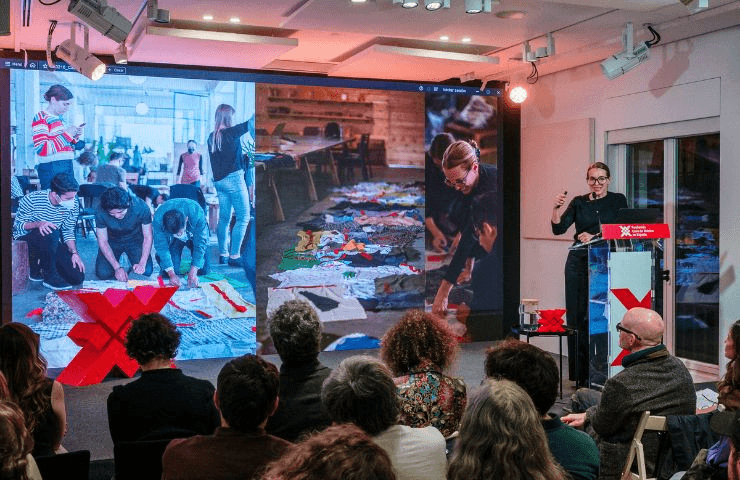
Tatiana Bilbao presented a body of work that approaches architecture not as a finished object but as an evolving process grounded in responsibility. She examined contemporary urban paradigms shaped by productivity and efficiency, arguing that modern cities have largely been organized to support economic production, often defining housing as a space of rest after labor rather than as a central site of daily life.
She proposed reconsidering the prevailing logic of production through what she described as reproduction - the everyday activities that sustain life, including eating, sleeping, caregiving, and social interaction. From this perspective, Tatiana Bilbao argued, architecture can contribute to shifting cities from systems primarily organized around output toward frameworks that acknowledge care as a structural condition.
Bilbao emphasized that care operates across multiple scales, beginning in the domestic environment and extending to neighborhoods, institutions, and ecosystems. Drawing on her experience contributing to a national social housing catalog in Mexico, she questioned the assumption that a single prototype can respond effectively to diverse climates and cultural contexts. "We cannot assume that a house built in the tropical south of Mexico can be the same as one built in the desert of Chihuahua", Bilbao said.
Rather than fixed typologies, Bilbao explained, her practice develops adaptable strategies that allow residents to modify and reinterpret spaces over time. Architecture, in this framework, enables change rather than prescribing a definitive outcome.
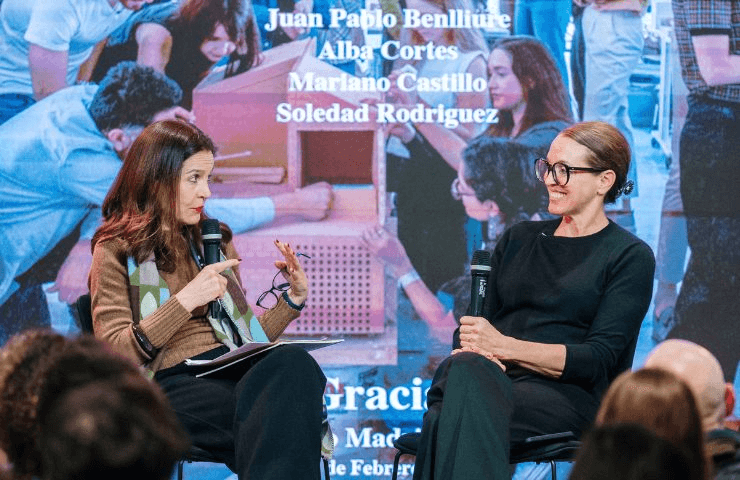
She also addressed the social implications of standardized spatial norms, noting that predefined room sizes or kitchen layouts may inadvertently reinforce hierarchies or overlook local practices. In post-earthquake reconstruction efforts in San Simón el Alto, her team worked directly with communities, contributing technical expertise while allowing residents to determine how spaces would be organized."We do not have the right to decide how someone else lives," she said. "Our role is to put our tools at the service of the community."
Across projects, including incremental housing systems, the Culiacán Botanical Garden, and the Mazatlán Aquarium, Bilbao described architecture as mediation between human and ecosystem, individual and collective, and permanence and transformation. In the case of the Mazatlán Aquarium, this approach involved rethinking the institution as a space where visitors could engage with ecological systems rather than viewing nature as an object of display. "We do not see architecture as an object," she noted. "We see architecture as a process because life is organic and constantly changing."
A Conversation on Authorship and Representation
Following the lecture, Professor Laura Martínez de Guereñu, architect, researcher, and IE University faculty member, moderated a discussion that expanded on themes of authorship and representation in architectural practice.
The conversation examined how architectural tools influence not only how projects are communicated, but how they are conceived and developed. Bilbao referenced the influence of Denise Scott Brown, noting how she broadened the methodological scope of architecture beyond drawings, sections, and built form. "She opened the possibility of understanding that architecture can also be made through photography, walking, conversation," Bilbao said.
This expanded conception of practice, Bilbao explained, has informed her studio’s approach to design. Methods such as collage, narrative frameworks, alternative drawing techniques, and collective workshops function not as stylistic devices, but as tools for inquiry and dialogue. These processes allow projects to emerge through conversation and exchange, rather than through a singular, predetermined vision.
The discussion also addressed the limits of individual authorship in contemporary practice. Bilbao emphasized that architecture today requires interdisciplinary collaboration and shared responsibility. "No one has the capacity to understand everything that needs to be understood in order to build," she stated. "Architecture must be deeply collective."
In concluding the conversation, Bilbao reiterated her position that architecture operates within broader social and ecological systems, and that its responsibility extends beyond formal resolution. "Architecture is not merely an object in a landscape," she said. "It is a process that allows us to inhabit this planet."
The full talk by architect Tatiana Bilbao at Casa México de España, part of IE School of Architecture & Design’s Craft & Care 2025-2026 lecture series, can be watched online here.
