IE School of Politics, Economics and Global Affairs highlights the need for greater integration, innovation and investment in Europe at CIVICA Week 2026

100 students from leading European universities gathered in Madrid for lectures and mentoring on European competitiveness.
IE University has hosted this year the CIVICA European Week 2026, a dynamic program of expert sessions, mentoring and challenges for undergraduate students from the ten leading European universities in Social Sciences that make up the CIVICA alliance, including Bocconi University, The London School of Economics and Political Science, and Sciences Po.
Around 100 students from across Europe took part in the week, which placed European competitiveness at the center of its activities. Participants visited the European Commission Representation in Spain and explored key topics including the EU institutional ecosystem, financial markets, innovation and connectivity, energy sustainability, and political communication campaigns.
"The European Union is seeking deeper integration at a time of external pressure from major global actors such as China, Russia and the United States," explained Dean Enrico Letta. "These challenges have been a wake-up call for Europe. We need further integration in areas such as energy, connectivity, finance, security and technology. This is why European institutions approved the ‘One Europe, One Market’ plan, which includes 42 measures to be implemented by the end of 2027 or early 2028."
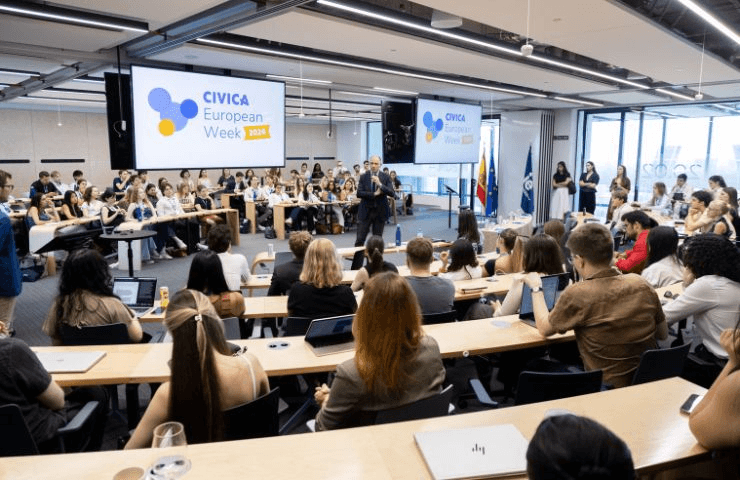
Dean Letta further illustrated the scale of the challenge through data: "Europe’s real GDP stands at €17 trillion, compared to €25 trillion in the United States. However, in financial terms, Europe’s share corresponds to just 12% of the global market, whereas the US accounts for 60%. Europe does not lack ideas; rather, it requires greater investment. With American investment reaching the trillions, we are not competing on an equal footing."
The week began with a welcome address by Borja Santos, Associate Dean. He highlighted Europe’s lack of strategic autonomy: "We remain dependent in areas such as defense, space and satellites. In energy, we pay more than twice as much as the US and 50% more than China. Reducing costs is essential to enhance competitiveness." Santos also emphasized the importance of EU enlargement: “It brings not only a larger market but also access to mineral resources, stronger geopolitical positioning, and an opportunity to reinforce the rule of law.”
Catherine E. De Vries, Vice Dean and Head of the Political Science and International Relations Department, delivered one of the week’s key lectures. She addressed the foundations of the EU, the role of European institutions, and the functioning of European democracy. "The EU’s strength lies in its scale, which provides greater bargaining power," she noted, while also pointing out that "the EU is often blamed for issues beyond its control; it is simply easier to blame Brussels."
The IE Competitiveness Hub Brussels also contributed to the program with a session on Europe’s innovation and connectivity challenges. Tullio Ambrosone, Coordinator of the Hub and Director of the Arel Single Market Lab, and Odysseas Konstantinakos, Research Fellow at the Hub and PhD candidate at the European University Institute, identified three key bottlenecks affecting Europe’s competitiveness: scale, capital and fragmentation. They highlighted the European paradox: "Europe has talent, ideas and savings, but lacks the investment architecture to scale them, resulting in a persistent gap in research, development and innovation."
Students worked throughout the week on group presentations addressing three key dimensions of European competitiveness: energy, innovation and financial markets. At the conclusion of the program, they presented their work before an expert jury, followed by an awards ceremony recognizing excellence across several categories, including Best Overall Presentation, Best Research Analysis, Best Communicator, and Most Innovative and Creative Project.
CIVICA, the European University of Social Sciences, brings together ten leading higher education and research institutions across the fields of social sciences, humanities, business and public policy. The alliance connects over 72,000 students and PhD candidates.