Competing Under Pressure: What IE Sci-Tech Students Learn at Global Hackathons

From St. Gallen to San Francisco and Stockholm, students applied their technical training in high-pressure environments - building, testing, and pitching solutions across disciplines.
A hackathon reduces the logic of engineering into a single constraint: limited time. There is no space for clean processes or complete information. What emerges instead is a different kind of learning - one built on approximation, iteration, and decision-making under pressure.
In early 2026, students from IE School of Science & Technology took part in three such environments: START Hack in St. Gallen, the Web Agents Hackathon in San Francisco, and HackEurope in Stockholm. Across contexts - from fintech to AI infrastructure - the challenge was less about what students knew and more about how quickly they could use it. Technical knowledge was essential. The test was translating abstract ideas into solutions that could be tested, communicated, and defended.
From defined problems to open decisions
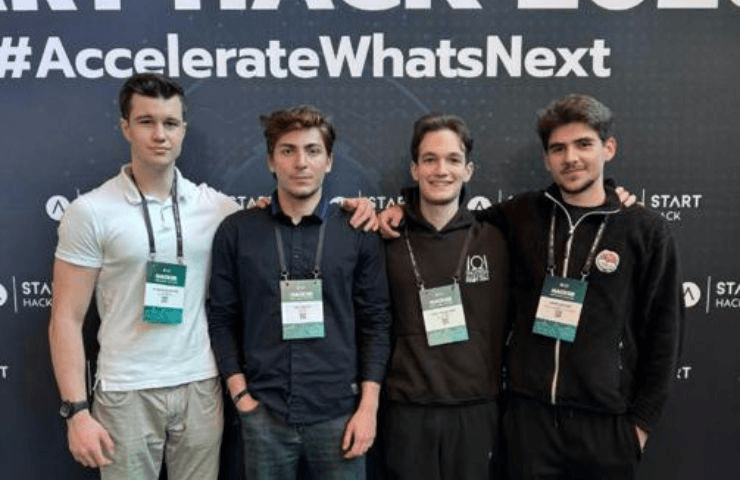
At START Hack in St. Gallen, a team working on a PostFinance challenge approached a problem - financial literacy - from a different angle. Rather than treating investment education as content delivery, they framed it as behavior.
"We were trying to solve how to teach diversified investing in a way that would actually be engaging," explains Bachelor in Business Administration & Computer Science and Artificial Intelligence student Irakli Sulamanidze. "Instead of making it feel like theory, we turned it into something interactive through a game-based approach."
This shift changes the nature of the problem. Designing a game requires thinking about incentives, feedback loops, and user engagement - areas that sit between finance, behavioral science, and software design. It also forces early decisions. There is no time to model every scenario or validate every assumption.
"The hardest part was making decisions quickly, even when we weren’t fully sure. You need to keep moving and not get stuck on one version of the idea."
Building under constraint
If St. Gallen emphasised iteration, HackEurope in Stockholm pushed teams further into physical and cognitive limits. A 24-hour format, minimal sleep, and continuous evaluation create a different kind of environment - one where endurance shapes outcomes as much as technical ability.
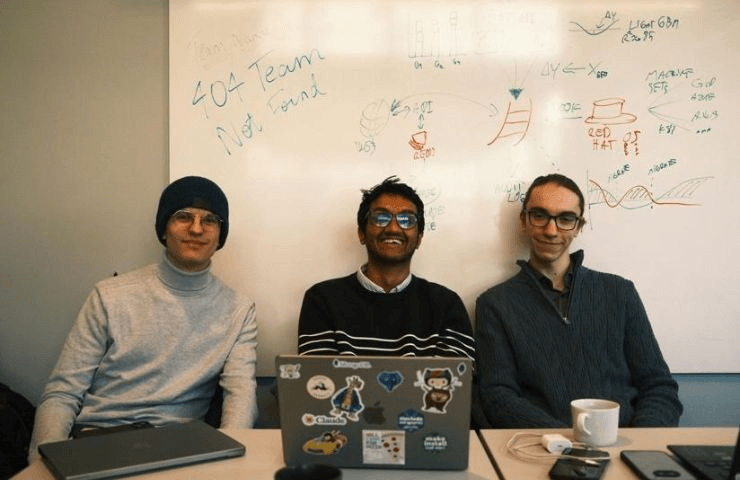
Students Armand Hubler (BBADBA), Daniel Rosel (BCSAI), and Aswin Subramanian Maheswaran (BCSAI) built a project focused on the energy cost of training AI models. Their premise: as AI systems scale, their environmental footprint becomes a design problem, not just an infrastructure issue.
"It was a 24-hour hackathon and we built a product on sustainable forms of training AI models," says Aswin. "We pitched it to technical founders and investors."
In this instance what stands out more than the topic of AI sustainability, are the conditions under which it was addressed. With limited time, the team had to reduce a complex systems problem into a coherent narrative and a functional prototype.
The environment reinforced a particular way of working: prioritizing clarity over completeness. What matters is identifying a viable direction quickly and making it understandable to others. As Irakli described it, building under pressure is rarely clean. It is a sequence of decisions that trade accuracy for progress.
Crossing contexts: from Europe to Silicon Valley
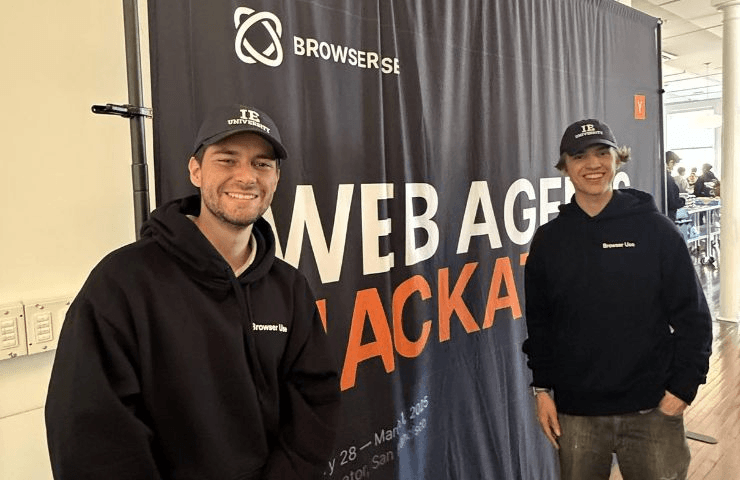
At the Web Agents Hackathon in San Francisco, the context changed again. Here, the focus was on autonomous systems and AI agents - an area where technical depth connects with fast-moving industry expectations.
Bachelor in Computer Science & Artificial Intelligence students Rodrigo Sagastegui and Ricardo Mendez entered a space shaped not only by engineering challenges but by proximity to companies actively deploying these systems. Working on the problem of product onboarding, they initially set out to simplify how users interact with complex platforms.
As the project evolved, they developed a Chrome extension that uses browsing agents to guide users step by step through any web application, turning interface complexity into something navigable in real time. For both, part of the value lay in the environment itself - working within San Francisco’s startup environment - where exposure to real workflows shapes how ideas are developed.
Participating in this environment exposes a different constraint - relevance. Ideas are evaluated on technical merit, but also on whether they fit into existing or emerging ecosystems.
Across all three hackathons, students moved away from solving clearly defined problems and into situations where the problem itself was still unclear. Instead of following a structured approach, they had to decide what mattered, test assumptions quickly, and adjust based on partial results. As Rodrigo notes,
"24 hours requires a lot of strategy… we were careful with the idea we wanted to pursue… and were smart enough to pivot quickly."
This meant working across disciplines in real time - aligning technical, business, and design perspectives while continuing to build. Progress depended on maintaining momentum under uncertainty, dividing work efficiently, and relying on prior collaboration. As Rodrigo says, "being able to put all those skills into practice in a highly dynamic, fast-paced environment was truly remarkable."
Teams as systems
One recurring element across all three experiences was the composition of interdisciplinary teams. Students came from different programs - business analytics, computer science, artificial intelligence - and often had not worked together before.
This diversity introduced friction but also expanded the solution space. "We came from different backgrounds, so we approached problems in different ways," Irakli explains. Under time pressure, teams cannot afford misalignment, so communication becomes central. Clarity - what the problem is, what the next step is - becomes as important as technical execution.
In this sense, the team itself operates as a system: inputs (skills, ideas) must be coordinated efficiently to produce an output within strict constraints.
The advantage of the Hack
Hackathons are often described as competitions, but their value lies elsewhere. They expose how people work when familiar structures disappear.
There are no complete datasets, no extended timelines, no fully defined problems. Instead, there is a sequence of decisions made with partial information. The ability to move forward - to build, test, discard, and rebuild - becomes the core skill.
For IE Sci-Tech students, these experiences make something visible that is less apparent in structured coursework: knowing something is not the same as being able to use it. The difficulty lies in applying that knowledge when time is limited, information is incomplete, and decisions cannot be postponed.
In most engineering and technology fields, that gap is becoming more pronounced. Systems are more interconnected, and problems rarely sit within a single domain. The ability to work through that complexity - quickly, and with others - is becoming a defining part of technical practice.