Designing Energy Systems Under Pressure: Lessons from Iberdrola at the IE Sustainability Datathon

Emilio Tejedor, AI lead at Iberdrola, reflects on charging models, data and what it takes to build energy infrastructure.
Designing infrastructure in energy is increasingly a question of coordination between data, regulation, and demand that does not stand still. At the latest edition of the Sustainability Datathon, held at the IE School of Science & Technology, students were asked to model a problem that reflects this shift: how to deploy an electric vehicle charging network beyond major urban centers. This requires combining road data, adoption forecasts, and grid constraints into a system that can hold under scrutiny.
For Emilio Tejedor, who leads AI program and VRO (Value Realization Office) functions at Iberdrola, the technical difficulty is not the main barrier for the students. "You have to put everything together into a single model that can produce something you can defend," he said. The emphasis is less on arriving at the right answer than on being able to justify how that answer was constructed.
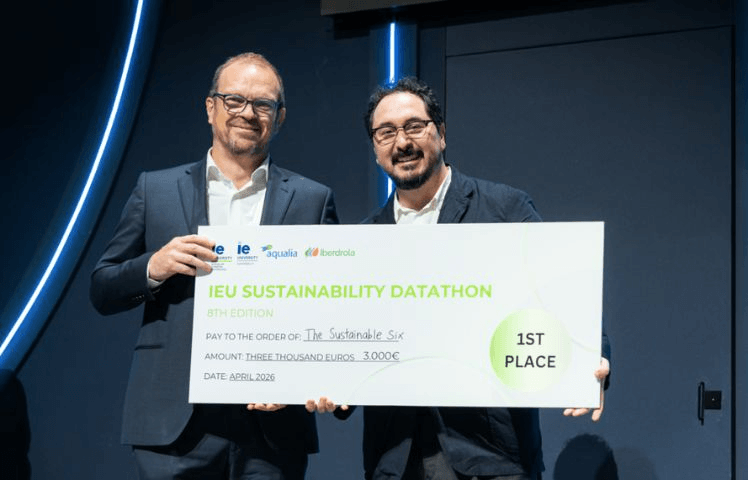
The Sustainable Six, composed of Apilash Balasingham, Henning Peleikis, Matthew Graham, Luis Guareschi Soto, Hugo Leroux, Alejandro Gutierrez Werner, winners of the 8th edition of the IEU Sustainability Datathon with the Iberdrola challenge showed with their project the minimum number of charging stations as well as their locations that Iberdrola would need to install in order to optimize their EV charging infrastructure.
Modelling is not the hard part
The challenge teams worked on - optimizing charging infrastructure for interurban routes - forced a specific type of thinking. It is not enough to map demand or identify gaps. The model must reconcile conflicting constraints: grid capacity, geographic distribution, future adoption, and cost.
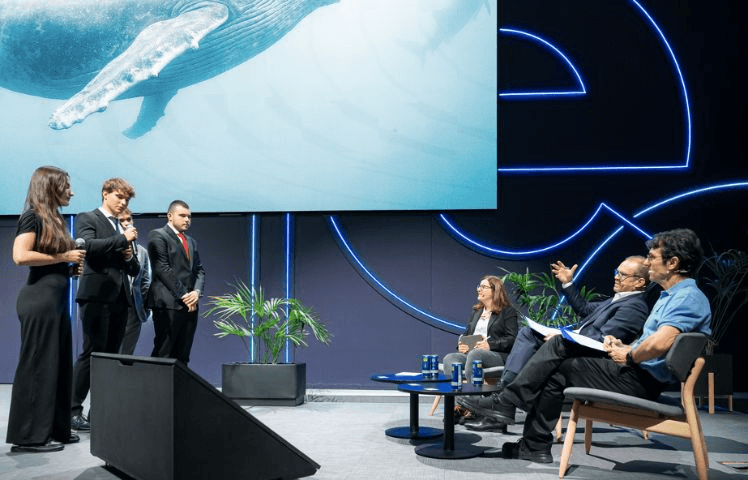
That tension is where most proposals weaken. According to Tejedor, the strongest submissions were not necessarily the most complex, but the ones that made their assumptions explicit. "The ideas have to be founded on solid data and assessment," he noted. "You might not be right all the time, but you need a good argument." A model is only as useful as its ability to be interrogated and adapted.
What becomes clear in this type of problem is that models do not operate in isolation. They sit within a system shaped by shifting demand, regulatory constraints, and long development timelines.
For Tejedor, this reflects how decisions are made in practice. Rather than being endpoints, models are tools used to navigate uncertainty, where assumptions are tested and adjusted over time.
In applied environments, this means making trade-offs explicit: between coverage and cost, speed and reliability, short-term demand and long-term infrastructure. The challenge is about structuring decisions in a way that can evolve as conditions change.
Energy systems move swiftly
The context for these expectations is a sector under pressure. Energy infrastructure has traditionally operated on long timelines and predictable demand. That is no longer the case.
"The pace of change is outstanding," Tejedor said. Demand is shifting quickly, driven by electrification, new consumption patterns, and customer expectations. Regulation, by contrast, moves more slowly. Companies are left balancing both.
This creates structural tension. Large operators must remain compliant while adapting to conditions that may change before a project is fully deployed. In renewables, where development cycles can span years, the economics of a project can shift between approval and operation.
"The business case you present today might not hold when the asset goes live," he noted.
AI is being applied where margins are thin
In this environment, AI is treated as a tool embedded across operations.
In retail energy markets, where competition is high and margins are limited, AI is used to improve customer retention and pricing decisions. In infrastructure-heavy parts of the business - networks and generation - it is applied differently: reducing operational costs, improving recovery times, and refining investment decisions.
Rather than AI solving the same problem across the organization, it adapts to the constraints of each business unit. What remains constant is the objective: improving the viability of both new developments and existing assets.
Energy companies used to operate in a largely one-directional system: generation, transmission, consumption. That model has fractured. Distributed generation, electric mobility, and bidirectional networks have introduced new actors and feedback loops. Customers are no longer just consumers; they can also produce and store energy. Smaller entrants can compete in areas that were once closed.
"It’s a completely new game," remarked Tejedor. This certainly creates a structural hurdle for large organizations. Established processes, designed for stability, must now accommodate rapid iteration. Smaller firms may move faster, but face scaling constraints. The competitive advantage shifts depending on context.
The Sustainability Datathon challenge
Tejedor commented that events like the Sustainability Datathon produce very interesting solutions. Although outputs are, by design, incomplete, since they have to be integrated into the broader ecosystem of projects in the company, these projects do serve a useful function.
They expose how participants approach uncertainty: how they structure a problem, how they prioritize variables, and how they defend their conclusions. For companies, this is often more revealing than the final model itself.
"Talent is everywhere," Tejedor said. "You never know where a new idea will come from."
In a system that does not stand still, decisions are made with incomplete information. What matters is the ability to move forward with partial visibility, and to adjust quickly as new constraints and opportunities, especially in AI emerge.
The energy sector is unlikely to stabilize in the near term. Electrification, decentralization, and regulatory shifts will continue to reshape how systems are built and managed. What remains constant is the need to adapt decisions and as the system continues to transform, as demonstrated by the winners, the Sustainable Six team.