Francesco Chechile on How to Succeed at the Tech Venture Bootcamp

Francesco Chechile, entrepreneur and a repeat mentor at the IE Tech Venture Bootcamp, shares how he met his next software engineer at the bootcamp.
Francesco Chechile knows early-stage entrepreneurship well - from building his own fintech company to guiding other founders through the uncertainty of product development. As a long-time mentor at the IE Tech Venture Bootcamp (TVB) - a joint Impact Xcelerator (IX) and Venture Lab initiative - he’s now returning for his fifth edition, bringing sharp questions and advice to the next cohort of Sci-Tech entrepreneurs.
His own startup, Rentee, is a financial platform designed for short-term rental managers, aimed at automating and accurately handling payouts, bank reconciliation, and keepbooking. Its value proposition focuses on eliminating manual tasks, reducing errors, and providing full visibility into the cash flow generated by bookings, regardless of the PMS or OTA used.
But beyond product features, Francesco’s impact at the Bootcamp has come through direct mentorship, feedback that challenges assumptions, and - most notably - hiring a student he met through the program.
Here are a few tips from Francesco, one of the TVB’s top mentors, for students joining the upcoming edition in February.
Mentoring: It's About the Problem, Not the Pitch
Francesco’s approach to mentoring isn’t about fine-tuning the aesthetics of a deck. His starting point is always the same: clarity on the problem.
- Do you truly understand the market you are entering?
- Is the problem real, specific, and painful enough?
- How does your solution compare meaningfully to existing alternatives?
He places particular emphasis on product-market fit and on helping founders clarify and sharpen their pitch - what the value really is, why it matters, and how to communicate it simply.
At TVB, he works with many teams in short sessions but usually selects one to dive deeper with. He challenges assumptions, pushes for sharper articulation of product-market fit, and encourages teams to test their ideas against reality. Occasionally, his feedback has prompted teams to pivot mid-program - something he sees as a healthy part of the process. Ultimately, the decision belongs to the founders, but the Bootcamp provides a rare window into what iteration actually looks like under pressure.
Spotting talent
It was during his first edition as a mentor that Francesco met Iciar Adeliño, now a second-year student in the Bachelor in Computer Science & Artificial Intelligence (BCSAI). He was immediately struck by her technical talent and more importantly, her mindset.
“I quickly realized she had a great capacity for coding, but what truly impressed me was her drive to solve problems using technology. I think she eats tech to survive.”
They met again at a Google for Startups challenge, where Iciar’s team won the competition. At the time, Francesco’s company was testing a new product. He invited her to join the team.
Since then, she’s led both backend and frontend development, contributed to product strategy, and even helped shape investor discussions. Her ability to navigate between technical execution and broader startup dynamics, he says, is what makes her stand out.
Francesco describes her versatility as invaluable, showing not just intellectual depth but the capacity to contribute across all dimensions of an early-stage business.
For Iciar, the Tech Venture Bootcamp offered a clear view into how early-stage teams operate under pressure. The pace, rapid iteration, and direct feedback from founders pushed her beyond technical problem-solving and into real product thinking.
“It was the first time I really understood what building a startup involves - prioritizing, communicating, and making decisions when you don’t have all the answers”
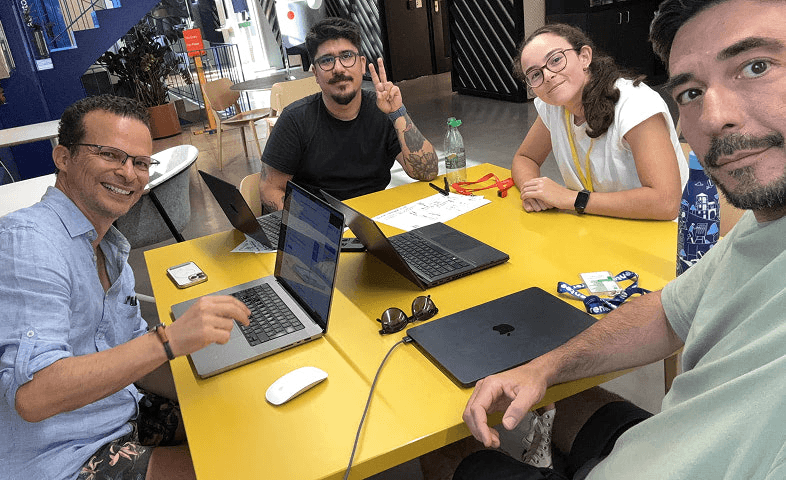
Working in that environment also made her approach and mindset visible to mentors, helping turn the Bootcamp into a stepping stone toward joining Francesco’s startup team.
For him, this experience reflects something larger: “I believe programs like the TVB provide great support, especially for startups that are starting or scaling, by giving them access to real talent.”
Advice to finalists and early-stage founders
Francesco’s advice to TVB finalists is grounded. Not every idea will make it past the program. That’s expected. But for those who are serious about continuing, the key is to stay close to people who have done it before.
“Programs like this sit somewhere between academia and the real world. If you want to build something real, keep going. Don’t wait for perfect conditions - start validating, learning, asking for advice. There are people who will support you, but only if they see you're serious.”
He also sees TVB as more than just an entrepreneurship accelerator. It’s a practical hiring ground. For him, it’s a rare environment where you can actually see how someone thinks under pressure. For a startup, that matters more than a CV.
Francesco’s continued involvement with the IE Tech Venture Bootcamp reflects a larger dynamic at IE Sci-Tech: experienced founders working directly with students on real problems, and talent flowing naturally from the classroom into early-stage companies.