Inside PLD Space: What It Takes to Build a Launch Company in Europe

An MXT immersion in Elche examines how aerospace ventures scale under constraint and what that reveals about deep tech ambition.
A rocket does not allow for iteration after deployment. It either reaches orbit or it doesn’t. That constraint shapes how companies like PLD Space are built.
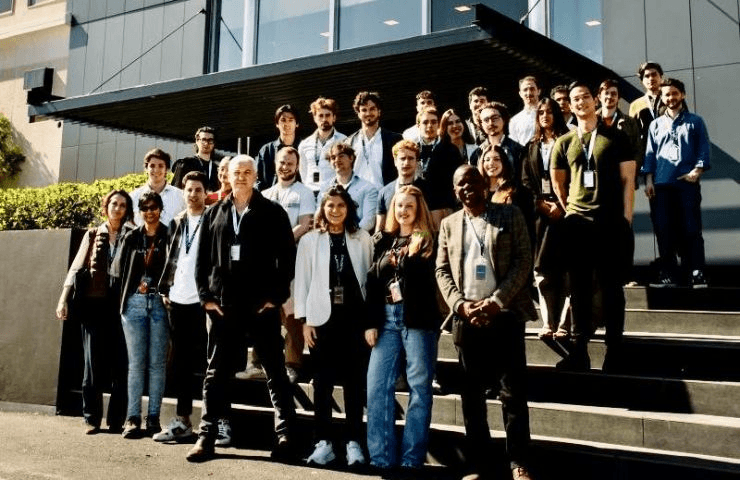
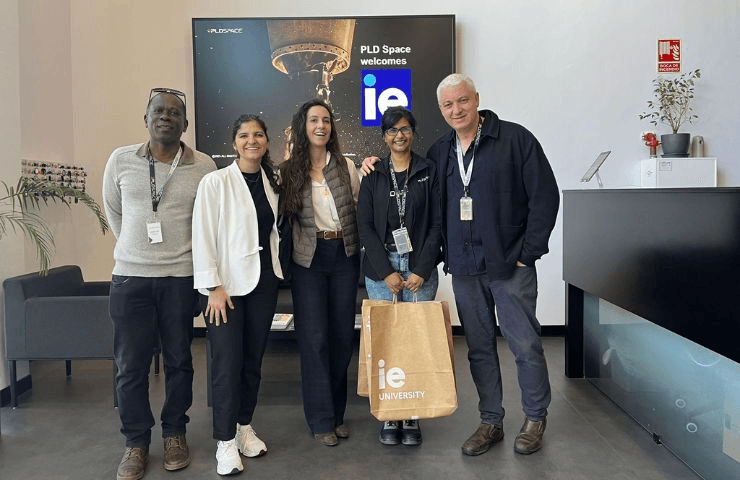
During a recent visit to the Spanish aerospace firm, students from the Management Xponential Technology (MXT) program from the IE School of Science & Technology and the IE Business School encountered an engineering environment where progress depends less on speed than on sequencing. Every subsystem - propulsion, structure, avionics - must work together under conditions that cannot be simulated away.
The visit forms part of the MXT program, delivered under the IEX Labs framework, where technical training is paired with venture and strategic decision-making. In this context, PLD Space becomes more than a case study in aerospace; it is a working example of how deep tech ventures take shape.
Engineering systems that resist iteration
In software, errors can be corrected after release. In launch systems, failure is terminal.
At PLD Space, testing is not a formality but a process of reducing uncertainty step by step. Each validation stage is designed to eliminate specific risks before the next irreversible phase. What appears in the classroom as systems engineering becomes, in practice, a negotiation between performance, safety, cost, and time. Improving one variable typically degrades another: increasing thrust affects structural stress, reducing weight introduces material risk, and compressed timelines limit testing.
In this context, the task is not to optimize in the abstract, but to arrive at a configuration that holds under real conditions.
From Elche to orbit
The students noticed a shift in where advanced engineering is happening. PLD Space, founded in Spain and operating from Elche, is developing the MIURA family of launch vehicles with ambitions that extend beyond small payload delivery to broader participation in the global space economy.
As one student put it, "I couldn’t believe how a young guy from Valencia could end up launching rockets into space, all produced and put into orbit from Elche."
Its trajectory reflects a category of a European venture that is capital-intensive, technically complex, and global from inception.
This is unfolding against renewed momentum in the global space sector. The recent Artemis launch - part of NASA’s programme to return humans to the Moon - signals a broader shift toward large-scale, state-backed space ambition, while creating parallel opportunities for private launch providers. Companies like PLD Space operate within this evolving landscape: not competing directly with heavy-lift missions, but building the infrastructure that supports a more distributed, commercially driven orbital economy.
Scaling ambition through constraint
PLD Space does not scale like a software company. Growth is not driven by user acquisition or rapid iteration, but by the resolution of tightly coupled technical challenges.
The company recently secured significant backing, including a €180 million funding round supported by international investors, demonstrating both the capital intensity and strategic relevance of launch capabilities in Europe. This level of investment reflects a commitment to long development cycles with high barriers to entry.
For MXT students, this reframes familiar ideas about venture growth. In digital environments, scale often precedes stability. In aerospace, stability must come first.
"I first met the founders of PLD Space when many people in Spain were laughing at the idea that two guys from Elche could build rockets. With the successful launch of Miura 1 and the ambitious plans for Miura 5, this MXT cohort could see firsthand that the only limits are the limits of your imagination," said Joe Haslam, Academic Lead of the MXT.
A different model of venture building
PLD Space represents a form of "10x" ambition that is not defined by rapid expansion, but by step changes in capability. Each successful test unlocks a new level of technical and commercial possibility.
This introduces a different kind of mindset. Progress is measured not in features shipped, but in risks eliminated. Timelines are extended, but the stakes are higher.
For students operating at the intersection of technology and business, this creates a useful tension. The tools of venture building, whether they be capital allocation, strategic positioning or market timing, must be adapted to systems that cannot be rushed.
No shortcuts
What distinguishes the PLD Space visit is not exposure to advanced technology, but exposure to its limits.
Aerospace engineering does not allow for simplification. Physical laws, regulatory requirements, and material constraints impose boundaries that shape every decision. These are not variables that can be optimized away; they define the system itself.
For IE Sci-Tech, these immersions place students in environments where technology is not yet abstracted into frameworks or tools. It must be understood in its full complexity.
As European space ventures expand, the challenge is at once technological and organizational: how to sustain precision, secure long-term capital, and operate at a level where failure is not iterative, but absolute. It is within that constraint that ambition becomes meaningful.