MXT Kicks Off with Esteban Granero on Technology, Resilience, and Reinvention

The new cohort of the Management Xponential Technology program began their journey with insights from former footballer-turned-entrepreneur Esteban Granero, exploring how performance, adaptability, and purpose drive technological innovation.
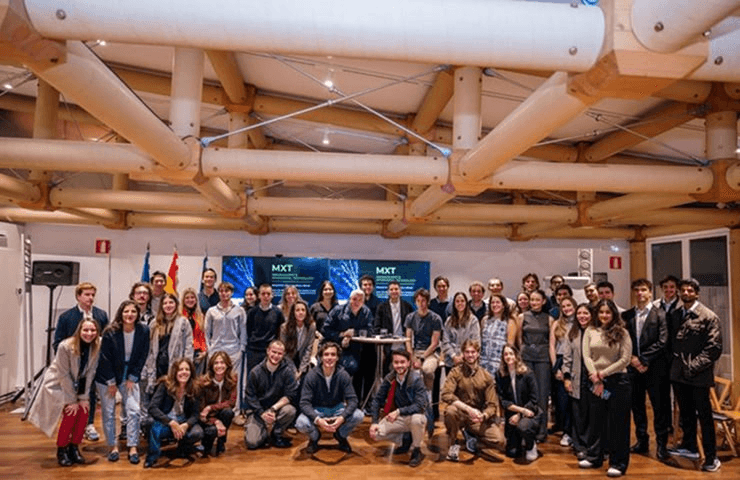
Bringing together students from IE Sci-Tech and the Business School, the Management Xponential Technology (MXT) program helps future leaders understand how emerging technologies can drive business transformation. Designed to connect technical expertise with a management mindset, it encourages students to learn not only from professors and guest speakers but also from one another.
At the launch of the third edition of the MXT at the Maria de Molina campus of IE this fall, Dean Ikhlaq Sidhu and Dean Lee Newman opened the session, discussing the history of joint management-and-technology programs and how MXT adds the "exponential mindset" component that today’s leaders need. Academic Director Raquel Cabero Quiles also welcomed the new cohort, emphasizing that MXT aims to foster a mindset for innovation and real-world impact — turning ideas into action through technology and collaboration.
From the Pitch to the Lab
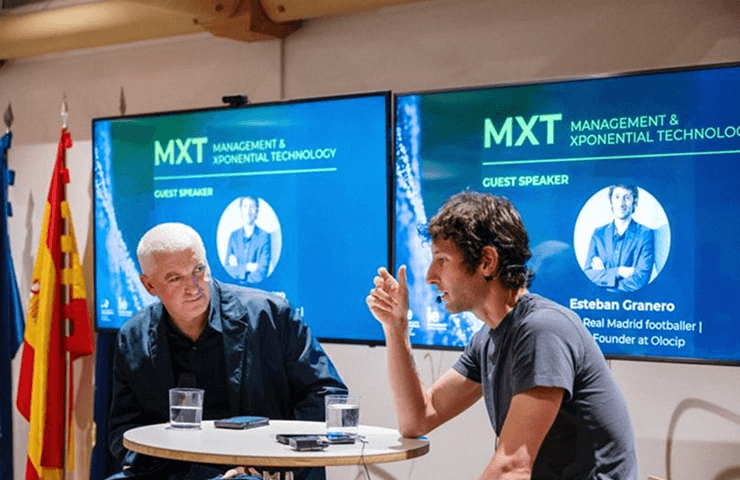
The evening’s guest speaker, Esteban Granero — former Real Madrid and Real Sociedad midfielder and now founder of the AI company Olocip — shared his journey from professional sports to technology entrepreneurship in a conversation led by Professor Joe Haslam, Academic Lead of MXT.
Granero’s interest in data began during his playing career, when he noticed clubs collected vast amounts of statistics without truly knowing how to use them. Analysts and coaches were surrounded by numbers but struggled to draw meaningful conclusions. As he later noted, sports often lags behind other industries in turning information into insight.
His curiosity eventually led him to collaborate with researchers at the Universidad Politécnica de Madrid, who would later become his partners at Olocip. As he explored the potential of data in sports, Granero realized that most analysis at the time was purely descriptive, focused on what had happened, rather than why. "There was no information about how the data interacted or how it could be used to make better decisions," he explained. This insight inspired him to launch his company in 2016, at a time when, as he put it,"talking about AI in football sounded strange."
Technology and Human Decision-Making
Granero described Olocip’s mission as helping experts make better, more informed choices. "What we do with technology is create tools that enhance decision-making," he said. "Experts know the field, but we want to provide them with the best possible data — data that reduces uncertainty."
He also cautioned against treating data as a numbers game. "It’s not about how many things a player does," he explained, "it’s about the value those actions bring to the probability of success." For Granero, technology is never meant to replace human intuition but to refine it: "There’s always resistance in sports, but tech should support decision-makers, not take decisions away from them."
Humility, Teamwork, and Perspective
Reflecting on his football career, Granero compared the dressing room to a "social lab." "You spend every day with people who are also your competitors," he said. "That teaches you quickly that ego is useless. You learn that you can’t do everything on your own."
That same philosophy guides him as a founder. "When I interview people, I look for commitment, fairness, and long-term vision," he said. "I don’t need to know everything. I trust my technical people to decide what kind of AI engineers we need. My job is to make sure the culture is right."

On Innovation and Simplicity
Granero also spoke about creativity as a matter of observation rather than invention. "Disruption isn’t always about complexity," he said. "Sometimes it’s about seeing what’s in front of you and daring to apply it differently."
He recalled a story from his playing days: "I saw a teammate take a free kick in a way I had never seen before: simple, almost effortless. The next time, I tried it and scored. People thought I had discovered something new, but I had just emulated something excellent. That’s also innovation."
A Shared Approach to Technology
On competition and access, Granero emphasized that technology should be shared, not hoarded. Collaboration fuels progress, he argued, while withholding innovation only slows it down. A club doesn’t lose its competitive edge because others adopt the same tools; it loses it by refusing to evolve.
He also questioned the logic of clubs developing proprietary systems. Specialized technology companies, he said, can provide more advanced, efficient solutions. “Even if everyone uses the same tools,” he noted, “the results will differ, what truly matters is how you use them.”
A Mindset for What’s Next
For MXT students beginning their projects, Granero’s message centered on mindset and continuous learning. Drawing parallels with his years on the field, he reminded them that setbacks are inevitable, even for top performers. Success, he said, comes from persistence: "The key is to keep going."
He encouraged students to approach challenges with openness and humility: "You have to be humble enough to listen, and when a challenge appears, you need to take it."