Rafael Schvartzman on Data, Aviation and the Long Road to Net-Zero

A conversation with IATA’s Regional VP for Europe on sustainability, data, and the future of aviation.
IE School of Science & Technology recently hosted the latest edition of its Sustainability Datathon - a recurring series that challenges students to work with real-world data at the intersection of technology and environmental responsibility.
This time, the focus was aviation, with the International Air Transport Association (IATA) coming on board as a strategic partner. Students explored how data and predictive modelling could inform decarbonization strategies in one of the world’s most complex - and scrutinized - industries.
We spoke with Rafael Schvartzman, IATA’s Regional Vice President for Europe, about the thinking behind the collaboration, what students brought to the table, and how the sector is shifting from reactive to predictive when it comes to sustainability.
Why bring a Datathon like this into an academic setting?
At IATA, we’re always looking for ways to collaborate with academia, especially on aviation’s biggest strategic and environmental challenges. The idea of working with students who are strong in data science, engineering, and systems thinking appealed to us right away.
It’s not just about giving them exposure to the industry. It’s about shaking up our own assumptions. In our daily work, we often get caught up in what’s immediately in front of us. Students bring a different kind of thinking that is less constrained, and more forward-looking.
Events like this are a genuine two-way exchange.
"We offer real datasets and problem statements. They respond with fresh models, critical questions, and in some cases, entirely new angles."
What kinds of ideas did students bring to the table?
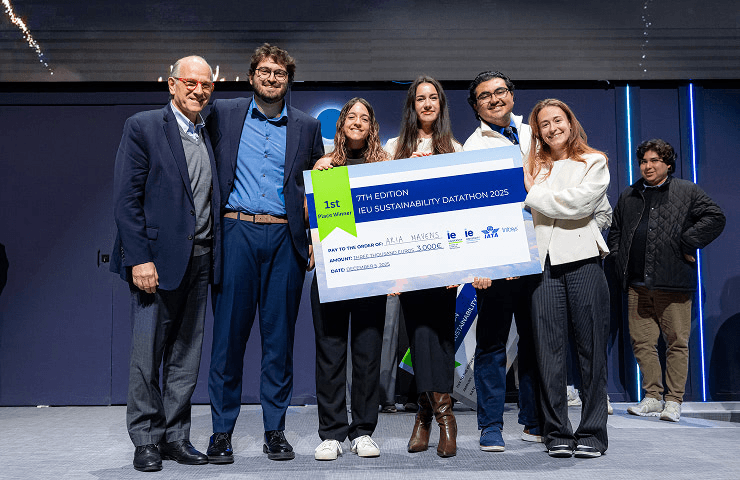
Several were genuinely surprising. We saw alternative ways of calculating and presenting CO₂ impacts, creative modelling of Sustainable Aviation Fuels (SAF), and some impressive efforts to make complex issues understandable to broader audiences.
What stood out was how many teams didn’t just stop at the data. They also looked at how to engage society - passengers, regulators, companies - in shaping a more sustainable aviation future. That broader lens is exactly what the industry needs more of.
We came in hoping to spark creativity. What we got were ideas that challenged us to think differently about both the technical and human aspects of the transition.
Let’s talk about the big picture. Why is sustainability such a critical issue for aviation right now?
Contrary to popular belief, aviation’s contribution to global CO₂ emissions is far from double digits. It’s currently estimated at around 2.5% - coincidentally, about the same as data centers.
That figure may seem relatively low, but aviation is more than just a mode of transport. It’s a key enabler of global economic growth, social connectivity, and sustainable development. By efficiently moving people and goods, air transport supports trade, tourism, and business. It also contributes to the UN Sustainable Development Goals by improving access to education, enhancing mobility, and fostering cultural exchange.
Ultimately, aviation connects communities, creates jobs, and underpins entire industries. It’s a catalyst for long-term economic progress and higher living standards.
To make sure the industry can continue to deliver those benefits - while aligning with the 2015 Paris Agreement on climate change - IATA and its member airlines have committed to a net-zero CO₂ emissions target by 2050.
But for us, sustainability goes well beyond carbon. We’re also working to address non-CO₂ emissions, reduce noise pollution, manage waste responsibly, and confront environmental issues such as illegal wildlife trafficking.
At the same time, data and technology are transforming how we operate. Over the past five years, we’ve seen more digital disruption than in the previous two decades. Today, we’re using data to streamline operations, and support real-time, informed decision-making.
But this is only the beginning. Emerging technologies - AI, machine learning, robotics - are still in early stages within aviation. As they mature, they’ll bring even more substantial changes to how the sector reduces its footprint and plans for the future.
Where does data come in? How is it changing the way the sector operates?
The aviation sector generates huge amounts of data. IATA collects, analyses, and redistributes information on almost every operational front - from safety and flight scheduling to fuel consumption and carbon emissions.
"Digital transformation is already well underway. In the last five years, we’ve seen greater change than in the previous two decades combined. Today we use data to streamline operations, optimize flight paths, improve maintenance, and understand customer behavior in real time."
But we’re only scratching the surface. AI, machine learning, and robotics are still at an early stage in our industry. Their potential to reduce emissions and improve efficiency is enormous - especially when it comes to predictive modelling.
For example, being able to anticipate SAF supply trends, simulate the impact of different policy scenarios, or optimize ground operations based on real-time data - these things change how we plan, not just how we react.
As more data becomes available - from satellites, sensors, digital workflows - our ability to model the system improves. That’s critical if we want to design realistic pathways to net-zero.
What about Sustainable Aviation Fuel? What’s the current data challenge there?

SAF is expected to contribute about 65% of the total CO₂ reduction required to reach net-zero. That makes it absolutely central to our strategy.
We already have a methodology in place for measuring its emissions impact, based on a full lifecycle approach aligned with ICAO’s CORSIA framework. It covers everything from feedstock cultivation to final fuel use.
But the big challenge now is harmonization. Different regions and suppliers use different standards and assumptions, which complicates reporting and slows down adoption.
Until we close those gaps, it will be harder to attract investment, develop clear regulations, and build trust across the value chain. Transparent, standardized data is essential.
Interestingly, some of the students at the Datathon explored new ways of visualizing these lifecycle dynamics. Their work won’t replace formal frameworks, but it can help us think about how to communicate these trade-offs more clearly.
How do you see these types of student collaborations fitting into the bigger innovation picture?
They’re more than just nice-to-have. They play a real role in shaping the future of the sector.
"When students work with real-world data, they begin to understand both the complexity and the opportunity. And when we in the industry listen to them, we see our own systems with new eyes."
For me, these collaborations are energizing. They remind us not to fall into the trap of "business as usual." They push us to ask better questions and sometimes, they point us toward answers we might have missed.
And for students who want to work with data, technology, or mobility - what would you say?
Life is a series of decisions we make with the head, the heart, and sometimes even both simultaneously! In the professional world, and particularly in aviation, data plays a critical role in the former.
Working with data puts you right at the center of the "five W’s and one H" of decision-making: who, what, when, where, why, and how. It’s intellectually stimulating, especially at a time when technology and digitalization are transforming almost everything we do, both professionally and personally.
In a globalized world where people and goods need to move freely, aviation - often described as "the business of freedom" - remains a highly compelling sector.
And more poetically, as the American writer John H. Secondari once imagined Leonardo da Vinci thinking: "Once you have tasted flight, you will forever walk the earth with your eyes turned skyward. For there you have been, and there you will always long to return."