Tech Leadership Insights: Paul Murphy and Juan Dominguez on AI, Investment, and the Future of Innovation

Exploring AI, Venture Capital, and the Next Wave of Tech Disruption.
IE Sci-Tech recently wrapped up its annual Tech Catalyst Leadership Program, designed to equip participants with the skills and knowledge to navigate the intersection of technology and business. Following the first session in Berkeley, the Madrid leg was packed with lectures, case studies, and hands-on projects on AI-driven innovation, emerging tech strategies and ethical leadership.
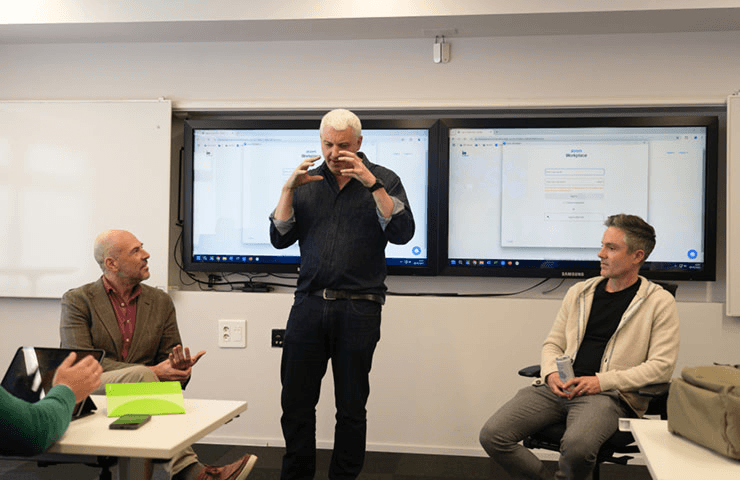
With an impressive lineup of industry leaders sharing their expertise, one standout session was the fireside chat between Paul Murphy, Partner at Lightspeed Venture Partners, and Juan Dominguez, Founder of Plaf. Their discussion delved deep into the AI investment landscape, the future of venture capital, and the evolving role of sovereign AI models. Here’s a sneak peek into some of the most compelling insights from their conversation.
AI Investment: A Global Perspective
Lightspeed, one of Silicon Valley’s most established VC firms with over $35 billion under management, has been an active player in AI investments. Murphy highlighted that the firm has poured nearly $2 billion into AI-related ventures, including foundation models, enterprise AI applications, and infrastructure solutions.
One of the central questions in the discussion was whether AI is a winner-takes-all market. Murphy argued that AI will create multiple multi-billion-dollar companies across different verticals. While firms like OpenAI, Anthropic, and Mistral are competing in the foundation model space, other AI-driven businesses are thriving in specific applications - from legal tech to enterprise productivity solutions.
The Competitive Landscape of AI
Murphy acknowledged that the AI race is still in its early stages, with various players staking their claim. Some key takeaways:
- Multiple Winners: AI is not a zero-sum game. Companies like OpenAI, Anthropic, Mistral, and xAI will coexist, serving different markets and priorities.
- Specialized AI Models: Enterprise customers, sovereign nations, and niche industries demand AI models tailored to their needs, not just general-purpose solutions.
- Shifting Value Chain: While infrastructure companies like NVIDIA and cloud providers dominate AI hardware, real value lies in AI-powered solutions that solve specific business problems.
The Future of AI Deployment: Sovereign and Enterprise AI
A major theme was the rise of sovereign AI models - governments and enterprises looking to develop their own AI models instead of relying on Silicon Valley giants. Dominguez and Murphy discussed how countries like India and France are investing in localised AI models to protect data sovereignty and reduce dependency on U.S.-based infrastructure.
AI Ethics: Open vs. Closed Models
The ethical considerations of AI were another focal point. Murphy pointed out that companies like Anthropic take a curated, rule-based approach to ethical AI, whereas Mistral believes in transparency and openness - letting users audit and modify AI behavior.
The conversation also touched on the long-term implications of AI decision-making, especially in areas like finance, law, and governance. Will AI systems align with human ethics, or will they optimize for pure efficiency?
Enterprise AI Adoption: Hype vs. Reality
While AI has seen explosive growth, Murphy emphasized that many AI startups struggle with real-world adoption. Enterprise AI solutions must deliver tangible ROI, not just hype. He cited an example of a major bank evaluating 100 AI startups, expecting 80% of them to fail within a few months.
Some key trends in enterprise AI:
- AI adoption is slower in regulated industries like finance and healthcare.
- High-quality training data is a bottleneck—many AI models have already consumed the best publicly available datasets.
- AI hallucinations (errors in generated content) remain a major challenge, especially in mission-critical applications.
What’s Next? The Future of AI in 2025 and Beyond
Murphy predicted that 2024 would be all about AI agents - software that autonomously performs complex tasks, rather than just generating text or images. While AI models were the focus in 2023, the next wave of innovation will center around intelligent automation and industry-specific AI solutions.
Key investment themes for 2025:
- AI agents for sales, customer service, and enterprise automation.
- AI-powered scientific research tools, such as materials discovery for carbon capture.
- Low-code/no-code AI development, allowing businesses to customize AI applications without deep technical expertise.
The session wrapped up with a discussion on AI’s impact on global markets, including regulatory challenges and geopolitical tensions around AI development. While the EU and the U.S. are taking different approaches to regulation, entrepreneurs are finding creative ways to navigate compliance and scale AI businesses.
As Murphy and Dominguez highlighted, the AI revolution is just getting started - but the companies that succeed will be those that move beyond hype and deliver real, scalable value.