From Tsunamis to Heatwaves: IE-RSME Workshop on Understanding and Responding to Extreme Events

The Real Sociedad Matemática Española and IE Sci-Tech Bring Together Experts to Transform Mathematical Modeling into Environmental Solutions.
The IE-RSME Workshop Series on Applied Mathematics brought together top minds in data science, meteorology, operations research, and computational mathematics at IE Tower. Co-organized by the Real Sociedad Matemática Española and IE Sci-Tech, the workshop addressed one of the most urgent global challenges: how to use mathematics to predict, understand, and respond to extreme events such as heatwaves, tsunamis, floods, and humanitarian crises.
Mathematics: A Frontline Tool for Climate Resilience
Opening with the provocative question "Is climate change real?", the workshop kicked off with an insightful presentation by José Luis Casado from AEMET, who explored how probabilistic tools, spatiotemporal models, and machine learning can provide early-warning systems, disaster forecasting, and strategic humanitarian response.
Dr. Ana C. Cebrián (University of Zaragoza) detailed her work modeling extreme temperature records in Spain, showing that the frequency of heatwaves has doubled in inland areas over the last decade. By using Bayesian inference and record-based hypothesis testing, her team revealed how climate change is altering not just averages but extremes—particularly during summer months.
In addition, Dr. Cebrián presented a spatiotemporal Bayesian model capable of mapping where and when new heat records will likely occur. Using real data from 40 Spanish weather stations, the research found that up to 90% of Spain has already shown statistically significant deviations from stationary climate behavior, with the most pronounced increases in landlocked regions.
These findings were more than statistical curiosities—they provided actionable evidence for localized climate adaptation strategies, including the development of risk maps and early-response frameworks.
From Predictive Power to Disaster Response
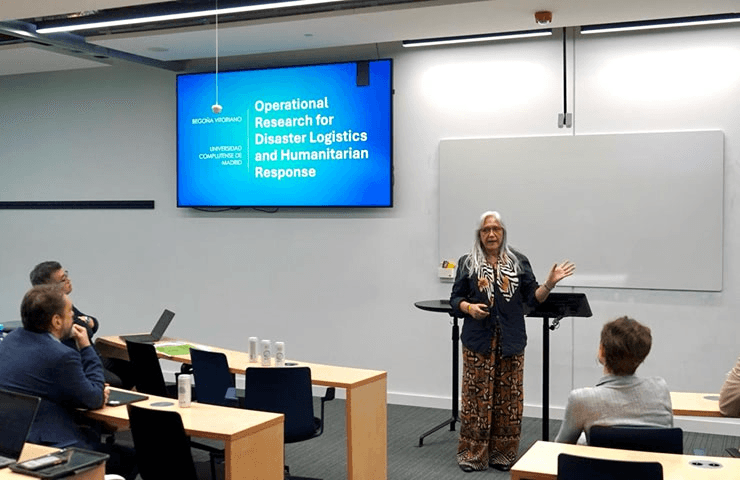
Beyond climate, the workshop also delved into catastrophic events and humanitarian logistics.
Professor Manuel J. Castro Díaz (University of Málaga) demonstrated state-of-the-art tsunami simulation platforms, integrating Shallow Water Equations, deep learning, and GPU-powered real-time forecasting. These models were capable of generating early-warning predictions within minutes, which are critical for saving lives in near-field tsunami zones. Castro’s work has been applied in real-life events such as the Stromboli eruption and has contributed to European civil protection networks.
Complementing the geophysical perspective, Dr. Begoña Vitoriano (Complutense University of Madrid) presented operations research models that support humanitarian decision-making post-disaster. From wildfires in Spain to flood relief in Mozambique, her team’s work helps NGOs and governments optimize the allocation of emergency resources, design robust logistical networks, and prepare for multi-scenario events where resources are scarce and infrastructure is damaged.
Connecting Climate, Health, and Data
The intersection of AI and climate data was further explored by José Luis Casado Rubio, a senior physicist at AEMET. Casado provided a comparative analysis of traditional physics-based models and emerging AI-driven approaches to weather forecasting. He highlighted key challenges in training AI systems with meteorological data—especially the risk of generating oversimplified, smoothed predictions that lack critical nuances. Drawing from his work at the European Centre for Medium-range Weather Forecasts (ECMWF), Casado is now leading a groundbreaking effort to develop a data-driven meteorological model tailored to Spain’s unique climatic conditions, combining scientific rigor with computational innovation.
The workshop also featured flash talks where attendees shared work tied to the event’s theme. Carolina García-Martos presented a project on how pollution affects respiratory health, and Javier Borondo showed how climate change impacts the food industry.
Students at the Forefront
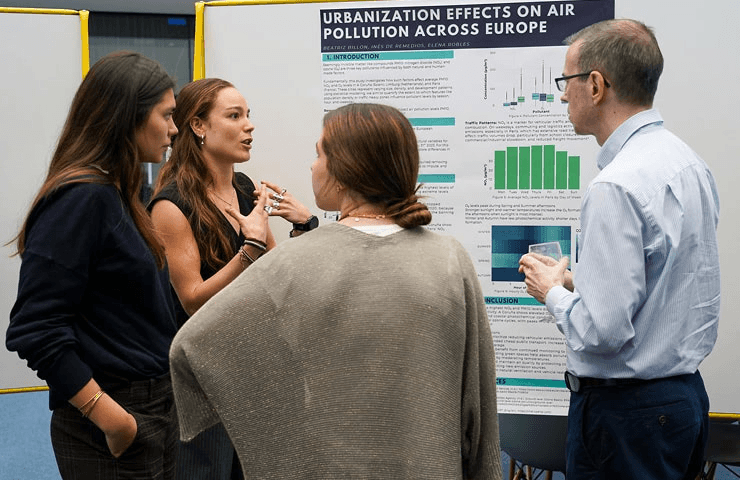
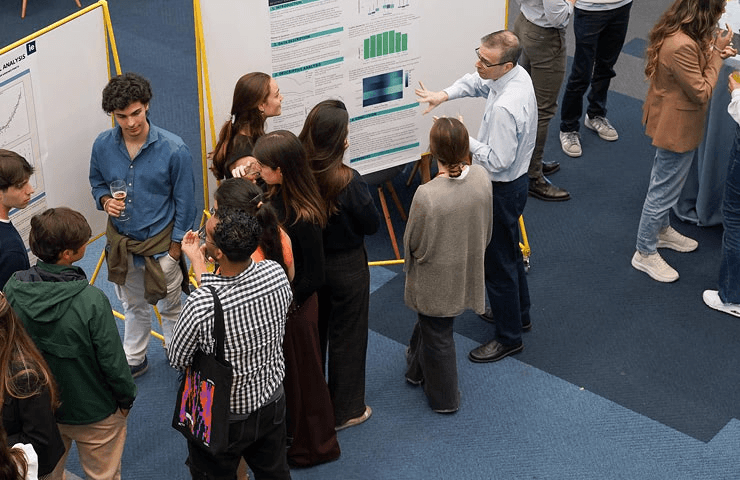
From flash talks on air quality to student-led posters on agricultural modeling, the workshop was a vivid showcase of applied mathematics in motion. Under the guidance of Professor Dae-Jin Lee, IE students demonstrated how mathematical models can drive real-world solutions. More than a lecture series, the IE-RSME Workshop ignited vital cross-sector collaboration—uniting academics, industry leaders, and climate agencies to turn cutting-edge research into actionable strategies for global environmental challenges.
Mathematics Meets Sustainability
At its core, the workshop illustrated how applied mathematics is a crucial - yet often overlooked - ally in the fight against climate-driven disasters. From forecasting extreme weather to designing equitable humanitarian supply chains, it was clear that lives could be saved through mathematics.
By combining rigorous scientific modeling with a commitment to real-world impact, the IE-RSME workshop reaffirmed the power of interdisciplinary collaboration. As weather systems become more volatile and populations more vulnerable, the value of mathematics—as both a predictive and strategic tool—is only set to rise.
The event was supported by the Bachelor in Applied Mathematics (BAM) and IE School of Sci - Tech and funded in part by the SPHERES project (PID2023-153222OB-I00), underscoring the growing recognition of IE’s applied mathematics research in global contexts. Faculty organizers included David Gómez-Ullate, Dae-Jin Lee, Manuele Leonelli, and Irene Alda-Ferrero.