- Home
- Spice Brings Tangible Tech To The Kitchen At Ieee Smc 2025
SPICE Brings Tangible Tech to the Kitchen at IEEE SMC 2025

IE Sci-Tech researchers introduce an AI-powered projection system that reimagines the cooking experience through tangible interaction.
What if your kitchen counter could guide you through a recipe in real time—no phone, no app, no mess? That’s the idea behind SPICE (Smart Projection Interface for Cooking Enhancement), an innovative new system developed by IE Sci-Tech’s researcher Vera Prohaska, supported by Assistant Professor Eduardo Castelló Ferrer and which was presented at the IEEE SMC 2025 conference.
SPICE is a tangible user interface (TUI) system designed specifically for two-handed, real-world tasks like cooking. While TUIs have been explored extensively in labs, their use in practical, everyday scenarios remains underdeveloped. SPICE fills that gap by blending AI-powered projection, agent-based simulation, and vision-language models into a smart interface that turns the kitchen counter into an interactive canvas.
From Screens to Surfaces
Instead of reading recipes on a phone or cookbook, users interact with digital prompts projected directly onto the cooking surface. These visual cues are responsive, spatially aware, and context-sensitive—guiding users through each step of the process based on what they’re doing in real time.
SPICE’s architecture includes a real-time tracking system to monitor user interaction, agent-based software to model recipe flows, and vision-language AI models to interpret and adapt to the cooking environment. It doesn’t just assist, it adapts.
A Smarter Way to Cook
In a comparative usability study, SPICE users completed their recipes in significantly less time, with fewer interruptions, and reported higher confidence, perceived efficiency, and even better taste in the final result compared to traditional text-based methods.
A Glimpse Into the Future of HCI
By focusing on the act of cooking - a universal, often improvisational, and sensory-rich task - SPICE pushes the boundaries of what tangible user interfaces can achieve. It points toward a future of Human–Computer Interaction (HCI) where information moves off the screen and into the physical spaces where we live and work. Rather than asking users to adapt to technology, systems like SPICE adapt to the context and complexity of real-life routines.
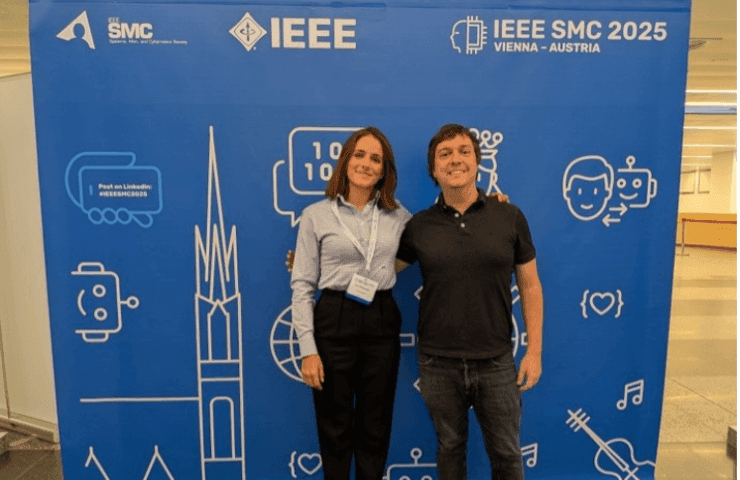
The team was proud to present SPICE at IEEE SMC 2025, a conference known for its focus on cutting-edge research in systems, man, and cybernetics. SPICE reflects the kind of work that defines the research culture at IE Sci-Tech: technically rigorous, and yet deeply human. It shows how technologies like agent-based modeling and vision-language AI can be translated into intuitive, meaningful interfaces—quietly improving how we interact with the world around us.
