
- Home
- Student Projects
- Mindset: Ai-driven News Recommendation System
MINDset: AI-Driven News Recommendation System
MINDset: AI-Driven News Recommendation System
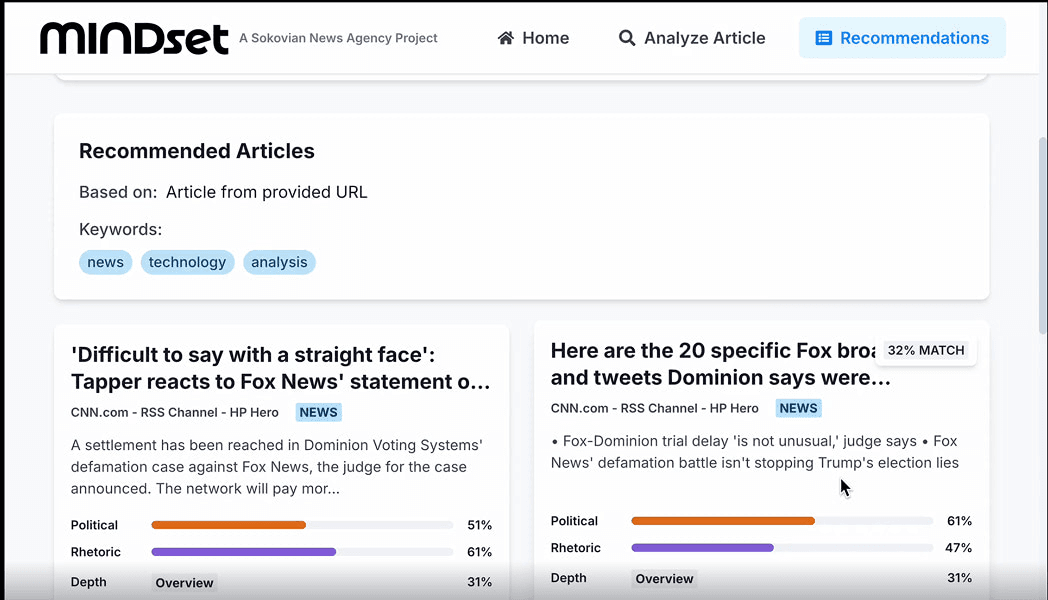
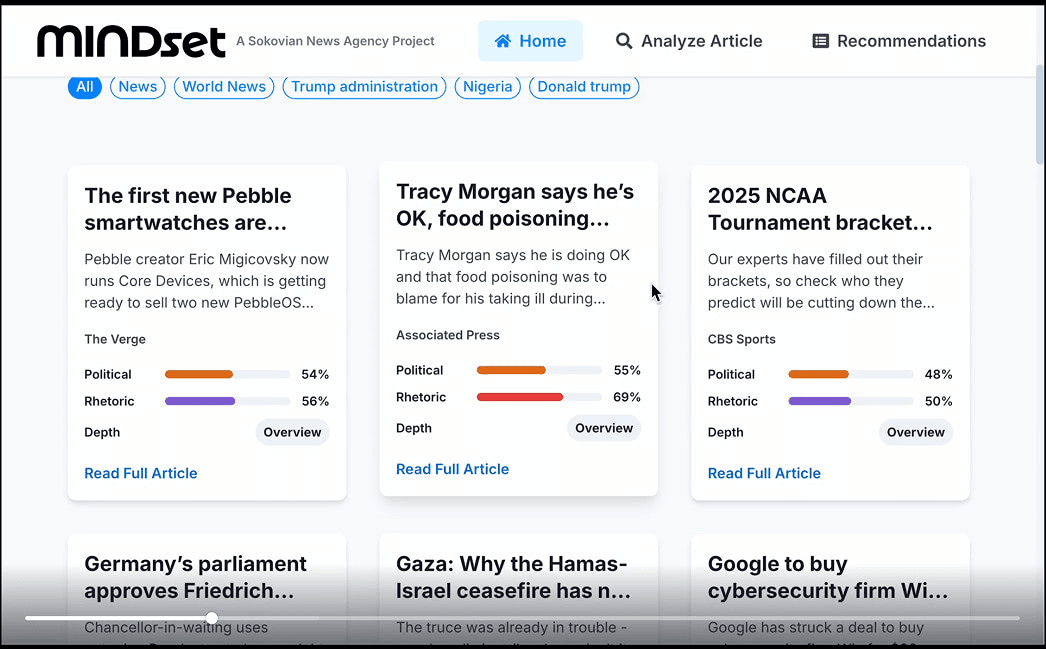
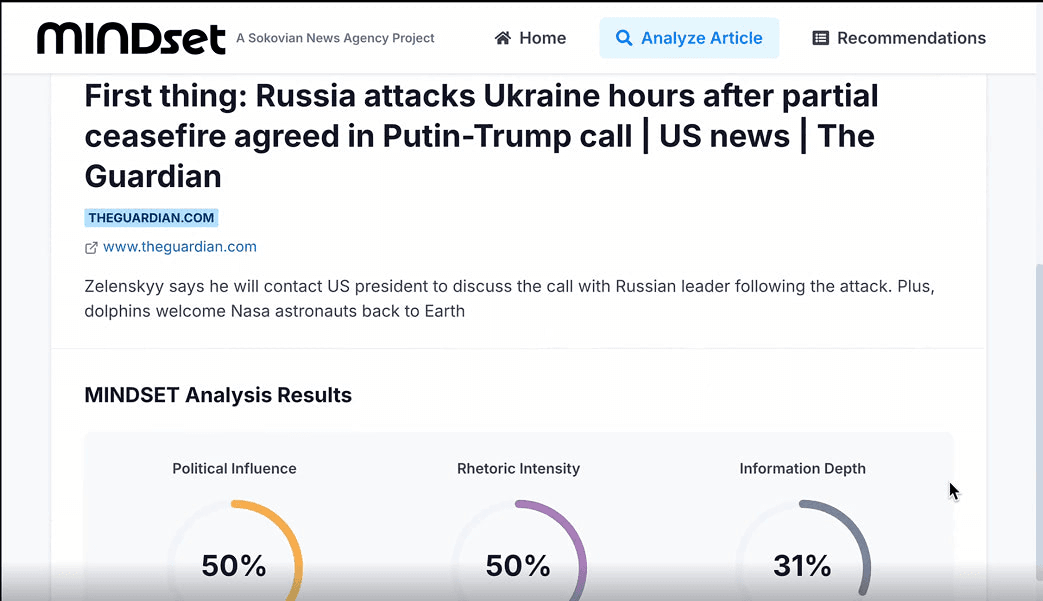
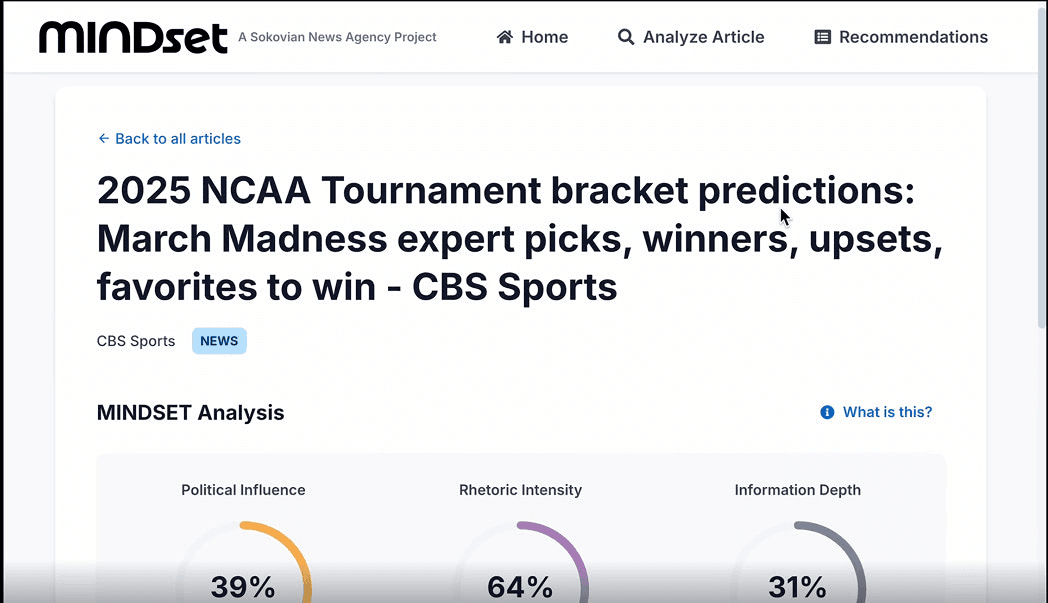
MINDset is an AI-powered news analytics platform developed to promote transparency, trust, and critical thinking in news consumption. It provides real-time metrics assessing political bias, rhetorical intensity, and information depth while delivering personalized news recommendations.
Project Overview
Project Overview
Can you provide a brief overview of the project you've been working on?
In response to declining public trust in media and growing misinformation, our team developed MINDset, a locally executed AI-powered platform designed to analyze news articles using advanced NLP techniques. The platform evaluates articles for political influence, emotional bias, and information completeness, empowering users to critically assess content credibility. Additionally, it employs personalized recommendation engines to ensure users receive diverse, balanced content.
Purpose of the project
Purpose of the project
What inspired or motivated you to choose this particular project?
Motivated by rising skepticism towards traditional news media and the increasing reliance on social media, which often fosters echo chambers and misinformation, our project aimed to enhance transparency in journalism. We sought to increase user engagement through trustworthy, personalized content, addressing critical issues identified through comprehensive surveys and market research.
Technical Details
Technical Details
Could you explain the technical aspects of your project? What software, tools do you use?
Our solution leveraged transformer-based NLP models such as DeBERTa, RoBERTa-Large, and XLNet for sentiment analysis, misinformation detection, and bias evaluation. Instead of cloud deployment, we implemented our models and data pipeline locally, extensively optimizing performance by learning and applying Rust programming for accelerated model training and data processing. We maximized the computational capabilities of the MacBook Pro M2 Max chip, achieving efficient real-time analytics and seamless interaction. For backend API deployment, we utilized FastAPI, while the frontend was developed with React.js, Chakra UI, Material UI, and animation libraries such as Framer Motion and GSAP. Additionally, the recommender system was built using Sentence-BERT embeddings with GPT-4 API integrations.
Challenges and Solutions
Challenges and Solutions
Were there any significant challenges you encountered during the project, and how did you overcome them? Can you share a specific problem-solving moment that stands out in your project?
One significant challenge was the absence of an internal dataset, which we addressed by employing Microsoft’s comprehensive MIND dataset. The local development posed another notable challenge, particularly in efficiently managing large-scale NLP computations. We overcame this by mastering and integrating Rust into our workflow, greatly reducing training and processing times by effectively leveraging the MacBook Pro M2 Max's advanced hardware.
Collaboration and Teamwork
Collaboration and Teamwork
Did you collaborate with other students or team members on this project? How did teamwork contribute to the success or progress of your project?
Our team specialized in distinct areas: Mayra spearheaded exploratory data analysis, Luis and Sravan led the data engineering, Rust optimization, and solution architecture, Jo managed model development, and Amanda focused on financial analysis. Consistent collaboration, regular sync-ups, and effective use of tools like GitHub and Figma enabled cohesive teamwork. Sharing knowledge, especially regarding Rust integration and local hardware optimization, was instrumental in overcoming technical hurdles efficiently.
Learning and Takeaways
Learning and Takeaways
What key lessons or skills have you gained from working on this project?
We significantly advanced our knowledge of local AI model deployment, real-time NLP processing, and hardware optimization. Major learning outcomes included mastery of Rust programming for performance-critical tasks, effective use of local computational resources, and balancing sophisticated NLP capabilities with practical user interfaces. Enhanced proficiency in NLP techniques, Rust programming, efficient system design, and front-end development were critical skills acquired during this project.
Future Development
Future Development
Do you have plans for further development or improvement of your project in the future?
Our future plans involve transitioning from local development to a scalable cloud-based solution via Microsoft Azure. We aim to integrate demographic data to refine personalized recommendations, extend AI capabilities to social media platforms, and continually enhance bias detection algorithms. Further developments also include monetizing premium analytics features and leveraging cloud infrastructure for broader scalability.
Pictures
Pictures
additional information
additional information
Check other student projects
Check other student projects