Wesam Al Asali, Professor of IE School of Architecture & Design, Creates Architectural Installations in Amman and Doha

Al Asali’s projects Tašbik at Amman Design Week 2026 and Falak at Design Doha Biennial 2026 explore traditional construction techniques and the structural potential of stone in contemporary architecture.
Madrid, 4 November 2026 - Wesam Al Asali, professor and researcher at IE School of Architecture & Design built Tašbik at Amman Design Week, held in October, and will design Falak at the Design Doha Biennial, opening on November 5 in Qatar. Both projects explore the potential of stone as a construction material, bringing traditional craftsmanship into dialogue with contemporary architectural design and construction techniques.
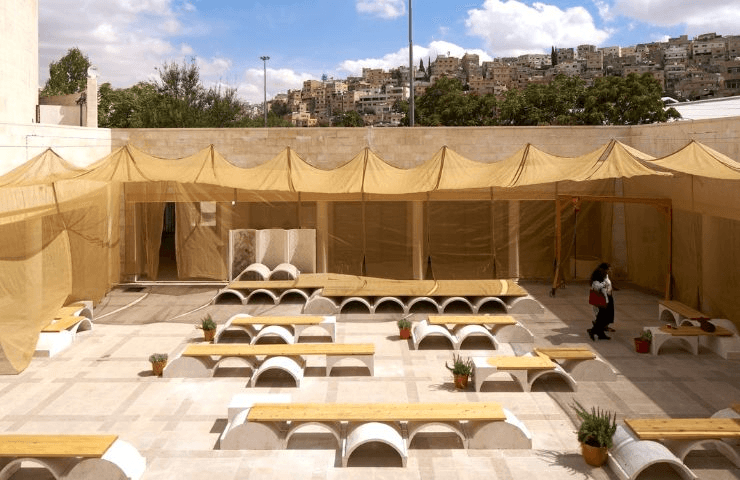
Tašbik, a temporary architectural installation, reintroduces the Mediterranean construction technique of bóvedas tabicadas (thin-tile vaulting) to the Arab region using locally sourced Jordanian limestone. Covering 256 square meters in Al Mudarraj, Amman Design Week’s open-air lecture courtyard, the installation consists of a series of stone vaults that serve as seating, a stage, and spatial enclosures. Its name, Tašbik (تشبيك), comes from the Arabic term from which the Spanish word tabicadas is derived, reflecting the historical connections between architectural traditions across the Mediterranean and the Arab world.
The project involved Anna Isabel Martinez and Yassamin Ghassimi, students at IE School of Architecture & Design, through the School’s Construction Lab. Architectural drawings and details were developed by Dalaa Al Khadra, with stone fabrication by Siwan Stone & Marble Amman and timber support from Home Pillars.
Al Asali will also design Falak, a site-specific architectural installation, at Arab Design Now 2026, the headline show of the Design Doha Biennial 2026, organized by Qatar Museums and curated by Noura Al Sayeh. Falak is conceived as a stone landscape intended to facilitate necessary yet postponed dialogues around materials, site, and community. The installation unfolds as an arched surface across leveled ground, exploring stone as a structural material capable of spanning and shaping space, while creating a setting for reading, reflection, and discussion.
The project involved design assistance from Marah Sharabti, architectural drafting by Abdalla Kilani, and engineering consultancy by Tensil Engineering in Cairo. Stone fabrication and assembly were carried out by Siwan Stone & Marble Amann, with the participation of stonemasons Abdel Rahman, Sahel, and Jaafar Waki, from Amman and Aleppo.
As part of the Design Doha public program, Al Asali will discuss his book Cultures of Making: Crafts, Scarcity, and the Environment in the Arab Region on November 6.
Cover photo by Sherbel Dissi. Interior photo by Edmund Sumner