Former Korean Minister Taeho Bark at IE University: "Tariffs Are the Climate We Will Live with for Years to Come"

During a visit hosted by IE School of Politics, Economics and Global Affairs, Bark explored the future of global trade and the strategic opportunities that a stronger EU-Asia cooperation could unlock.
IE School of Politics, Economics and Global Affairs recently welcomed Taeho Bark, President of the Global Commerce Institute at Lee & Ko and former Minister for Trade of the Republic of Korea, for a conversation on the evolving relationship between Korea, Asia and the European Union (EU).
In a discussion moderated by Ilke Toygür, Director of the Global Policy Center at IE University, Bark argued that trade tariffs should no longer be viewed as temporary measures, noting that "tariffs are no longer a storm to wait out. They are the climate we will all live with for years to come."
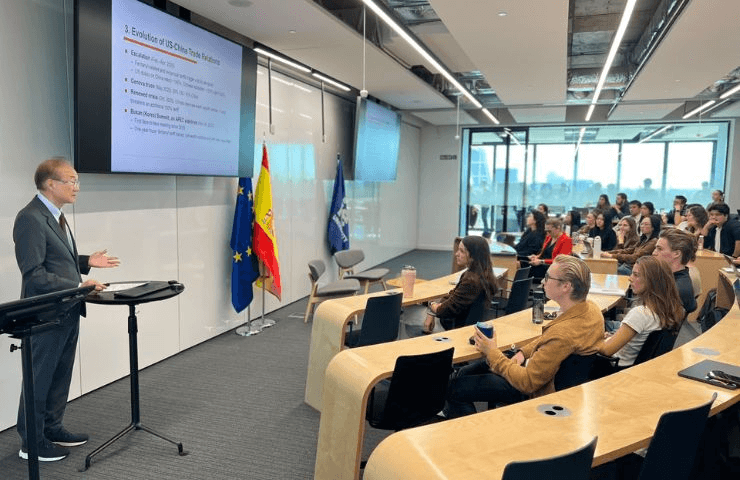
Against a backdrop of rising geopolitical tensions and economic fragmentation, Bark highlighted the need for closer cooperation among like-minded partners, emphasizing that "the EU and middle powers such as Japan, Canada, Australia and Korea should resist coercion and defend the rules-based trading order together." In this context, he suggested that the EU should consider joining the Comprehensive and Progressive Agreement for Trans-Pacific Partnership (CPTPP), following the example of the United Kingdom after Brexit.
Referring to the growing economic interdependence between Europe and Asia, Bark said that "in terms of market access and supply chains, Europe and Asia have a potential area for cooperation," adding that "we all need diversification and the EU and East Asia, especially Korea and Japan, are natural partners."
Professor Ilke Toygür also underlined the strategic opportunity for stronger EU-Asia ties, arguing that "Asian countries like Korea are increasingly looking at the European Union to diversify. The EU has a great opportunity to build its global communities." To achieve this, she noted, "the EU should think beyond its bilateral free trade agreements and security and defense partnerships and work on a broader network of partnerships instead."
The discussion also addressed the future of the multilateral trading system. Bark stressed the urgency of restoring the effectiveness of the World Trade Organization (WTO), explaining that "it used to provide an effective way to resolve trade disputes, with a court system of seven judges determining who was right and who was wrong. But because new judges have not been appointed, the system is now largely unable to settle conflicts".
This visit is framed within the School’s Public Leadership Initiative, designed to bring high-level public leaders to campus, among other activities, to discuss today’s most pressing global challenges.
Through academic programs, distinguished fellows, youth leadership initiatives, research, scholarships, and an annual recognition, the Public Leadership Initiative prepares future leaders on the belief that rigorous preparation and direct exposure to experienced public leaders are key to making a lasting impact.