Inside the XRPL Commons Immersion: Testing Financial Infrastructure in Paris

As part of IE Sci-Tech’s Ripple-IE Blockchain, XRPL - Policy Gateway Specialization, students worked inside the XRP Ledger ecosystem to examine how blockchain-based systems are built and constrained.
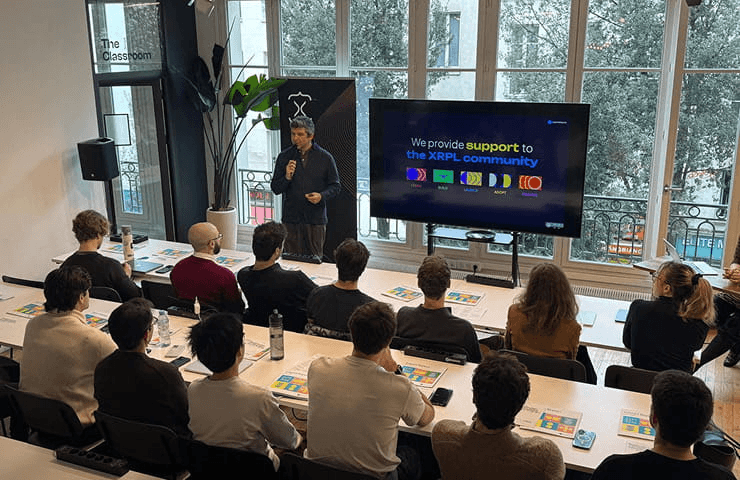
The XRPL immersion in Paris placed students inside a functioning blockchain environment, rather than a simulated one. For three days at XRPL Commons, they worked alongside developers, researchers, and founders building directly on the XRP Ledger observing how systems behave under operational conditions rather than theoretical models.
The experience extends the premise of the Ripple–IE Blockchain, XRPL – Policy Gateway Specialization: that blockchain cannot be understood at a single layer. Infrastructure, regulation, business logic, and application design evolve together, and decisions in one domain quickly propagate into the others.
From academic model to operating environment
The first sessions focused on the XRP Ledger’s architecture: how consensus is reached, how transactions are validated, and how roles within the network distribute authority.
Students examined tokenization, account structures, and transaction flows as components of a system where business logic is embedded directly into code. The question underpinning these sessions was how a decentralized application behaves under real operational conditions - where performance, reliability, and coordination matter as much as user experience.
One of the more persistent themes throughout the immersion was liquidity. In traditional finance, liquidity is often treated as an emergent property of markets. Within blockchain systems, it must be deliberately constructed.
Sessions on automated market makers, issued assets, and cross-currency payments exposed how fragile this construction can be. Mechanisms designed to facilitate value transfer - liquidity pools, token standards, on-ledger exchanges - also introduce new dependencies and risks.
For students, this reframed decentralized finance. The challenge is ensuring that value can move consistently across assets and participants without central intermediaries.
If liquidity defines the internal functioning of a system, interoperability defines its external viability. The immersion made clear that this remains an open problem.
Workshops on the XRP Ledger EVM sidechain and cross-chain tools such as Axelar highlighted the technical effort required to operate across multiple blockchain networks. Students encountered a landscape of partially compatible systems, where integration is ongoing and incomplete.
Each additional layer - bridges, routers, sidechains - extends functionality while increasing complexity. Interoperability, in this context, is a continuous process of coordination between protocols, each with its own assumptions and constraints. What appears seamless at the user level is, in practice, the result of layered engineering compromises.
Constraints shape venture thinking
Development sessions moved from protocol-level mechanics to application design. Students worked on payment systems, token issuance, and advanced features such as escrow and payment channels - mechanisms that underpin financial use cases.
Even relatively contained applications required decisions about security, system design, and user interaction. Developers and product specialists at XRPL Commons worked alongside students, providing feedback that reflected real constraints.
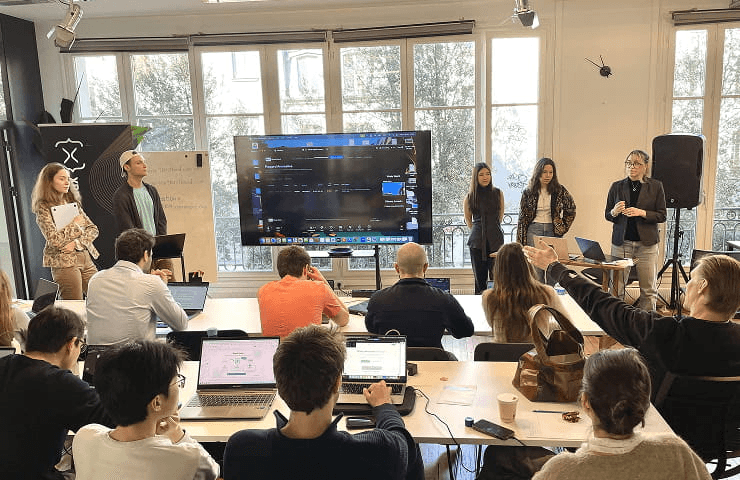
This proximity to developers and founders shaped how projects were approached. As Bachelor in Computer Science & AI student Nikoloz Kipiani explained, "We grounded the development process in real-world constraints, trying to build a system that not only worked, but took into account the context it would be deployed in."
The final phase shifted into a constrained build sprint, where teams worked on predefined problems across decentralized finance tools, ledger analytics, and XRPL-based applications.
The presence of XRPL Commons’ broader ecosystem - including contributors to its "Aquarium" residency - added another layer. Students were presenting directly to practitioners working within the same limitations, where feedback is shaped by what can actually be implemented.
Beyond the technical work, the experience also created access to the ecosystem itself. As Bachelor in Economics & International Relations student Artem Abesadze noted, working alongside XRPL teams and startups provided " (...) direct exposure to the ecosystem and the opportunity to build meaningful connections with people actively working in it," offering a useful perspective beyond the classroom.
XRPL: evolving infrastructure
XRPL Commons operates as a development environment for teams building on the XRP Ledger, combining training, collaboration, and residency programmes. The immersion placed students directly within this environment.
The Paris experience had students working in this complex environment. Questions of governance, compliance, scalability, and user adoption were embedded in every technical decision.
Exposure to founders building across different sectors reinforced this broader perspective. Master in Computer Science & Business Technology student Irene del Carmen Gracia observed, "The resident and founder testimonies showcased how they have integrated XRPL features across sectors - from investing to social impact - highlighting how blockchain extends beyond payments and can reshape how businesses operate."
By the end of the three days, the focus had shifted from understanding blockchain technology and its application to understanding the conditions under which decentralized systems evolve.
The XRPL Commons immersion revealed a field still negotiating its own parameters - balancing decentralization with efficiency, openness with control, and experimentation with reliability.
Decentralized infrastructure emerges here as an active design space, where technical and economic decisions are made in parallel, and where their consequences are immediately visible.