Sci-Tech Student Spotlight with Marta Merino

IE Economics and Applied Mathematics student Marta Merino shares her perspective on combining mathematical training with entrepreneurship, leadership, and real-world experimentation.
Marta Merino approaches her degree as a way to test how analytical thinking translates into real decisions. As a student in Economics and Applied Mathematics (BIEBAM) at IE School of Science & Technology, she has combined quantitative training with hands-on experience in entrepreneurship, student leadership, and community-building. What links these is not just technical training, but an interest in how economic systems reflect behavior, incentives, and complexity in the real world.
Her academic path at IE Sci-Tech has already gotten her building a startup idea, coordinating student teams, and developing technical projects in Python - each context requiring a different way of applying the same core skills.
In this Student Spotlight Marta shares how she chose her degree, what she learned from building her first MVP, and how experiences beyond the classroom have shaped her perspective.
What inspired you to start a degree in Economics and Applied Mathematics?
As a teenager, I knew I wanted something intellectually challenging. I was strong in mathematics and physics, but I realized engineering was not the path I wanted to follow. At the same time, I felt drawn to economics.
What attracted me most was combining the analytical rigor of mathematics with the real-world perspective of economics.
When I discovered the dual degree at IE, I genuinely felt it was the perfect fit. It brought together both sides of what interested me most.
What drew me to IE however, was not only the degree itself, but also everything that surrounds it. I often say that at IE, you do not leave with only a degree, you leave with a whole experience. It’s a very international environment - you meet people from all over the world and learn about global issues in a much more direct way. There’s also always something happening - events, talks, clubs, labs, and new opportunities to explore. That environment allows you to discover different paths and gradually build a profile that aligns with your goals.
Tell us about the MVP you built during the Start-Up Lab. What did that experience teach you?
Building and pitching my MVP was one of my first real experiences with entrepreneurship. It was the first time I could see what it actually means to take an idea and turn it into something tangible.
Throughout the lab, I was guided by my professor, Leticia Ponce, and I also learned a great deal from the events, talks, and guest speakers we had the chance to hear from.
To build the MVP, I relied on what I learned in Programming I and II. That made me realize how valuable classroom learning can be when you apply it to a real project.
Presenting it to angel investors and receiving feedback was especially valuable. It gave me a clearer understanding of how ideas are evaluated and how important it is to keep refining a project.
Most importantly, it gave me the opportunity to test whether entrepreneurship was something I was interested in, and I discovered that it was.
How have your experiences outside STEM shaped your perspective?
Through my volunteering experience in an inclusion project for a dance school, I had the opportunity to step outside my usual environment and engage with different realities. It taught me the importance of empathy, adaptability, and understanding the needs of others.
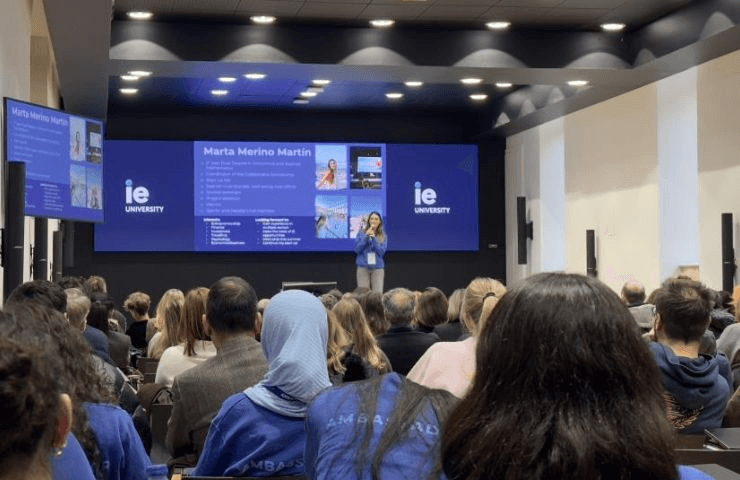
My role in the Collaboration Scholarship has also been very meaningful. I started by helping prospective students understand what university life is really like and later became Coordinator.
In this role, I act as a link between the student team and admissions, while also supporting other students. It has helped me develop leadership and communication but also showed me the value of trust and accountability. It made me think more about contributing to a community, not only focusing on individual goals.
How has the Sci-Tech community shaped your experience?
The Sci-Tech community has played a very important role. Through clubs, labs, and shared initiatives, students find communities where they feel connected while developing new interests and skills.
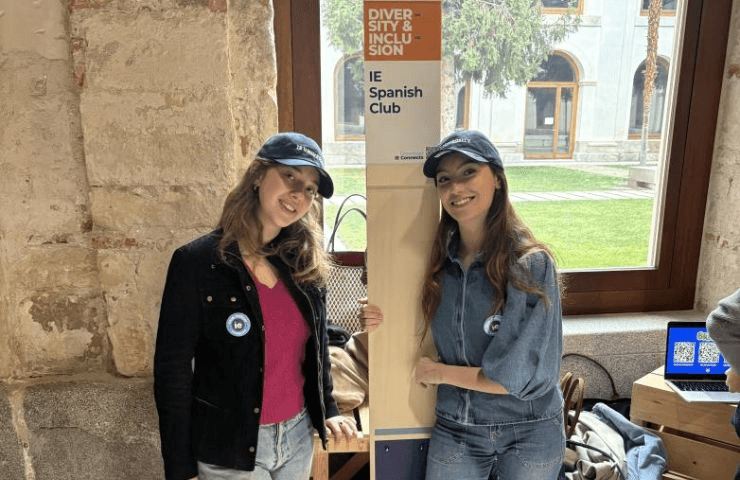
As founder of the Spanish Club and Co-President of the Wellbeing Club, I’ve had the chance to build communities around shared interests. That has been especially meaningful, because in reality you don’t only work with mathematicians - you work with people from all kinds of different backgrounds. Clubs also provide opportunities to organize events and learn from professionals with real experience.
Labs, on the other hand, offer a more hands-on and in-depth experience. They give students the chance to work on real challenges, often with real companies, over a longer period of time and with the guidance of a professor. I think this is especially valuable during the first years of university, when students are still exploring their interests and gaining exposure to different fields.
One of the most special experiences I’ve had was a trip to Barcelona with the math class, where we took a guided tour of the Sagrada Família from a geometric perspective. It was fascinating to see how math concepts can be reflected so beautifully in architecture. We also visited the Barcelona Supercomputing Center, where we learned about high-performance computing and its real-world applications.
In particular, the Sci-Tech community creates targeted opportunities such as events, intensive bootcamps, Tech Day, and competitions like the Datathon, where students can get involved from day one. That proactive and dynamic environment is one of the reasons why my university experience has been so enriching.
Where do you see yourself in five years?
I see myself working in an international environment, which is something I value both personally and professionally. Being surrounded by people from different countries has shaped how I think.
At the same time, I’m very interested in launching my own startup. Through experiences such as Start-Up Lab, I discovered how much I enjoy building ideas and turning them into something real.
I’m also starting to gain exposure to corporate environments. I’m currently attending a workshop at Deloitte as part of the Young Corporate Program (YCP), which offers a first look into how large organizations operate and make decisions. I’ve also been selected as one of ten IE students to attend CIVICA European Week 2026, where I’ll work with students from universities such as Bocconi and LSE.
However, I also want to remain open. I still have time to explore different industries, gain experience, and understand where I can create the most value. For me, it’s about balancing clear ambitions with openness to new opportunities.
 What do you like to do outside university?
I enjoy spending time with my friends and family. I’ve always been a very open person, and I like meeting new people, trying new things, and making the most of new experiences.
I also enjoy traveling and discovering new places. The international environment at IE makes this very natural, and I’d like to take advantage of that by exploring new perspectives and cultures.
Has a course or professor had a strong impact on you?
Leticia Ponce had a strong impact through Start-Up Lab. She guided me through developing my MVP and helped turn the experience into something practical and motivating. Through her course, I also connected with the entrepreneurial ecosystem and attended events such as South Summit.
Miguel Vaquero has also been great. As a researcher and my advisor, he connects what we learn in class with how it is used in practice.
What I value in both is that they don’t only teach content but actually help you understand how it applies and why it matters beyond the classroom.