What the Viz Competition Revealed About Infrastructure and Equity in EVs

From global supply imbalances to behavioral bottlenecks, IE University students used data visualization at the to interrogate the limits of electric mobility.
The difficulty with electric vehicles is no longer just technological performance. It is coordination - across infrastructure, regulation and behavior. This issue surfaced during a data visualization competition at IE School of Science & Technology, where students worked with large datasets on energy systems and EV adoption.
The strongest teams exposed different points of friction: uneven global supply chains, fragmented regulatory systems, and the gap between technical efficiency and user behavior.
Infrastructure reflects supply chain imbalance
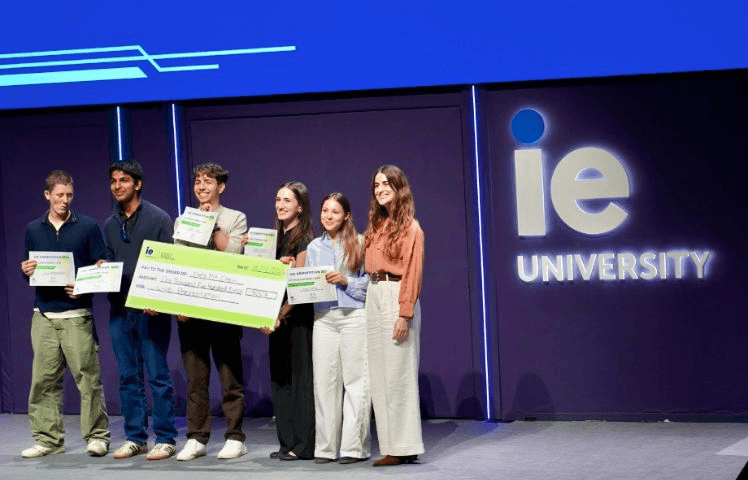
The team Data Pit Crew, made up of Bachelor in Data and Business Analytics students Ema Garita, Gabriela Mariucci, Pablo Jurado, Aarrush Gupta, and Elijah Cuyamendous, received the €1,500 award for best live presentation - focusing on disparities embedded in the global expansion of EV infrastructure. Their analysis pointed to a structural imbalance: "more developed countries are being able to have more EV infrastructure to work with as opposed to less developed countries," as they put it.
The issue, in their view, extends beyond infrastructure deployment. It connects to how resources are sourced and distributed across the EV value chain. "There’s a lot of policies, especially in the EU, that target to work more on making the supply chain more… equitable," the group noted, referencing ongoing attempts to address environmental and human rights concerns in battery production.
Their proposal suggested adapting ideas from fair trade models to EV supply chains. The objective would be more fair distribution of resources, particularly in regions that currently benefit less from electrification while contributing more to its material inputs. The implication is that the transition to electric mobility risks reproducing existing global asymmetries unless distribution becomes a central design constraint.
The data challenge
Teams described the same underlying constraint: the difficulty of working with large, inconsistent datasets.
For Data Pit Crew, the challenge was less about analysis than about trust. "The hardest part was definitely trying to figure out which data to trust and which not to," they explained. Global datasets, they noted, often carry embedded biases that become more visible when compared across regions.
This uncertainty shaped how they approached visualization. Rather than presenting definitive conclusions, the team focused on making limitations visible. The goal was not only to analyze data, but to communicate its boundaries.
That emphasis extended to presentation. "You can have as much data as you want, but if you can’t communicate that to the people who matter, then it falls on deaf ears," one member said. Another added that the process required "being open minded… if you think about everybody, you’re reaching equitable solutions." In this framing, visualization becomes a form of mediation between technical evidence and policy relevance.
Another recognized team, FlashCharge, approached the problem from a different angle. Composed of Bachelor in Behavior and Social Science students Soraya Stoiber, Yuliyana Gercheva, Letizia Caracatzanis Berlandi, Maria Maksymovych, and Eva Uzunova, they received the judges’ honorable mention and a €500 award.

Their project centered on an algorithm designed to improve charging efficiency, but their analysis extended to how usage patterns shape system performance. One observation from the team was that "electric cars are mostly efficient… when you’re driving shorter distances," while longer trips expose constraints in charging availability and planning.
They also pointed to regulatory fragmentation as a limiting factor. "China is one country, so it’s easy for them to regulate everything," one participant noted, contrasting this with Europe, where "different regulations mean it’s going to take longer to create more EVs and charging points."
For FlashCharge, the central issue was convenience. Adoption depends less on technical capability than on whether systems integrate into daily routines. "The main issue is convenience for people," the team explained, pointing to everyday frictions - where to park, how to charge, how long it takes - as barriers to wider uptake.
Framing and interpreting information
Unlike other teams, FlashCharge worked under tighter constraints - three days instead of two weeks - and with limited prior exposure to technical datasets. Their approach as social science students was different.
Faced with "five data sets… with like 30,000 different variables," the main challenge was not computation but selection. "The hardest part was to choose something that is actually meaningful," one student said. Raw data, they argued, "doesn’t really mean anything if you don’t put a meaning to it."
Their solution was to narrow the scope and introduce behavioral concepts to interpret the data. This included reframing numerical patterns through psychological language, offering what they described as "a completely different perspective of the same data."
The experience also reshaped how they approached communication. "We finally figured out how to synthesize data and make it a good story," one participant reflected, adding that structure mattered as much as content: "it’s your beginning, your middle and your end… the whole storyline."

Understanding the system
Across both teams, one theme recurred: the limits of treating EV adoption as a purely technical transition. Infrastructure gaps, regulatory fragmentation and behavioral constraints all complicate the picture.
What the competition revealed is that progress in electric mobility depends on aligning these layers - something that data alone does not resolve. It requires decisions about distribution, coordination and user experience.
For students, the exercise was less about producing definitive answers than about learning where the system resists simplification. As one student from Data Pit Crew summarized, the process required "thinking outside the box and finding other alternatives” - a shift from analyzing data to questioning the systems behind it.
Congratulations to all the winning teams – Data Pit Crew, The Metrics, and FlashCharge – check out their posters which are available for viewing until beg. May in the Sci-Tech floor 4 Common Area.