- Home
- Civica
- Civica News
- Ie University Hosts Civica Honours Seminar "bridging Gaps, Building Equity: Gender, Diversity And Inclusion At Work"
IE University hosts CIVICA Honours Seminar "Bridging Gaps, Building Equity: Gender, Diversity and Inclusion at Work"

IE University welcomed students coming from other CIVICA universities to a seminar led by IE University’s Professor Patricia Gabaladón, PhD in Economics.
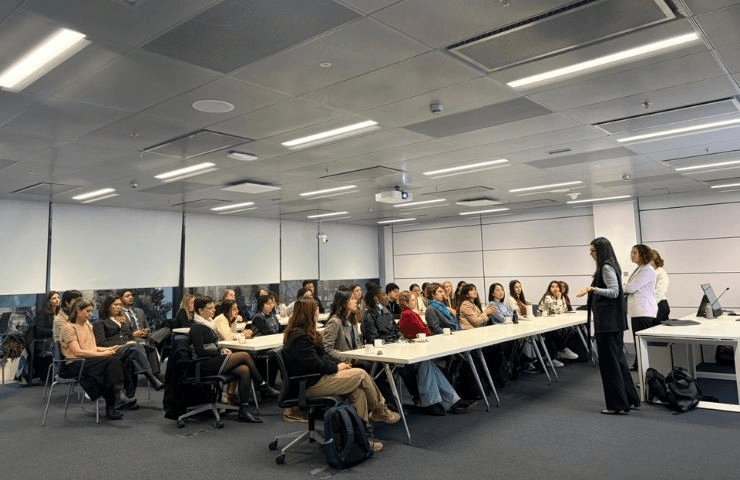
This CIVICA Winter Honours Seminar took place at IE University for the second consecutive year. The immersive learning experience brought together experts on the subject of gender, diversity and inclusion in the workplace, who provided intensive lectures over the span of four days. Ten students from Bocconi, Hertie School, and Sciences Po have enjoyed the event with other twenty students from IE University, who have discovered the María de Molina and the IE Tower campuses in Madrid for them. Beyond the classroom, they got on-hands experiences, including a visit to BBVA and a chat with Cecilia Malmström, former European Commissioner for Trade (2014–2019) and fellow at IE School of Politics, Economics and Global Affairs.
Patricia Gabaldón, PhD in economics from University of Alcala and former fellow at Harvard University, is specialized in the application of Economics and Sociology to improve stakeholders’ decision-making processes regarding gender issues. Patricia Gabaldón led a seminar with unique witnesses and approaches on the topic, including the replication of gender biases through artificial intelligence and its development in certain social environments. Miguel Ángel Paniagua, former professional basketball player, and now sports commentator. "We have improved a lot in the number of things, but sports are still the ground where toxic masculinity is", he explained, before initiating discussion with master students on how these attitudes develop from a young age. Students also highlighted the possibility of focusing on the African region, which embodies the comprehensive scope of the seminar.
During the visit to BBVA, they deepened into diversity and inclusion’s strategies. They discovered BBVA’s Equality Plan, through which the institution has achieved 35% of women in leadership positions. The strategy is targeted to contribute equal opportunities for women and men across the organization, focusing on aspects such as recruitment, promotion, compensation, and work–life balance. The hands-on experience concluded with perspectives from the founders of the Women in Banking initiative, which enhances visibility for women in the sector and provides them mentoring and networking opportunities.
Cecilia Malmström offered a special opportunity to share impressions with students, amidst an agenda dedicated to exchange insights with both professors and students. Through the guidance of Catherine E. De Vries—Professor of Political Science, Chair of the Politics and International Relations Area at IE University, and Vice Dean at IE School of Politics, Economics and Global Affairs—, she discussed issues such as the future of the European Union, how to deal with professional failure, which skills are necessary for leadership positions, and the impact of gender in a political career. She emphasized the importance of establishing networks with people from diverse backgrounds and establishing new alliances, including countries such as Canada, Australia, or Japan. "Identify someone who has the same goals, but maybe from a slightly different angle", she advised, in the case of challenging mediation cases.
Students finished the experience by presenting their policy challenge projects, in which they addressed a specific gender issue in a European country. Proposals varied from paternity leave reforms to retirement plans restructuring, in countries such as Poland, Italy or Germany. The two may aspects of the proposals were the importance of institutional design for behavioural and cultural change, and the role played by education through the process. CIVICA master students explained that "cultural and gender biases may be amplified without a structural plan starting from childhood education over gender equality".