IE University students embark on a transformational leadership journey trekking in the Himalayas

IE School of Politics, Economics and Global Affairs organizes the sixth edition of its annual trip to Nepal, one of the school’s flagship initiatives, in collaboration with world-renowned alpinist Edurne Pasaban.
Kathmandu, April 2026. Every year, IE School of Politics, Economics and Global Affairs offers students from the Bachelor in International Relations and other dual degrees the opportunity to travel to Nepal for a transformational leadership journey. In 2026, 30 students from 11 nationalities participated in this trip where, through a series of demanding treks in the Himalayas, they explored personal growth, leadership and global awareness.
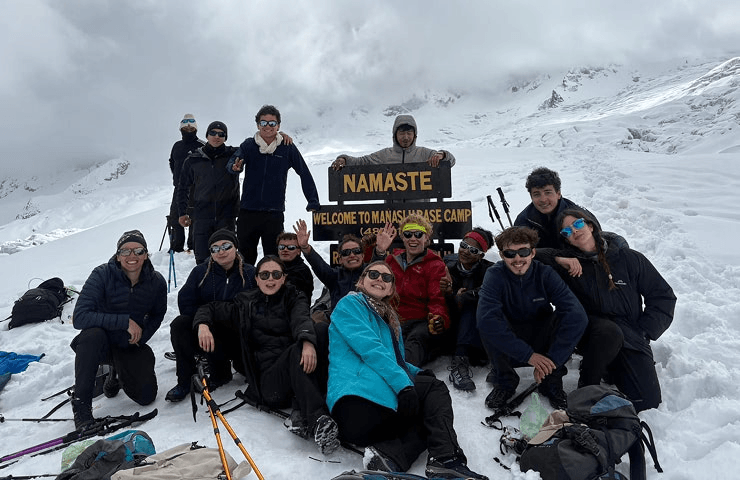
"Amid the Himalayan peaks, our students discover that real leadership is not about visibility but about enabling the team to move forward together", explained Pablo Marco, Associate Vice-Dean of IE School of Politics, Economics and Global Affairs, who accompanied the students in this year´s trip with other two staff members. As the journey tests their limits, they learn to recognize their boundaries and rely on one another. These lessons in self‑knowledge, resilience, and shared purpose will stay with them and shape the professionals and decision‑makers they are becoming in a world that needs leaders who understand that to lead is to serve", he concluded.
The most challenging part of the trip was the trekking experience in the Himalayas, where students hiked to local points such as Deng, Namrung, Shyala, Pungeon Monastery, Samagaon, and Sando. They counted on the support of one of the world’s most experienced alpinists: Edurne Pasaban. As the first woman to climb the world’s 14 highest mountains, Pasaban guided students through a physical challenge designed to push them out of their comfort zones.
Guided by six sherpas, the expedition covered 34 hours of trekking and around 75km, reaching the Manaslu Base Camp at 4,800 meters. Beyond the physical effort, Pasaban also taught students how to face and overcome extreme conditions.
Connection and self-discovery
"The group arrived in search of adventure, and took away something much deeper: connection, self-discovery, and a new way of understanding themselves," Edurne Pasaban said. "The students had to confront their fears, their doubts, and their own inner barriers. Some managed to reach base camp; others had to turn back. And that was one of the greatest lessons: learning how to deal with frustration and failure."
IE University students visited Nepal’s capital, Kathmandu, where they spent time at Kailash School, an organization that identifies families with limited resources and supports vulnerable young people by providing education and housing.
They also visited the Rangjung Yeshe Institute, where a Buddhist monk introduced them to Buddhist philosophy and practice. The trip additionally included stops in the city of Bhaktapur and at the Boudha Stupa.
Global citizenship
The transformational leadership journey to Nepal has become one of the flagship initiatives of IE School of Politics, Economics and Global Affairs, reflecting the School’s commitment to experiential learning and global citizenship.
Borja Santos Portas, Associate Dean, has been designing and coordinating this initiative since 2019. "We wanted to give our International Relations Bachelor students a unique experience that could be personally transformative — one they will carry with them forever. The lessons learned on the mountain, in moments of vulnerability and within the community forged along the way, are the same ones that will resurface in a high-stakes team meeting, in a conflict with partners, or in the toughest moments of life. After six editions, I am very proud of every generation that has gone through this experience."