Sviatlana Tsikhanouskaya highlights the importance of safeguarding democracy during her visit to IE University

The leader of the Belarusian democratic movement in exile shares her experience with IE University students and faculty.
Madrid, 10 April 2026. This week, IE School of Politics, Economics and Global Affairs hosted Sviatlana Tsikhanouskaya, the internationally recognized leader of the Belarusian democratic movement, at IE Tower, IE University’s campus in Madrid. Tsikhanouskaya, a prominent voice advocating for freedom and human rights across Europe, addressed an audience of students and faculty.
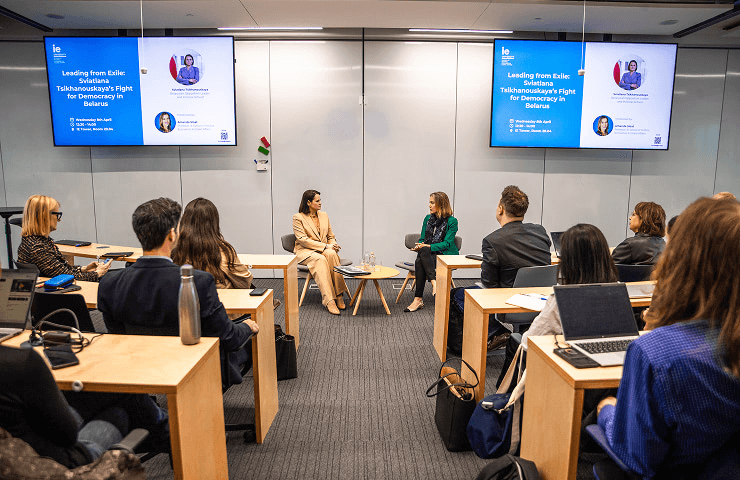
At the opening of the event "Leading from Exile: Sviatlana Tsikhanouskaya’s Fight for Democracy in Belarus", Catherine E. De Vries, Chair of the Politics and International Relations Area at IE University, and Vice Dean at IE School of Politics, Economics and Global Affairs, highlighted the impact of Tsikhanouskaya’s activism. De Vries noted that "her unexpected candidacy, that many underestimated, became a unifying force and inspired one of the biggest peaceful protests in Belarus."
The event was moderated by Amanda Sloat, Professor of Practice in the School, who worked closely with Sviatlana Tsikhanouskaya when she served in the United States government and interviewed her recently for IE University podcast Power and Purpose. "For students considering careers in public service, her unusual path — from stay-at-home mom to leader of a global democracy movement following the imprisonment of her activist husband — provided a powerful example of how ordinary people can do extraordinary things," she stated.
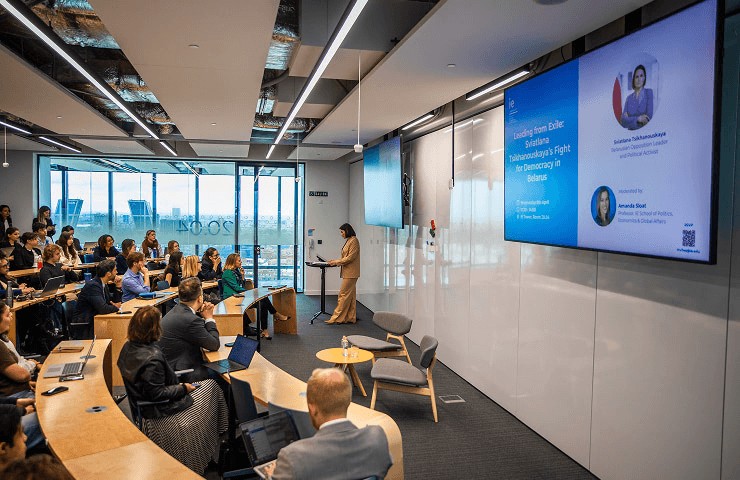
From her side, Sviatlana Tsikhanouskaya emphasized the importance of civic responsibility, noting that “democracy sometimes is taken for granted. People should cheer on what they have. It is the responsibility of every person to take care of democracy."
Tsikhanouskaya also explained how the Belarusian democratic forces work abroad: "We work as the government in exile. We are promoting democracy, trying to build strong institutions and saving people from repression. Our fight is not isolated; it is part of the global fight for democracy. Venezuela, Ukraine are only some other examples”.
She highlighted the importance of Europe’s support: "We need Europe and the EU because only in Europe we can defend our country, values and language," she said. "It is important for Belarusian people not to be abandoned, not to be forgotten (…). This fight is also important for our allies", Tsikhanouskaya sentenced, emphasizing also the importance of distinguishing between a regime and its citizens: "The most precious thing of a nation is the people. I am proud of the people who resist in my country. They are threatened and it is easy to give up. But people can’t stop."
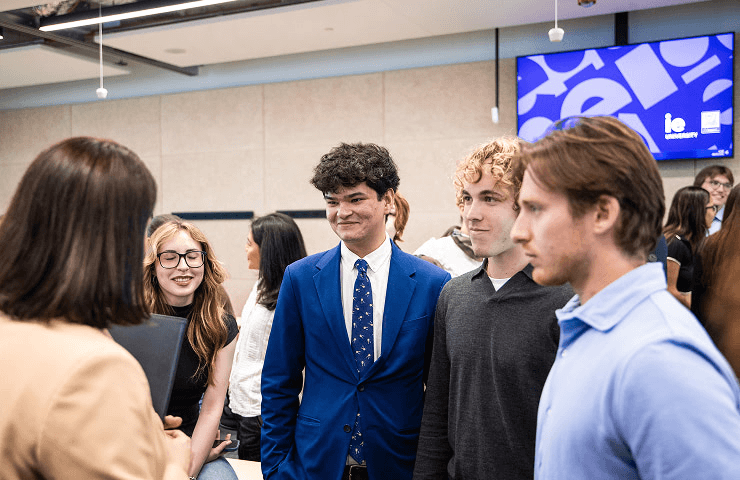
Reflecting on her own experience, she shared the difficult choice she faced: "I was asked either you stay in Belarus in prison or leave the country with my children. I left. Now I dream of living in a country where I don’t have to explain to my kids what war is".
Sviatlana Tsikhanouskaya also spoke about the personal dimension of her work: "I speak for the people who cannot. Sometimes it is exhausting and I don’t feel confident, but I am doing my best to be the example and keep this connection with the people inside Belarus".