- Home
- We Are Law School
- News
- Cani Fernández: "competition Policy And Competitiveness Are Complementary Objectives, Not Opposing Ones"
Cani Fernández: "Competition policy and competitiveness are complementary objectives, not opposing ones"

The President of the CNMC takes part in a LawAhead Center session focused on today’s key regulatory and competition challenges.
On February 23, IE Law School’s LawAhead Center on the Legal Profession held a new session featuring Cani Fernández, President of the Spanish National Commission on Markets and Competition (CNMC), as guest speaker.
The event brought together partners and senior executives from major law firms, corporate legal departments, and the Center’s sponsors to reflect on the Commission’s approach to competition policy and regulated markets.
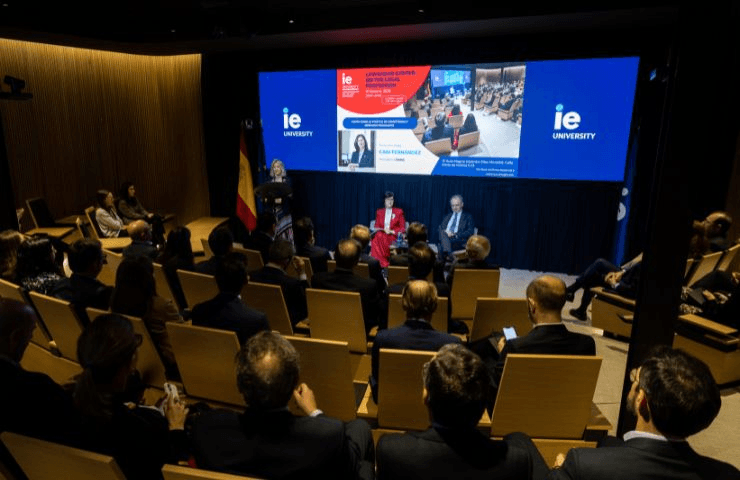
In her opening remarks, Soledad Atienza, Dean of IE Law School, underscored that competition law has been part of the School’s DNA since its inception, reflecting both its international outlook and the research work carried out by its faculty.
During her remarks, Fernández argued that "competition policy and competitiveness are complementary objectives, not opposing ones. Competitive markets are a key driver of innovation, efficiency and lower prices—essential components of global competitiveness." In this regard, she stressed that competition authorities should not be portrayed as responsible for Europe’s lack of competitiveness.
In her view, if companies fail to scale up, this is due "to excessive and fragmented regulation across Member States and to the absence of a genuine single market at European level."
Regarding merger control, she explained that although the CNMC had already been assessing the impact of concentrations not only on immediate market conditions but also on innovation and dynamic efficiencies, it has closely followed and participated in the revision of the Guidelines on the assessment of mergers.
Energy featured prominently in the session. In the electricity sector, the President highlighted the challenge of designing a remuneration framework that is attractive to investors and aligned with the level of investment required. In this area, Fernández specified that "three recent lines of work stand out: access to and connection with the networks, their remuneration methodology, and the financial rate of return."
She concluded by reiterating the CNMC’s primary objective: to preserve and promote the proper functioning, transparency and effective competition across all markets and productive sectors, while ensuring efficient regulation for the benefit of both consumers and businesses.
About the LawAhead Center on the Legal Profession
The LawAhead Center on the Legal Profession at IE Law School promotes reflection on the challenges and opportunities facing the legal sector in Spain and globally. The Center brings together leading business law firms—CMS Albiñana, Cuatrecasas, Gómez-Acebo & Pombo, Garrigues, Pérez-Llorca, Roca Junyent, and Uría Menéndez— alongside major corporations such as AENA, CaixaBank, Mapfre, Microsoft, and Telefónica.


