Kent Walker, Google’s President of Global Affairs, explores Europe’s AI-driven future at IE University with Dean Enrico Letta

Both leaders shared insights on how collaboration between technology and policy is key to Europe’s success in the AI-driven future
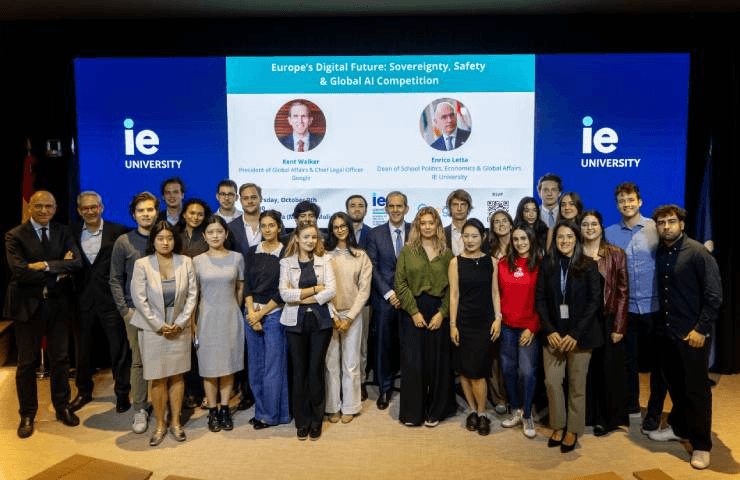
IE University recently hosted a high-level conversation on “Europe’s Digital Future: Sovereignty, Safety & Global AI Competition”, featuring Enrico Letta, Dean of IE School of Politics, Economics and Global Affairs, and Kent Walker, President of Global Affairs and Chief Legal Officer at Google. The discussion examined Europe’s position in the global digital landscape and the challenges and opportunities that AI brings for competitiveness, innovation, and sovereignty.
Building on these themes, the event explored how the European Union can lead responsibly in AI regulation without stifling deployment, how to strengthen the transatlantic digital partnership in a complex geopolitical context, and how to achieve genuine digital sovereignty while avoiding costly barriers for European businesses. The conversation also addressed competition enforcement and the need to simplify Europe’s regulatory environment to enable growth and innovation across the continent.
Kent Walker reflected on the importance of regulatory frameworks that foster innovation and growth rather than slow it down. He explained the concept of the “Total Addressable Market (TAM)”, noting that a single European country is often too small to attract significant investment. He argued that embracing scale and growth potential - what he described as the idea of a “28th regime,” enabling companies to view all of Europe as a single launchpad- would make the continent more competitive and appealing to investors.
Walker also highlighted Europe’s digital transformation gap: “Today, less than 15% of European companies use AI on a daily basis. Europe needs to dream big and make it easier for its innovators to create,” he said. He described AI as an accessible tool capable of driving transitions and empowering entrepreneurs. Although Europe has more startups than the United States, he stressed that many struggle to scale due to regulatory and market fragmentation.
The President of Global Affairs and Chief Legal Officer at Google called for unified frameworks that support growth and market integration, and for education systems that bridge disciplines through dual degrees combining technology, business, and social sciences. Addressing the question of sovereignty, he stressed that it must not become isolation: “Sovereignty should mean protecting what truly matters, without limiting our ability to share knowledge and grow together as a global community.”
Enrico Letta reflected on the European project, speaking about the “dream to start small and become big.” He drew a parallel between the European Union’s origins and its digital future: while Europe achieved unity in its past with the creation of a single currency, it remains fragmented in its digital present, with 27 distinct markets. “Europe is united for the past but fragmented for the future,” he remarked.
Dean Letta underlined the need to bridge competences between hard sciences (technology and engineering) and the social sciences, including policy, ethics, and governance. He agreed with Walker that AI is still not fully integrated into Europe’s business life and questioned why the continent that was once the cradle of innovation now lags behind.
Finally, Letta highlighted the collaboration between Google and IE University as a positive example of partnership between academia and industry. The event gave IE students, particularly those in the Master in Technology & Global Affairs, for which Google is a key partner, the opportunity to engage directly with two global leaders and explore how technology, governance, and education must evolve together to shape Europe’s role in the age of AI.