- Home
- We Are Law School
- News
- Human Rights Knowledge As A Driver Of Justice And Fundamental Freedoms
Human rights knowledge as a driver of justice and fundamental freedoms

Dr. Michael Wiener, Human Rights Officer at the United Nations Office of the High Commissioner for Human Rights, shares insights with IE Law School students at an event hosted by the Legal Clinic.
On March 26, IE Law School’s Legal Clinic welcomed Dr. Michael Wiener, Human Rights Officer at the United Nations Office of the High Commissioner for Human Rights (OHCHR), where he works on issues related to minority rights, indigenous peoples, and freedom of religion or belief.
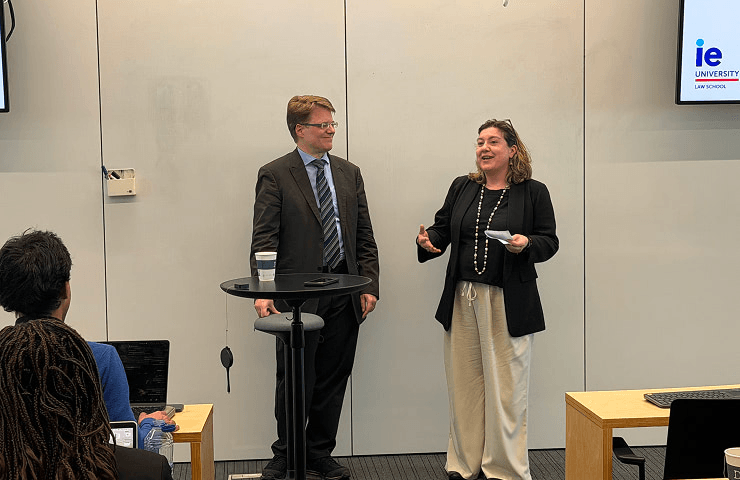
The session began with a working meeting with Legal Clinic students assigned to the project “OHCHR – Hate Speech and Incitement to Violence in Online Gaming: Legal Analysis for UN Special Procedures”, for which the United Nations is the beneficiary, represented by Dr. Michael Wiener, under the supervision of ECIJA Abogados, with the participation of Helena Suárez.
He later delivered the open seminar “Faith in United Nations Human Rights Treaties”, addressed to IE Law School students. The session explored key issues at the intersection of religion, human rights, and global governance, following an introduction by Casilda Cortés, Director of the Legal Clinic.
Access to the United Nations and current challenges
Dr. Wiener provided students with an overview of entry pathways into the United Nations system, highlighting the competitive nature of recruitment processes and the importance of official vacancy announcements as the primary access route.
He also addressed some of the current challenges in the human rights field, including the impact of political and financial factors on the continuity of international programs.
In parallel, he emphasized the growing role of legal professionals in addressing online hate speech, underlining the need for clear ethical standards and robust frameworks within organizations and digital platforms.
Education with impact
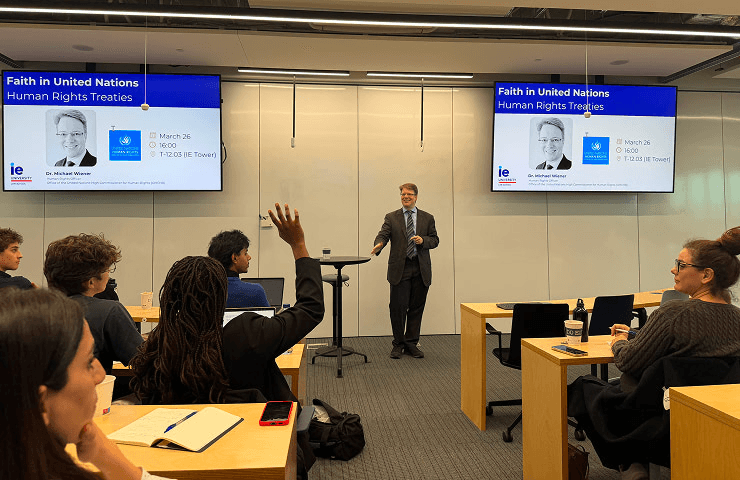
Dr. Wiener stressed the importance of a strong foundation in human rights law, particularly its practical implementation across different professional contexts. As he noted: “Wherever you are in your future career, you can always change things in a small or large way, but studying law can be truly impactful.”
He also highlighted the value of IE University’s academic environment as a space for constructive dialogue: “It is a perfect opportunity for learning from each other. You may disagree, and that’s fine, as long as you have the possibility to disagree agreeably, which is how you can avoid politicization.”
As a final reflection, he stressed that the impact of international human rights law lies in its practical application: understanding these frameworks enables accountability, prevents abuses, and protects vulnerable populations. In this sense, it is an essential tool to ensure justice and fundamental freedoms.
ABOUT IE LAW SCHOOL LEGAL CLINIC
The Legal Clinic is a program of IE Law School created in 2014, which combines an innovative, lab-based approach with the model of university legal clinics. Inspired by the U.S. tradition, it offers a pioneering way of teaching law through practical work with real clients and a commitment to social impact.