- Home
- We Are Law School
- News
- The Jean Monnet Chair In Eu Digital Private Law Examines The Challenges Of The Right To Honour On Digital Platforms
The Jean Monnet Chair in EU Digital Private Law examines the challenges of the right to honour on digital platforms

Leading experts gathered at IE Law School to discuss freedom of expression, digital regulation, and the protection of fundamental rights.
The Jean Monnet Chair in EU Digital Private Law at IE Law School brought together leading experts from academia, the judiciary, regulatory bodies, and legal practice to examine the challenges involved in protecting the right to honour in an environment shaped by digital platforms, artificial intelligence, and increasing regulatory complexity.
The event was opened by Soledad Atienza, Dean of IE Law School, and Professor Francisco de Elizalde, who holds the Jean Monnet Chair in EU Digital Private Law. Both highlighted the importance of fostering spaces for reflection on the legal challenges arising from digital transformation and the impact of new technologies on fundamental rights.
HONOUR IN CONFLICT WITH OTHER FUNDAMENTAL RIGHTS
Moderated by Sara Sánchez, Professor at IE Law School, the first panel brought together Mateja Durovic, Judge at the European Court of Human Rights; Enrique Arnaldo, Justice of the Spanish Constitutional Court; Vera Sopeña, Head of the DSA Unit at Spain’s National Commission on Markets and Competition (CNMC); and Javier Moreno, former Editor-in-Chief of El País, to discuss how digital transformation is reshaping the balance between the right to honour, freedom of expression, and the right to information.

Mateja Durovic noted that the main challenge today lies in identifying reliable and relevant information in an environment where any content can be commented on and amplified by millions of people. He also highlighted the new risks associated with the public presence of judges and other institutional actors in digital spaces.
For his part, Enrique Arnaldo reflected on the evolution of the concept of honour, which is closely linked to human dignity and shaped by the cultural changes of each era. He recalled that politicians must tolerate a higher degree of criticism due to their public exposure, while stressing that there is no right to insult and that freedom of expression cannot justify offensive or unnecessarily harmful statements.
From a regulatory perspective, Vera Sopeña analysed the impact of the Digital Services Act (DSA) and explained how European legislation seeks to ensure that what is illegal offline can also be effectively addressed in the digital sphere.
From a journalistic perspective, Javier Moreno warned against placing excessive trust in regulation. Drawing on professional experiences related to major public-interest investigations, he highlighted the unintended consequences that certain restrictions may have on journalistic work.
PROTECTING HONOUR IN THE DIGITAL ENVIRONMENT
Moderated by Javier Muñoz, International Director at Ontier and Professor at IE Law School, the second panel featured Raúl Rubio, Partner at Pérez-Llorca; Cristina Mesa, Partner at Garrigues; and Luis Ruiz-Rivas, Partner at Dikei. Together, they examined the main challenges involved in protecting fundamental rights within the digital ecosystem.
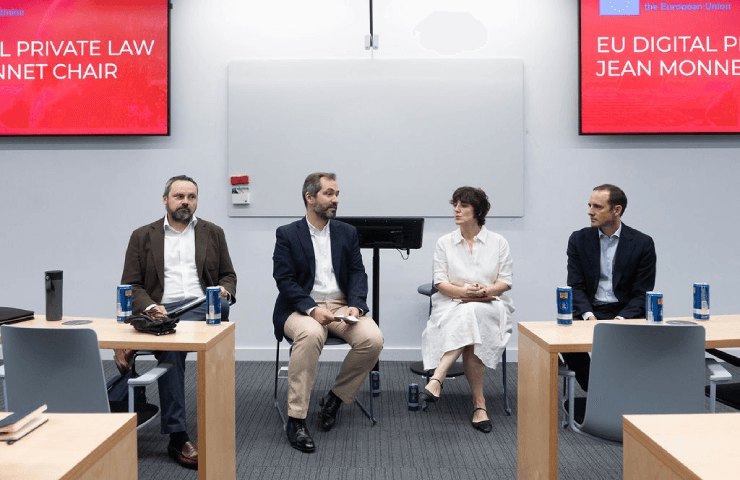
Javier Muñoz opened the discussion by asking whether freedom of expression is genuinely under threat and warned about the risks posed by what he described as “algorithmic censorship,” which he characterised as a significant threat to liberal democracies.
Cristina Mesa focused on another form of censorship: social censorship. In her view, it can be more severe than judicial censorship due to the speed and reach of public condemnation in the digital environment. She also argued for greater precision in the definition of sensitive legal concepts such as hate crimes.
Raúl Rubio warned about the privatisation of the protection of fundamental rights and pointed out that, in contrast to the growing influence of organisations and interest groups in shaping the digital ecosystem, individual users lack an equivalent capacity to defend their rights and interests.
Luis Ruiz-Rivas addressed the procedural challenges faced by individuals seeking to protect their online reputation, ranging from the slow pace of judicial proceedings to issues related to anonymity, the international nature of digital platforms, and the identification of the entity responsible for the service.
The panellists also discussed with the audience the role of digital platforms in the dissemination of content and the need to find mechanisms that effectively protect individual rights without transferring to platforms responsibilities that belong to public authorities.
ABOUT THE CHAIR
The Jean Monnet Chair in EU Digital Private Law, part of the Jean Monnet Centre of Excellence for Law & Automation (Lawtomation), examines how European digital regulation is transforming private law and positioning it as a cornerstone of the digital society.
Led by Professor Francisco de Elizalde, it fosters research, teaching, and interdisciplinary dialogue with institutions, businesses, and civil society to assess the capacity of the European legal framework to address the challenges of the digital era.


