- Home
- We Are Law School
- News
- The Global Rise Of Anti-gender Movements And Their Legal Strategies
The global rise of anti-gender movements and their legal strategies

Professor Ruth Rubio-Marín discusses in an interview for IE Law School the legal strategies behind this global trend.
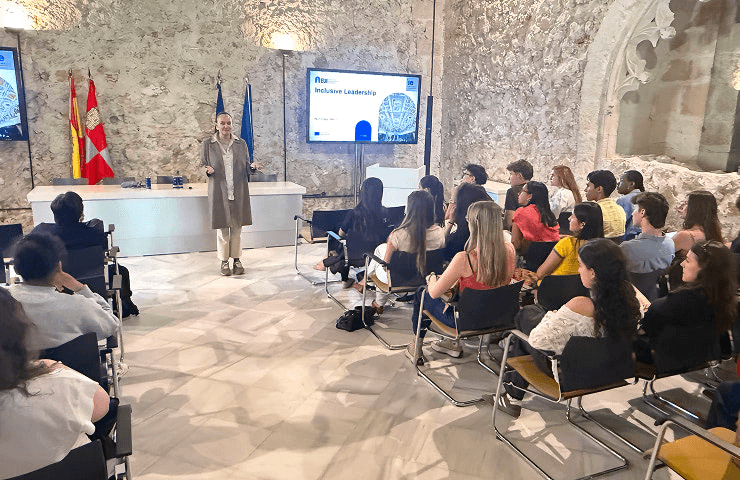
In a global context where equality is at the center of public debate, legal frameworks have become a key battleground. In this setting, Professor Ruth Rubio-Marín examined the constitutional strategies of the transnational anti-gender equality movement during her participation in two IE Law School initiatives: the LL.M. Expert Series—an annual initiative that brings together professionals and academics to explore the trends shaping the legal sector—and the Inclusive Leadership Seminar, held in Segovia for undergraduate students.

Rubio-Marín is Professor of Constitutional Law at the University of Seville, Adjunct Professor at the European University Institute, and Director of the UNESCO Chair in Human Rights and Interculturalism. Her academic trajectory includes appointments at institutions such as NYU, Columbia and Princeton, as well as collaboration with the United Nations and the European Union.
In this interview, she reflects on how legal frameworks are increasingly being used to challenge and redefine equality, and what this means for the future of democratic governance.
Why is equality being contested again today?
Equality is being challenged on several fronts. On one side, a small but growing group of anarcho-capitalists is reasserting the absolute primacy of the market and rejecting redistributive justice altogether. On another, rising xenophobia within far-right parties is reshaping political discourse.
But one of the most explicit and coordinated challenges today concerns gender equality. This backlash is driven by what can be described as a global anti-gender movement—a loose but increasingly influential coalition. It brings together religious actors, far-right political forces, civil society organizations, and, more recently, think tanks, media and tech actors, as well as segments of economic elites and traditional aristocracies.
What unites them is their opposition to what they label “gender ideology”—a deliberately vague and pejorative term used to attack feminist and LGBTQ+ advances. These include same-sex marriage, trans rights, reproductive rights such as abortion and contraception, but also sex education and academic fields like gender studies, critical race theory, or decolonial thought.
These developments are framed as threats—to the traditional family, to children, and even to national identity. They are often portrayed as foreign or Western impositions, particularly when promoted through international institutions or foreign policy mechanisms.
Are we seeing a setback in rights, or a shift in how rights are defined?
Increasingly, it is the latter. Legal discourse, unlike explicitly religious arguments, can appear neutral and therefore more broadly persuasive. As a result, we are seeing a growing reliance on legal strategies to contest gender equality—not simply by opposing rights, but by redefining them.
In countries such as Poland, Hungary, and the United States, capturing or reshaping judicial institutions has been a deliberate strategy. The goal is to reinterpret existing legal frameworks in ways that erode protections for women and sexual and gender minorities.
One emerging approach is the construction of a hierarchy of rights, where property rights, religious freedom, parental authority, freedom of speech, and conscientious objection are framed as superior to equality claims.
Other tactics include misinformation campaigns and the deliberate undermining of international human rights instruments. For example, the Council of Europe’s Istanbul Convention has been reframed by opponents as a vehicle for “gender ideology” or even “queer propaganda.”
“We are seeing a growing reliance on legal strategies to contest gender equality.”
What explains the link between the anti-gender movement, authoritarianism, and democratic backsliding?
There is no single explanation—but several dynamics intersect.
To a large extent, this movement can be understood as a reaction to the profound gender transformations of the past 50 years. In that sense, the backlash reflects both the success of feminist and LGBTQ+ movements and the fact that social progress is rarely linear.
We are also witnessing a broader climate of anxiety and disorientation. Economic precarity, climate crises, pandemics, technological change, and rising inequality have created fertile ground for simplified, identity-based narratives.
Within this context, a perceived “crisis of masculinity” has become particularly salient. While women have made significant gains in education, employment, and public life, many men experience a loss of traditional roles without a clear alternative.
This sense of displacement can be mobilized politically. Far-right populist movements often respond by promoting hypermasculine leadership and rigid gender roles, alongside nationalist and pro-natalist agendas.
Why are young men a key target—and how are they being reached?
Anti-gender movements have become highly sophisticated in their use of digital tools. They deploy a wide range of strategies: social media mobilization, disinformation campaigns, online petitions, transnational networks, and the creation of alternative media ecosystems. This includes podcasts, documentaries, YouTube channels, blogs, and even gamified content targeting younger audiences.
Influencer-style communication—often using humor, irony, or “anti-woke” rhetoric—has proven especially effective on platforms like TikTok and YouTube.
Within this ecosystem, movements such as the “Red Pill” and the broader “manosphere” play a central role. These online spaces promote a worldview in which feminism is blamed for distorting gender relations and disadvantaging men.
Women are often portrayed in reductive and hostile terms, while men are encouraged to pursue dominance, control, and self-sufficiency. Relationships are framed as transactional, and emotional vulnerability is stigmatized.
This narrative resonates particularly with young men who feel alienated—whether due to economic insecurity, social isolation, or confusion about evolving gender norms.
However, research increasingly highlights the risks: the normalization of misogyny, the creation of echo chambers, and the erosion of healthy relationship models. In some cases, these dynamics can escalate into support for violence or coercion.