- Home
- We Are Law School
- News
- Ie Law Summit 2026: Rethinking The Practice Of Law In An Increasingly Complex Geopolitical Landscape
IE Law Summit 2026: Rethinking the practice of law in an increasingly complex geopolitical landscape

IE Law School alumni leading corporate legal departments and international law firms examine the fragmentation of the global order and the evolving role of lawyers as strategic business partners in the age of AI.
On February 26, IE Law School hosted the IE Law Summit 2026, bringing together alumni, legal professionals, business leaders, current students, and future candidates for a strategic discussion on how to redefine the practice of law in an international environment shaped by growing uncertainty and unprecedented structural change.
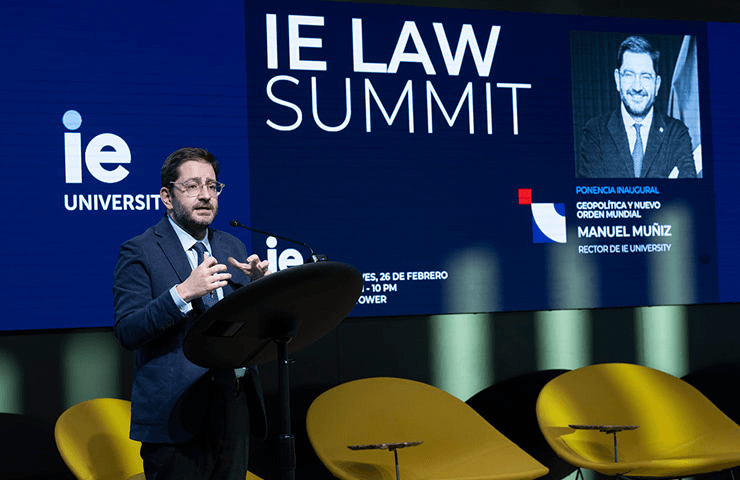
The event opened with remarks by Manuel Muñiz, Rector of IE University, who provided an in-depth analysis of the emerging global landscape. Muñiz noted that we are leaving behind “an exceptional historical period of hyperglobalization, unipolarity, and deep integration” and entering a new phase marked by a triple fracture—economic, political, and multilateral. On the political front, he linked the rise of extremist movements to the precarization of the working class, despite historically high levels of prosperity, and to the “disappearance of the middle class as a pillar of stable political systems.” According to Muñiz, the defining structural challenge of our time is the reconstruction of the social contract amid profound technological disruption.
The first panel featured Elena Torregrosa, Chief Legal Officer and Vice-Secretary of the Board at Gestamp; Javier Folguera, General Counsel and Secretary of the Board at Hispasat; and Virginia Beltramini, General Counsel and Secretary of the Board at Moeve. The session was moderated by Carmen Pérez-Llorca, Vice Dean of Strategic Initiatives at IE Law School. The panelists examined the structural evolution of the lawyer’s role within organizations, highlighting its shift toward an increasingly strategic and cross-functional function.
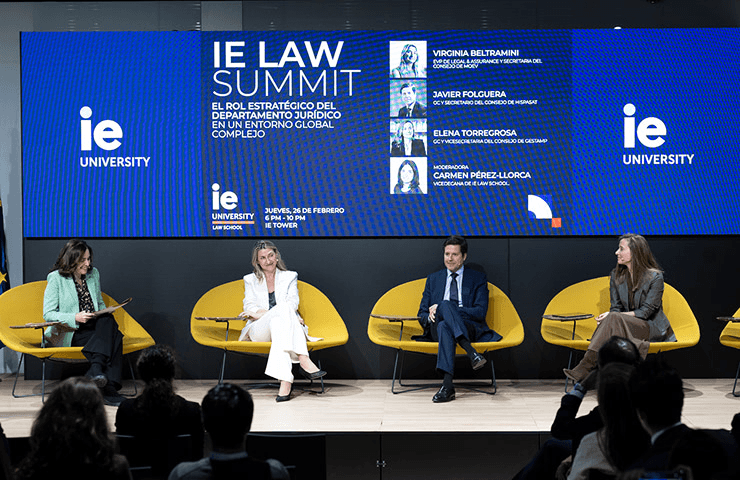
Javier Folguera highlighted the growing sophistication of legal advisory work in strategic sectors such as space and stressed the need for enhanced risk analysis in critical contexts. He also pointed out that AI-driven disruption will increase the importance of soft skills: "Lawyers with sound judgment—those who can adapt machine-generated advice to real-world situations—will be the ones truly valued."
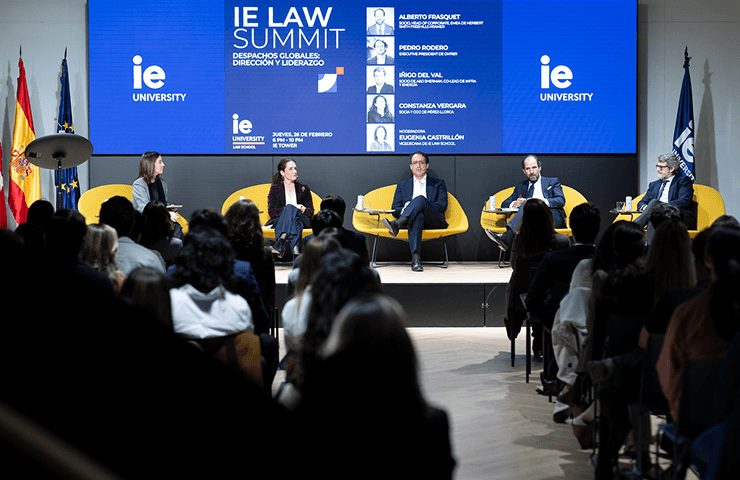
The second panel focused on the future of leadership in global law firms within an increasingly interconnected market. Participants included Alberto Frasquet, Partner and Head of Corporate EMEA at Herbert Smith Freehills Kramer; Pedro Rodero, Executive Chairman of Ontier; Constanza Vergara, Partner and Chief Operating Officer at Pérez-Llorca; and Íñigo del Val, Partner at A&O Shearman. The session was moderated by Eugenia Castrillón, Vice Dean of Programs at IE Law School.
In this discussion, panelists agreed that the sector’s competitive advantage will lie in a more diversified advisory model capable of guiding clients through complex and strategic decisions. "The billing space for law firms will become narrower in terms of hours and broader in terms of services," said Íñigo del Val.
Alberto Frasquet underscored the growing demand for professionals with an "international mindset, sector-specific expertise, and real interaction across offices," highlighting mobility, secondments, and effective cross-border collaboration as key differentiators. In the same vein, Pedro Rodero noted that the development of global, multi-jurisdictional teams requires “the implementation of new coordination roles, regional leads, or client heads” capable of integrating local expertise with global vision.
Constanza Vergara added that internationalization responds both to the need to accompany clients and to attract and develop talent: “Internationalizing means creating career opportunities.” In an increasingly transversal legal landscape, she emphasized the importance of balancing the strength of a global brand with respect for local particularities.


