- Home
- We Are Law School
- News
- Lawtomation Days 2025: Building Legal Trust In The Ai Era
Lawtomation Days 2025: Building legal trust in the AI era

The fourth edition of IE Law School’s Lawtomation Days conference was held in Madrid on October 2nd and 3rd.
Organized by the IE Law School’s Jean Monnet Centre of Excellence for Law and Automation (Lawtomation), the Lawtomation event explores the intersection of law and automation, and this year’s theme was "Technology and (Dis)Trust: AI Between Confidence and Controversy." It brought together leading voices in law, tech and policy to discuss how legal frameworks can adapt in order to sustain trust in AI-driven decision-making and digital governance in an era of such radical and fast-moving change.
This year’s two-day event featured 23 panels, 120 speakers, 80 institutions from 25 countries, and more than 200 participants, and covered an array of legal domains—from criminal and competition law, to labor and data protection regulations. This edition also marked the launch of the Jean Monnet Chair on EU Digital Private Law, led by Francisco de Elizalde, Associate Professor at IE Law School and co-director of Lawtomation. The new Chair will further enhance the scope and impact of the Centre’s work.
As in previous years, the atmosphere was one of vibrant cross-generational and cross-disciplinary dialogue, as participants reflected on the ethical, regulatory and societal impact of emerging technologies.
Keynote highlights: reimagining labor law and data rights
The opening panel, chaired by Antonio Aloisi, Associate Professor at IE Law School and co-lead of the Lawtomation Centre, began with a talk by Michèle Finck (University of Tübingen), who challenged the conventional view of the European Union’s AI Act as a stringent regulatory tool. She argued it may actually serve as a deregulatory instrument, given its broad scope and undefined legal terms.
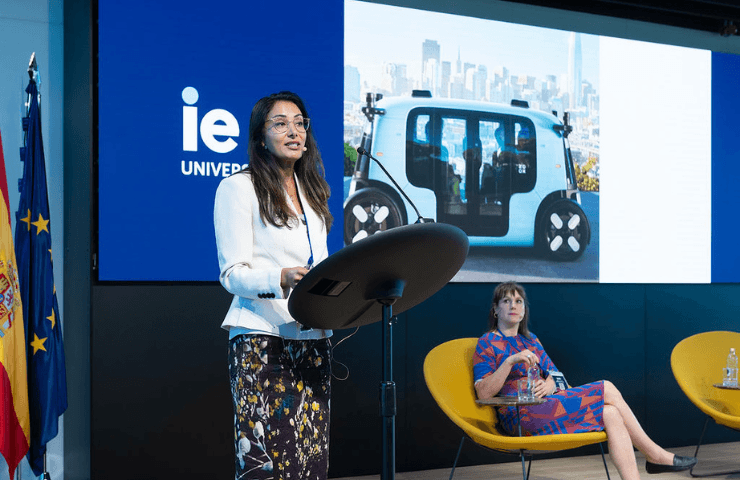
Her intervention was followed by a presentation from Veena B. Dubal (University of California, Irvine School of Law), which called for a reconsideration of data rights in the workplace. Dubal explained how modern algorithmic management systems undermine current labor protections, drawing on examples from California’s thriving gig economy. She argued that laws must go beyond transparency and shift the focus to governing outcomes, including wage stability and worker dignity, because, as she puts it, "the systems, by their nature, are not knowable."
Panel discussions: criminal law, governance and predictive justice
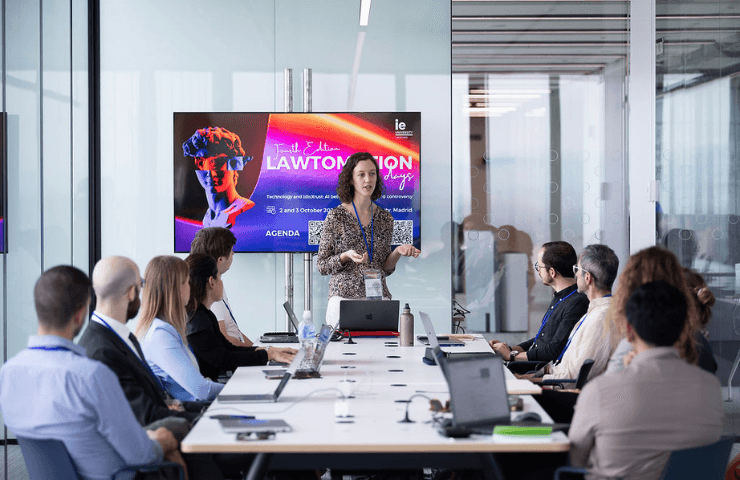
There was a rich variety of discussions on the schedule over the course of the event, with parallel panels considering all manner of legislation in digital environments. The key areas included:
Criminal law: the use of facial recognition and how algorithmic tools can be leveraged for victim support.
Platform governance and data politics: including discussions on algorithmic decision-making and its impact on production and labor.
Private law and trust: assessing how legal frameworks can empower individuals in digital settings.
Predictive justice: reflecting on innovative tools like chatbots to assist workers in deciding between legal action and alternative dispute resolution.
 Closing reflections: a vision for the future of law
The closing panel was chaired up by Francesca Palmiotto, Assistant Professor at IE School, with keynotes from Mathias Siems (European University Institute) and Ignacio Cofone (University of Oxford). Siems discussed the challenges and opportunities for the use of AI for legal research. He advocated for a risk assessment-based approach, rather than prohibition across the board, suggesting that soft guidelines and literacy initiatives could help scholars navigate the ethical use of AI in research and writing.
Cofone then called for a reimagining of data protection law in response to AI’s disruptive practices. He identified three key shifts: the emergence of inferences, the relational nature of data, and the power imbalance between individuals and data controllers. As a result, he stressed that regulation must move beyond consent and focus on accountability for consequences, especially where plausible inferences lead to a potential for harming individuals.
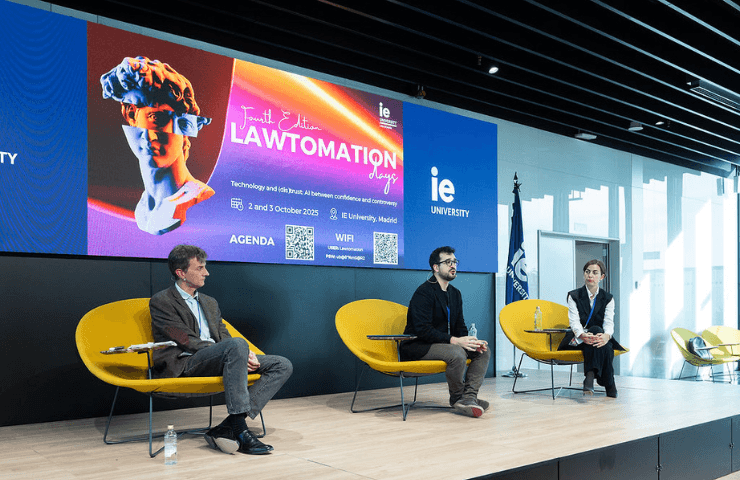
Thank you to all the speakers, organizers, faculty, staff, the 64 amazing student volunteers, and our partners—the International Labour Organization, the European Law Institute (ELI) and The Digital Constitutionalist—for making this collective success possible.


